Have you kept up with marketing’s evolution? If not, it’s time to catch up.
Remember 2010? It felt like a simpler time. We had just been handed the keys to a high-performance machine called marketing automation and we were driving it 100 miles per hour without GPS.

In partnership with:
Featuring
Featuring
How are you going to stand out in 2026?
Buyers are in control of the buying process. Over 70% of it is happening online. And they are putting companies on their short list of vendors that provide value and establish trust with their content.
How are you accounting for this in your 2026 strategy?
You need to stand out. To make sure your buyers notice you. Let us help you build that into your strategy for next year -->


The Revenue Marketer

Have you kept up with marketing’s evolution? If not, it’s time to catch up.
Still chasing 10% efficiency gains?
2023-2025 were the years of experimentation with AI. 2026 is the year to make it transformative. If you're still trying to figure out the strategic advantage AI will bring to your team, we're here to help!

Remember 2010? It felt like a simpler time. We had just been handed the keys to a high-performance machine called marketing automation and we were driving it 100 miles per hour without GPS.
If you have steered B2B marketing for the last 15 years, you have survived three distinct eras. You lived through the content explosion, the pivot to account-based marketing and then buying group led marketing. Now, you are standing on the edge of the most significant shift since the invention of the internet.
We are moving from evolution to revolution. To understand where we are going in 2026, a phase called the agentic era, we have to be honest about where we have been. We must look at the bad habits we picked up along the way and the foundational truths we learned. If you were behind on the account-centricity of 2015, and the data discipline of 2020, you will not just be behind in 2026. You will be obsolete.
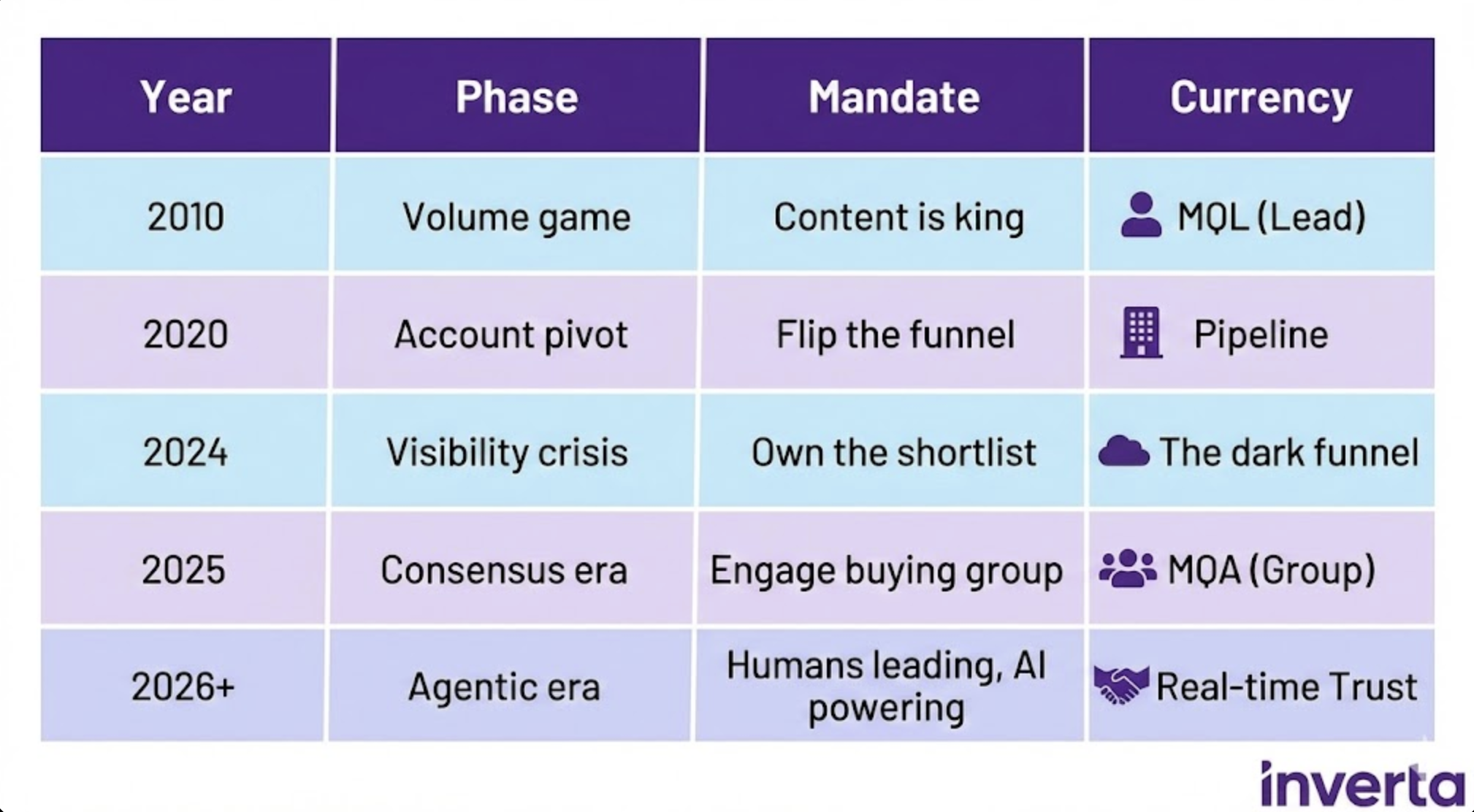
The Volume Game (2010)
- The Mandate: Content is king.
- The Currency: The marketing qualified lead (MQL).
In 2010, digital marketing felt like magic because we could finally track people. Platforms promised that if we just built the machine, the revenue would follow. The mandate was simple: more. More ebooks, more blog posts, and more emails.
We operated under a broadcast mindset and gated everything. If you wanted to read a generic PDF, you had to give us your title and your email. We used the marketing qualified lead to justify our existence, but we were really just automating our bad habits. We were not segmenting. Instead, we were spraying and praying. We treated every form fill like a hand-raiser, passing thousands of leads to sales teams who promptly ignored them. We learned the hard way that activity is not intent. We built massive databases of people who downloaded one thing and never wanted to hear from us again.
Marketing qualified leads are a scam. Sellers know it. You know it. The “hot prospect” with a student email address knows it.
The Account Pivot (2013)
- The Mandate: Flip the funnel.
- The Currency: Pipeline.
By 2013, the noise was deafening and conversion rates were plummeting. A report from that era showed that just 0.75 percent of marketing qualified leads converted to revenue. We were screaming into a digital void.
Account-based marketing promised to fix the sins of the volume game. The premise was seductive: stop fishing with nets and start fishing with spears. We learned to market only to the accounts that could actually buy. This was a necessary correction where we used technology to focus. We used new tools to identify target accounts, personalized our messaging, and orchestrated advertising.
But progress stalled because we treated it as a separate discipline. It was often just a program running off to the side while the demand generation team kept blasting emails. We also over-relied on the inverted funnel model without doing the hard work of mapping the actual buyer’s journey. We tried to layer new technology over broken strategies, forgetting that an account is just a collection of humans trying to solve a problem.
The Visibility Crisis (2023)
- The Mandate: Own the shortlist.
- The Currency: Awareness and trust.
In 2024, we lost visibility. Buyers stopped filling out forms and refused to talk to sales reps until they were nearly 80 percent of the way through their journey. This is the dark funnel. Buyers are doing their research in Slack communities, on review sites, and in peer groups. They are building shortlists without us.
This shifted the burden entirely to marketing. If you are not in the lead during that anonymous research phase, the deal is lost before it begins. Marketers felt under siege and were flailing with random acts of marketing because they lacked a single, coherent plan to reach buyers where they actually live.
The Consensus Era (2025)
- The Mandate: Respect the committee.
- The Currency: Marketing qualified accounts (MQA).
Today, we must stop pretending leads exist and start respecting the buying group. B2B purchasing decisions are made by committees, not individuals. This is not a fancy twist on account-based marketing. It is how demand generation must work.
If one person visits your pricing page, that is interesting. If the CFO, the engineering leader, and a developer from the same account all visit your site in the same week, that is a signal. Successful marketers in 2025 have unified their data to see these connections. They do not hand over a lead. They hand over an account story that shows sales exactly who is engaged and what they care about.
The Agentic Era (2026 and beyond)
- The Mandate: Led by humans but powered by artificial intelligence.
- The Currency: Real-time trust.
Welcome to the revolution. We are entering the era of AI agents, which are systems that take action rather than just suggesting text. In the agentic era, personalization means an agent understands a buyer’s specific pain point based on their history and autonomously serves them custom content in real-time.
This means:
- Prioritize signals over schedules: Stop running campaigns based on your calendar and start running them based on buyer actions.
- Enable agents to talk to agents: Your agent will soon negotiate with a buyer’s agent to vet feature lists or schedule meetings.
- Practice radical responsiveness: You must read and react to data instantly across channels. If a buying group is active now, you cannot wait for a weekly report to tell you.
AI is not about replacing human creativity but enhancing it. It's ready to pitch in with ideas and support, but it relies on your guidance and expertise to really shine.
Own your future in the agentic era
The coming year will separate those who continue to shout into the void from those who finally listen to the market. Success in 2026 requires more than an expensive tech stack. It requires the courage to dismantle the silos that have kept marketing and sales apart for decades.
The fundamentals have not changed. It is still about the right message to the right person at the right time. We simply have the technology to actually do it. Get your house in order. Align your people, structure your data and systems, and define your path. The agentic era is coming. You can either lead the way as a pathfinder or fade into the background of a messy, automated world.
About the author
Service page feature

Artificial intelligence


Remember 2010? It felt like a simpler time. We had just been handed the keys to a high-performance machine called marketing automation and we were driving it 100 miles per hour without GPS.
If you have steered B2B marketing for the last 15 years, you have survived three distinct eras. You lived through the content explosion, the pivot to account-based marketing and then buying group led marketing. Now, you are standing on the edge of the most significant shift since the invention of the internet.
We are moving from evolution to revolution. To understand where we are going in 2026, a phase called the agentic era, we have to be honest about where we have been. We must look at the bad habits we picked up along the way and the foundational truths we learned. If you were behind on the account-centricity of 2015, and the data discipline of 2020, you will not just be behind in 2026. You will be obsolete.
The Volume Game (2010)
- The Mandate: Content is king.
- The Currency: The marketing qualified lead (MQL).
In 2010, digital marketing felt like magic because we could finally track people. Platforms promised that if we just built the machine, the revenue would follow. The mandate was simple: more. More ebooks, more blog posts, and more emails.
We operated under a broadcast mindset and gated everything. If you wanted to read a generic PDF, you had to give us your title and your email. We used the marketing qualified lead to justify our existence, but we were really just automating our bad habits. We were not segmenting. Instead, we were spraying and praying. We treated every form fill like a hand-raiser, passing thousands of leads to sales teams who promptly ignored them. We learned the hard way that activity is not intent. We built massive databases of people who downloaded one thing and never wanted to hear from us again.
Marketing qualified leads are a scam. Sellers know it. You know it. The “hot prospect” with a student email address knows it.
The Account Pivot (2013)
- The Mandate: Flip the funnel.
- The Currency: Pipeline.
By 2013, the noise was deafening and conversion rates were plummeting. A report from that era showed that just 0.75 percent of marketing qualified leads converted to revenue. We were screaming into a digital void.
Account-based marketing promised to fix the sins of the volume game. The premise was seductive: stop fishing with nets and start fishing with spears. We learned to market only to the accounts that could actually buy. This was a necessary correction where we used technology to focus. We used new tools to identify target accounts, personalized our messaging, and orchestrated advertising.
But progress stalled because we treated it as a separate discipline. It was often just a program running off to the side while the demand generation team kept blasting emails. We also over-relied on the inverted funnel model without doing the hard work of mapping the actual buyer’s journey. We tried to layer new technology over broken strategies, forgetting that an account is just a collection of humans trying to solve a problem.
The Visibility Crisis (2023)
- The Mandate: Own the shortlist.
- The Currency: Awareness and trust.
In 2024, we lost visibility. Buyers stopped filling out forms and refused to talk to sales reps until they were nearly 80 percent of the way through their journey. This is the dark funnel. Buyers are doing their research in Slack communities, on review sites, and in peer groups. They are building shortlists without us.
This shifted the burden entirely to marketing. If you are not in the lead during that anonymous research phase, the deal is lost before it begins. Marketers felt under siege and were flailing with random acts of marketing because they lacked a single, coherent plan to reach buyers where they actually live.
The Consensus Era (2025)
- The Mandate: Respect the committee.
- The Currency: Marketing qualified accounts (MQA).
Today, we must stop pretending leads exist and start respecting the buying group. B2B purchasing decisions are made by committees, not individuals. This is not a fancy twist on account-based marketing. It is how demand generation must work.
If one person visits your pricing page, that is interesting. If the CFO, the engineering leader, and a developer from the same account all visit your site in the same week, that is a signal. Successful marketers in 2025 have unified their data to see these connections. They do not hand over a lead. They hand over an account story that shows sales exactly who is engaged and what they care about.
The Agentic Era (2026 and beyond)
- The Mandate: Led by humans but powered by artificial intelligence.
- The Currency: Real-time trust.
Welcome to the revolution. We are entering the era of AI agents, which are systems that take action rather than just suggesting text. In the agentic era, personalization means an agent understands a buyer’s specific pain point based on their history and autonomously serves them custom content in real-time.
This means:
- Prioritize signals over schedules: Stop running campaigns based on your calendar and start running them based on buyer actions.
- Enable agents to talk to agents: Your agent will soon negotiate with a buyer’s agent to vet feature lists or schedule meetings.
- Practice radical responsiveness: You must read and react to data instantly across channels. If a buying group is active now, you cannot wait for a weekly report to tell you.
AI is not about replacing human creativity but enhancing it. It's ready to pitch in with ideas and support, but it relies on your guidance and expertise to really shine.
Own your future in the agentic era
The coming year will separate those who continue to shout into the void from those who finally listen to the market. Success in 2026 requires more than an expensive tech stack. It requires the courage to dismantle the silos that have kept marketing and sales apart for decades.
The fundamentals have not changed. It is still about the right message to the right person at the right time. We simply have the technology to actually do it. Get your house in order. Align your people, structure your data and systems, and define your path. The agentic era is coming. You can either lead the way as a pathfinder or fade into the background of a messy, automated world.
Resources
About the author
Service page feature
Artificial intelligence
Have you kept up with marketing’s evolution? If not, it’s time to catch up.

Speakers
Other helpful resources
Remember 2010? It felt like a simpler time. We had just been handed the keys to a high-performance machine called marketing automation and we were driving it 100 miles per hour without GPS.
If you have steered B2B marketing for the last 15 years, you have survived three distinct eras. You lived through the content explosion, the pivot to account-based marketing and then buying group led marketing. Now, you are standing on the edge of the most significant shift since the invention of the internet.
We are moving from evolution to revolution. To understand where we are going in 2026, a phase called the agentic era, we have to be honest about where we have been. We must look at the bad habits we picked up along the way and the foundational truths we learned. If you were behind on the account-centricity of 2015, and the data discipline of 2020, you will not just be behind in 2026. You will be obsolete.
The Volume Game (2010)
- The Mandate: Content is king.
- The Currency: The marketing qualified lead (MQL).
In 2010, digital marketing felt like magic because we could finally track people. Platforms promised that if we just built the machine, the revenue would follow. The mandate was simple: more. More ebooks, more blog posts, and more emails.
We operated under a broadcast mindset and gated everything. If you wanted to read a generic PDF, you had to give us your title and your email. We used the marketing qualified lead to justify our existence, but we were really just automating our bad habits. We were not segmenting. Instead, we were spraying and praying. We treated every form fill like a hand-raiser, passing thousands of leads to sales teams who promptly ignored them. We learned the hard way that activity is not intent. We built massive databases of people who downloaded one thing and never wanted to hear from us again.
Marketing qualified leads are a scam. Sellers know it. You know it. The “hot prospect” with a student email address knows it.
The Account Pivot (2013)
- The Mandate: Flip the funnel.
- The Currency: Pipeline.
By 2013, the noise was deafening and conversion rates were plummeting. A report from that era showed that just 0.75 percent of marketing qualified leads converted to revenue. We were screaming into a digital void.
Account-based marketing promised to fix the sins of the volume game. The premise was seductive: stop fishing with nets and start fishing with spears. We learned to market only to the accounts that could actually buy. This was a necessary correction where we used technology to focus. We used new tools to identify target accounts, personalized our messaging, and orchestrated advertising.
But progress stalled because we treated it as a separate discipline. It was often just a program running off to the side while the demand generation team kept blasting emails. We also over-relied on the inverted funnel model without doing the hard work of mapping the actual buyer’s journey. We tried to layer new technology over broken strategies, forgetting that an account is just a collection of humans trying to solve a problem.
The Visibility Crisis (2023)
- The Mandate: Own the shortlist.
- The Currency: Awareness and trust.
In 2024, we lost visibility. Buyers stopped filling out forms and refused to talk to sales reps until they were nearly 80 percent of the way through their journey. This is the dark funnel. Buyers are doing their research in Slack communities, on review sites, and in peer groups. They are building shortlists without us.
This shifted the burden entirely to marketing. If you are not in the lead during that anonymous research phase, the deal is lost before it begins. Marketers felt under siege and were flailing with random acts of marketing because they lacked a single, coherent plan to reach buyers where they actually live.
The Consensus Era (2025)
- The Mandate: Respect the committee.
- The Currency: Marketing qualified accounts (MQA).
Today, we must stop pretending leads exist and start respecting the buying group. B2B purchasing decisions are made by committees, not individuals. This is not a fancy twist on account-based marketing. It is how demand generation must work.
If one person visits your pricing page, that is interesting. If the CFO, the engineering leader, and a developer from the same account all visit your site in the same week, that is a signal. Successful marketers in 2025 have unified their data to see these connections. They do not hand over a lead. They hand over an account story that shows sales exactly who is engaged and what they care about.
The Agentic Era (2026 and beyond)
- The Mandate: Led by humans but powered by artificial intelligence.
- The Currency: Real-time trust.
Welcome to the revolution. We are entering the era of AI agents, which are systems that take action rather than just suggesting text. In the agentic era, personalization means an agent understands a buyer’s specific pain point based on their history and autonomously serves them custom content in real-time.
This means:
- Prioritize signals over schedules: Stop running campaigns based on your calendar and start running them based on buyer actions.
- Enable agents to talk to agents: Your agent will soon negotiate with a buyer’s agent to vet feature lists or schedule meetings.
- Practice radical responsiveness: You must read and react to data instantly across channels. If a buying group is active now, you cannot wait for a weekly report to tell you.
AI is not about replacing human creativity but enhancing it. It's ready to pitch in with ideas and support, but it relies on your guidance and expertise to really shine.
Own your future in the agentic era
The coming year will separate those who continue to shout into the void from those who finally listen to the market. Success in 2026 requires more than an expensive tech stack. It requires the courage to dismantle the silos that have kept marketing and sales apart for decades.
The fundamentals have not changed. It is still about the right message to the right person at the right time. We simply have the technology to actually do it. Get your house in order. Align your people, structure your data and systems, and define your path. The agentic era is coming. You can either lead the way as a pathfinder or fade into the background of a messy, automated world.
About the author
Service page feature