DWH Canada engages 35 of its 50 target accounts

In partnership with:
Featuring
Featuring
How are you going to stand out in 2026?
Buyers are in control of the buying process. Over 70% of it is happening online. And they are putting companies on their short list of vendors that provide value and establish trust with their content.
How are you accounting for this in your 2026 strategy?
You need to stand out. To make sure your buyers notice you. Let us help you build that into your strategy for next year -->

DWH Canada engages 35 of its 50 target accounts
10x ROI
$1.3M
"This one campaign unlocked the budget for all our other programs."

Cassandra Dewey
The Revenue Marketer

DWH Canada engages 35 of its 50 target accounts
Still chasing 10% efficiency gains?
2023-2025 were the years of experimentation with AI. 2026 is the year to make it transformative. If you're still trying to figure out the strategic advantage AI will bring to your team, we're here to help!

Delta Web Hosting (DWH) is an IT engineering company and always builds its own technology if it can. That means they rarely purchase subscriptions from others. But because of this, their martech stack was failing them.
The account-based ambition swept through their various global marketing teams and most found they were really quite limited in what they could do. The internally built email, analytics, and sales enablement software couldn’t take an account-based view. Nor integrate with each other.
This meant that DWH was largely running its ABM plays out of Excel and Outlook. DWH Canada engaged Inverta, and only through grit, tech-savvy, and the support of a tireless internal advocate, did they launch a winning ABM campaign that proved to the entire company that it was time to change its tech policies.
This is an anonymized case study—the names and logo have changed, the story is real.
Blocked on email, reporting, and most everything
DWH initially signed on to do five programs with Inverta, this being one, to help promote its new message of modernization and migrating to the cloud. They have one of the smartest marketing teams out there and nearly 100% global brand recognition. But after getting in and realizing the simplicity of the internal tooling, the Inverta team recommended focusing entirely on getting this first 1:few ABM program across the line—to prove the need for more support with others.
Inverta had already run a successful one-to-many ABM campaign with the global team, and narrowing from just raw lists to contacts within accounts was a stretch. Now, narrowing to a one-to-few campaign, it was doubly difficult. That increased need for more data, contact-level targeting, and limited comms channels was just more than its tools could support.
Erin and team still ran their process, repeatedly pressed for more access, and found technical workarounds
“DWH is a closed system,” says Erin Rampey, Client Partner at Inverta. “They don’t even allow third-party meeting recorders into meetings, to give you a sense.” Erin was able to advocate for using Uberflip Hub Pages, but the security team had to review and they approved very little of the functionality. “We had that one tool—and a stripped down version,” recalls Erin. “We were like, how can we pull it off with this?”
That tech lockdown meant they couldn’t use as much of Uberflip’s personalization features and they’d have to build all 50 landing pages, one at a time. Erin and team audited all the company’s content. The array of white papers was all they could work with, and they couldn’t create more in time for the campaign. “It gets even worse,” laughs Erin. “We couldn’t mobilize any of the marketing-oriented email sends either.”
But this didn’t stop Inverta. Erin and team still ran their process, repeatedly pressed for more access, and found technical workarounds to create the following:
- Content and messaging audit
- Program design and alignment workshop
- Buyer’s journey map
- Outreach sequences
- Implementation and launch
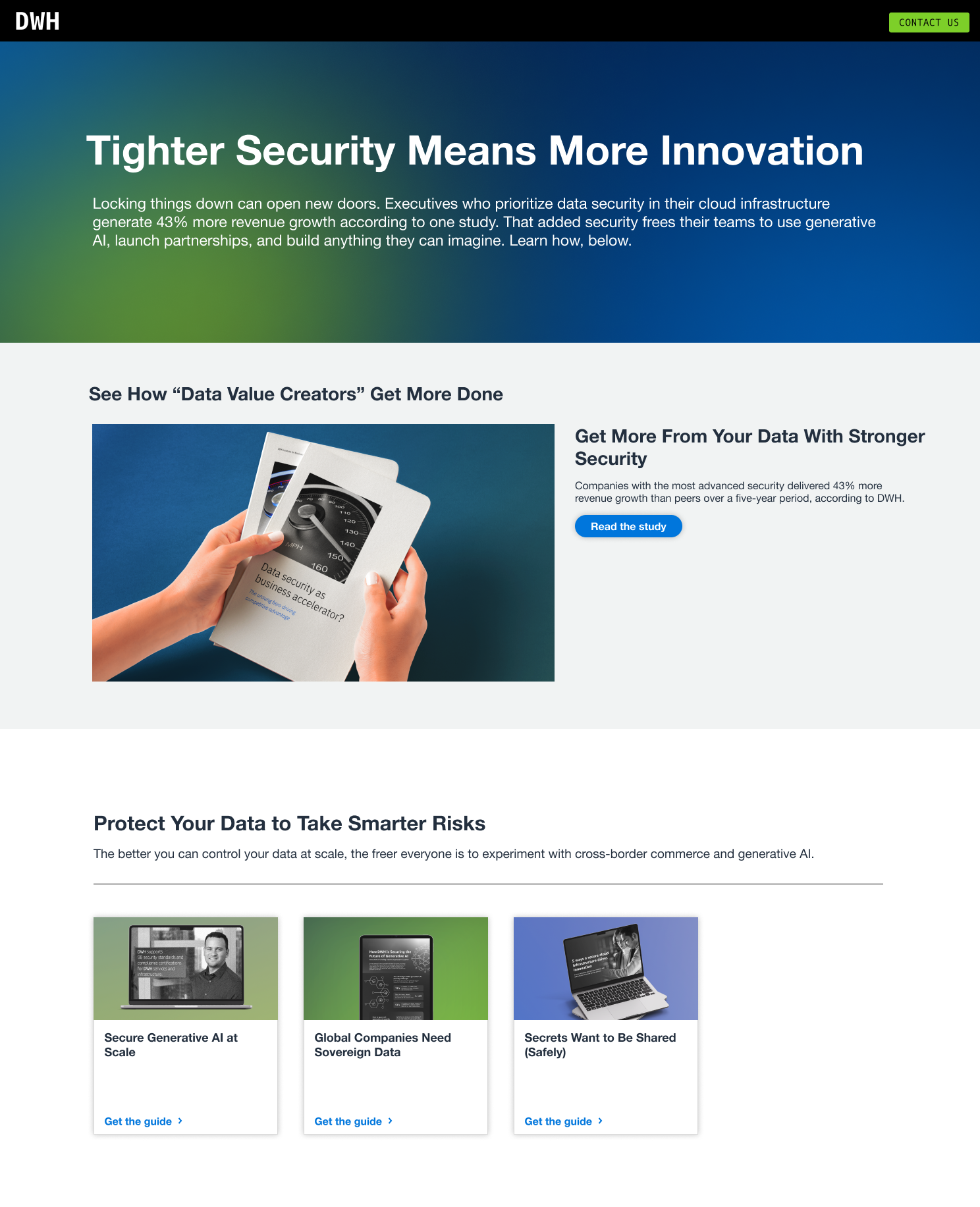
Then there was talking to sales. And thankfully, that went better than expected. “I think this succeeded in part because we had such strong partners on both the marketing and sales side, willing to hold each other accountable to action,” says Erin. Cassandra, the marketing director at DWH, chased everyone down for weekly meetings, escalated when someone didn’t give feedback, and found additional data that nobody realized their system could report on.
This succeeded because we had such strong partners on both the marketing and sales side, willing to hold each other accountable.
They opened 18 deals worth $1.3M
Erin and team were able to make the best of a highly locked-down environment and get multi-channel campaigns including coordinated sales outreach set up, pointing back to the account-specific hub pages. And thankfully, it worked. The account-based theory held strong, and accounts that they’d previously just peppered with high-level messaging started to reply. Suddenly, Cassandra and team were earning the attention of other DWH marketing teams.
The results:
- 35 of 50 target accounts engaged with a <12% bounce rate
- 70% of target accounts engaged with content
- 190% increase in contact outreach success
- The return was 10x the marketing spend
DWH Canada added $1.3M in pipeline from this campaign alone. And from six accounts, they generated 18 opportunities. This proved the potential for investing more in coordinated action. If DWH Canada could achieve this with just hub pages and multi-channel outreach and sales plays, what else might they achieve with less restrictions?
As a result of this project, Inverta is now consulting the global organization on a coordinated rollout of its own internal account-based methodology.
About the author
Service page feature

Martech


Delta Web Hosting (DWH) is an IT engineering company and always builds its own technology if it can. That means they rarely purchase subscriptions from others. But because of this, their martech stack was failing them.
The account-based ambition swept through their various global marketing teams and most found they were really quite limited in what they could do. The internally built email, analytics, and sales enablement software couldn’t take an account-based view. Nor integrate with each other.
This meant that DWH was largely running its ABM plays out of Excel and Outlook. DWH Canada engaged Inverta, and only through grit, tech-savvy, and the support of a tireless internal advocate, did they launch a winning ABM campaign that proved to the entire company that it was time to change its tech policies.
This is an anonymized case study—the names and logo have changed, the story is real.
Blocked on email, reporting, and most everything
DWH initially signed on to do five programs with Inverta, this being one, to help promote its new message of modernization and migrating to the cloud. They have one of the smartest marketing teams out there and nearly 100% global brand recognition. But after getting in and realizing the simplicity of the internal tooling, the Inverta team recommended focusing entirely on getting this first 1:few ABM program across the line—to prove the need for more support with others.
Inverta had already run a successful one-to-many ABM campaign with the global team, and narrowing from just raw lists to contacts within accounts was a stretch. Now, narrowing to a one-to-few campaign, it was doubly difficult. That increased need for more data, contact-level targeting, and limited comms channels was just more than its tools could support.
Erin and team still ran their process, repeatedly pressed for more access, and found technical workarounds
“DWH is a closed system,” says Erin Rampey, Client Partner at Inverta. “They don’t even allow third-party meeting recorders into meetings, to give you a sense.” Erin was able to advocate for using Uberflip Hub Pages, but the security team had to review and they approved very little of the functionality. “We had that one tool—and a stripped down version,” recalls Erin. “We were like, how can we pull it off with this?”
That tech lockdown meant they couldn’t use as much of Uberflip’s personalization features and they’d have to build all 50 landing pages, one at a time. Erin and team audited all the company’s content. The array of white papers was all they could work with, and they couldn’t create more in time for the campaign. “It gets even worse,” laughs Erin. “We couldn’t mobilize any of the marketing-oriented email sends either.”
But this didn’t stop Inverta. Erin and team still ran their process, repeatedly pressed for more access, and found technical workarounds to create the following:
- Content and messaging audit
- Program design and alignment workshop
- Buyer’s journey map
- Outreach sequences
- Implementation and launch
Then there was talking to sales. And thankfully, that went better than expected. “I think this succeeded in part because we had such strong partners on both the marketing and sales side, willing to hold each other accountable to action,” says Erin. Cassandra, the marketing director at DWH, chased everyone down for weekly meetings, escalated when someone didn’t give feedback, and found additional data that nobody realized their system could report on.
This succeeded because we had such strong partners on both the marketing and sales side, willing to hold each other accountable.
They opened 18 deals worth $1.3M
Erin and team were able to make the best of a highly locked-down environment and get multi-channel campaigns including coordinated sales outreach set up, pointing back to the account-specific hub pages. And thankfully, it worked. The account-based theory held strong, and accounts that they’d previously just peppered with high-level messaging started to reply. Suddenly, Cassandra and team were earning the attention of other DWH marketing teams.
The results:
- 35 of 50 target accounts engaged with a <12% bounce rate
- 70% of target accounts engaged with content
- 190% increase in contact outreach success
- The return was 10x the marketing spend
DWH Canada added $1.3M in pipeline from this campaign alone. And from six accounts, they generated 18 opportunities. This proved the potential for investing more in coordinated action. If DWH Canada could achieve this with just hub pages and multi-channel outreach and sales plays, what else might they achieve with less restrictions?
As a result of this project, Inverta is now consulting the global organization on a coordinated rollout of its own internal account-based methodology.
Resources
About the author
Service page feature
Martech
DWH Canada engages 35 of its 50 target accounts

Speakers
Other helpful resources
Delta Web Hosting (DWH) is an IT engineering company and always builds its own technology if it can. That means they rarely purchase subscriptions from others. But because of this, their martech stack was failing them.
The account-based ambition swept through their various global marketing teams and most found they were really quite limited in what they could do. The internally built email, analytics, and sales enablement software couldn’t take an account-based view. Nor integrate with each other.
This meant that DWH was largely running its ABM plays out of Excel and Outlook. DWH Canada engaged Inverta, and only through grit, tech-savvy, and the support of a tireless internal advocate, did they launch a winning ABM campaign that proved to the entire company that it was time to change its tech policies.
This is an anonymized case study—the names and logo have changed, the story is real.
Blocked on email, reporting, and most everything
DWH initially signed on to do five programs with Inverta, this being one, to help promote its new message of modernization and migrating to the cloud. They have one of the smartest marketing teams out there and nearly 100% global brand recognition. But after getting in and realizing the simplicity of the internal tooling, the Inverta team recommended focusing entirely on getting this first 1:few ABM program across the line—to prove the need for more support with others.
Inverta had already run a successful one-to-many ABM campaign with the global team, and narrowing from just raw lists to contacts within accounts was a stretch. Now, narrowing to a one-to-few campaign, it was doubly difficult. That increased need for more data, contact-level targeting, and limited comms channels was just more than its tools could support.
Erin and team still ran their process, repeatedly pressed for more access, and found technical workarounds
“DWH is a closed system,” says Erin Rampey, Client Partner at Inverta. “They don’t even allow third-party meeting recorders into meetings, to give you a sense.” Erin was able to advocate for using Uberflip Hub Pages, but the security team had to review and they approved very little of the functionality. “We had that one tool—and a stripped down version,” recalls Erin. “We were like, how can we pull it off with this?”
That tech lockdown meant they couldn’t use as much of Uberflip’s personalization features and they’d have to build all 50 landing pages, one at a time. Erin and team audited all the company’s content. The array of white papers was all they could work with, and they couldn’t create more in time for the campaign. “It gets even worse,” laughs Erin. “We couldn’t mobilize any of the marketing-oriented email sends either.”
But this didn’t stop Inverta. Erin and team still ran their process, repeatedly pressed for more access, and found technical workarounds to create the following:
- Content and messaging audit
- Program design and alignment workshop
- Buyer’s journey map
- Outreach sequences
- Implementation and launch
Then there was talking to sales. And thankfully, that went better than expected. “I think this succeeded in part because we had such strong partners on both the marketing and sales side, willing to hold each other accountable to action,” says Erin. Cassandra, the marketing director at DWH, chased everyone down for weekly meetings, escalated when someone didn’t give feedback, and found additional data that nobody realized their system could report on.
This succeeded because we had such strong partners on both the marketing and sales side, willing to hold each other accountable.
They opened 18 deals worth $1.3M
Erin and team were able to make the best of a highly locked-down environment and get multi-channel campaigns including coordinated sales outreach set up, pointing back to the account-specific hub pages. And thankfully, it worked. The account-based theory held strong, and accounts that they’d previously just peppered with high-level messaging started to reply. Suddenly, Cassandra and team were earning the attention of other DWH marketing teams.
The results:
- 35 of 50 target accounts engaged with a <12% bounce rate
- 70% of target accounts engaged with content
- 190% increase in contact outreach success
- The return was 10x the marketing spend
DWH Canada added $1.3M in pipeline from this campaign alone. And from six accounts, they generated 18 opportunities. This proved the potential for investing more in coordinated action. If DWH Canada could achieve this with just hub pages and multi-channel outreach and sales plays, what else might they achieve with less restrictions?
As a result of this project, Inverta is now consulting the global organization on a coordinated rollout of its own internal account-based methodology.
About the author
Service page feature