Proof: what $20K/month gets you
.svg)

In partnership with:
Featuring
Featuring
How are you going to stand out in 2026?
Buyers are in control of the buying process. Over 70% of it is happening online. And they are putting companies on their short list of vendors that provide value and establish trust with their content.
How are you accounting for this in your 2026 strategy?
You need to stand out. To make sure your buyers notice you. Let us help you build that into your strategy for next year -->

%20(1).webp)

The Revenue Marketer


Proof: what $20K/month gets you
Still chasing 10% efficiency gains?
2023-2025 were the years of experimentation with AI. 2026 is the year to make it transformative. If you're still trying to figure out the strategic advantage AI will bring to your team, we're here to help!

Marketing agency pricing is one of the most deliberately opaque topics in B2B. Ask ten agencies what they charge, and you'll get ten different frameworks — retainers, project fees, hourly blended rates, performance bonuses, setup fees, and minimum commitments wrapped in enough nuance to make a CFO's eye twitch.
This article doesn't do that. We're going to tell you exactly what $20,000 per month buys with Inverta, why that number is structured the way it is, and how it compares honestly to the alternatives most growth-stage CEOs are evaluating. If you came here looking for transparent marketing services pricing, this is it.
What marketing agencies actually charge — and what you get
Before we make the case for anything, let's establish a baseline. What does a typical digital marketing agency cost?
The range is enormous, which is part of the problem. Digital marketing agency prices vary by specialization, geography, size, and scope. But here's a fair summary of what most B2B companies encounter when shopping marketing agency pricing:
Content and SEO agencies: $3,000–$10,000 per month. You get blog posts, keyword research, and monthly reporting. You don't get demand gen, RevOps, paid media, or anything that maps directly to pipeline.
Paid media agencies: $3,000–$8,000 per month plus ad spend. You get campaign management in one channel. You don't get the content to convert the traffic, the RevOps to route the leads, or the strategy to connect it to your actual business goals.
Full-service digital marketing agencies: $8,000–$25,000 per month. You get broader coverage but typically through a generalist team model — an account manager who touches multiple clients, junior coordinators doing the execution, and senior strategists who show up for quarterly reviews.
Specialized B2B demand gen agencies: $10,000–$20,000 per month. Better, but typically narrowly scoped — they own pipeline generation in specific channels, not your entire marketing function.
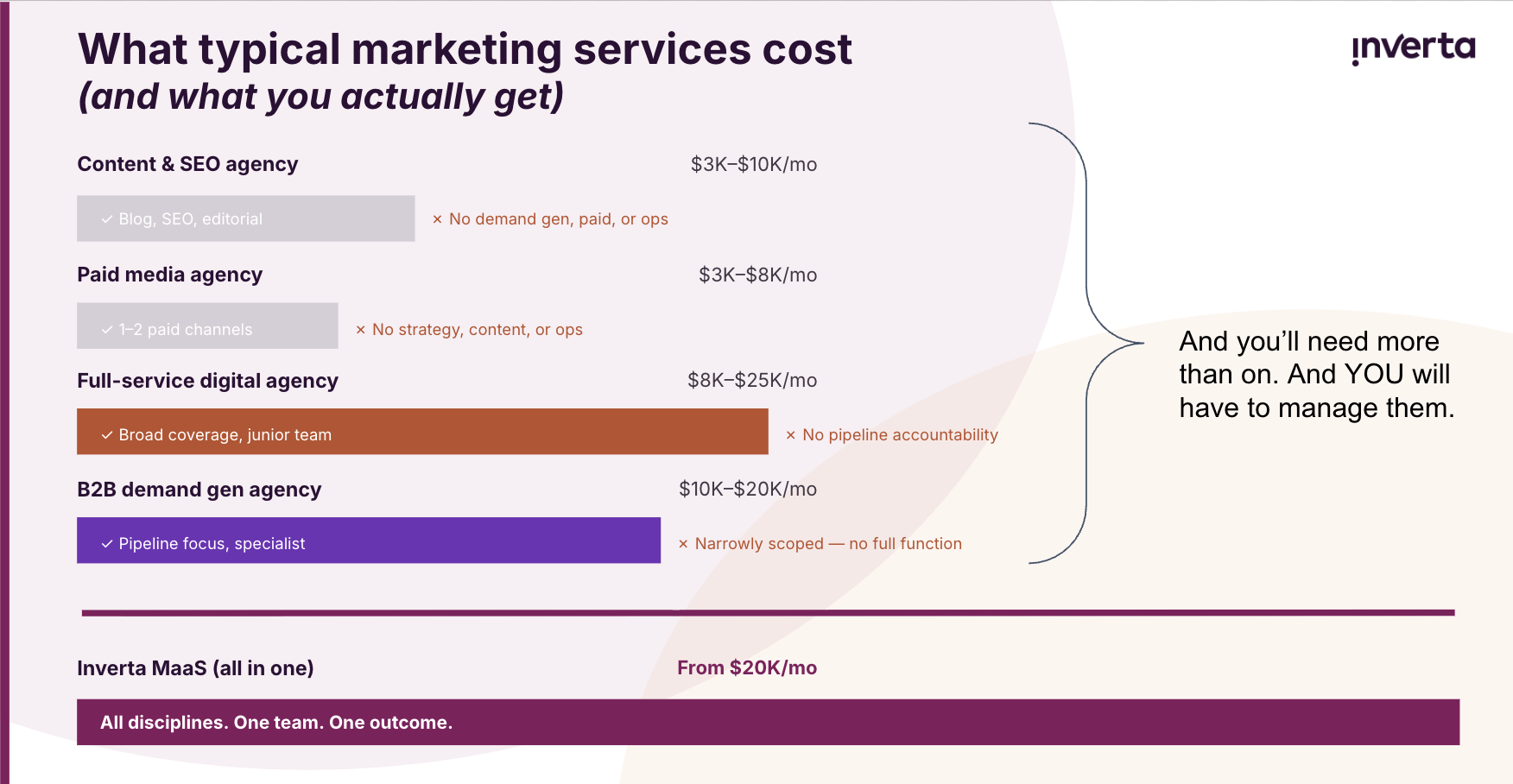
How much do marketing agencies charge per month across all of these engagements if you're trying to cover your full marketing function? Usually $20,000–$35,000 — and you're still managing three to five different vendor relationships, with no single partner accountable for the whole motion.
The coordination cost nobody prices in
Here's the line item that never appears in a marketing agency pricing deck: your time.
When you're running multiple marketing services vendors — a content agency, a paid media shop, a RevOps consultant, maybe a fractional CMO to coordinate them — someone has to hold the strategy together. Someone has to make sure the content agency's keyword targets align with the paid media agency's ad copy. Someone has to ensure the leads being generated are actually being worked by sales. Someone has to build the reporting that connects all of it.
At most growth-stage companies, that someone is the CEO. Or the VP of Sales doing double duty. Or nobody — in which case you have a collection of agencies producing outputs that don't add up to a pipeline.
This is what digital marketing agency prices don't include: the organizational overhead of making point solutions work together. It's real, it's expensive in CEO hours, and it compounds every month you're trying to run marketing by committee.
The line item that never appears in a marketing agency pricing deck is your time — and it's the most expensive item on the list.
What $20K/month actually buys with Inverta
Inverta's Marketing as a Service model starts at $20,000 per month. No setup fees. No minimum term that locks you into a relationship that isn't working. One monthly investment, one integrated team, one accountable partner.
Here's what that covers:
Strategy and positioning. A senior marketing strategist who owns your messaging architecture, your campaign strategy, and your go-to-market motion. This isn't a quarterly check-in — it's active, continuous strategic leadership.
Demand generation. Paid search, paid social, content, and email — operated as an integrated motion, not as separate channels. Campaigns that are built to generate pipeline, not just traffic.
Content and creative. The assets that support your demand gen motion: the thought leadership that builds credibility in the dark funnel, the conversion content that turns interest into action, and the sales enablement content that accelerates deals in progress.
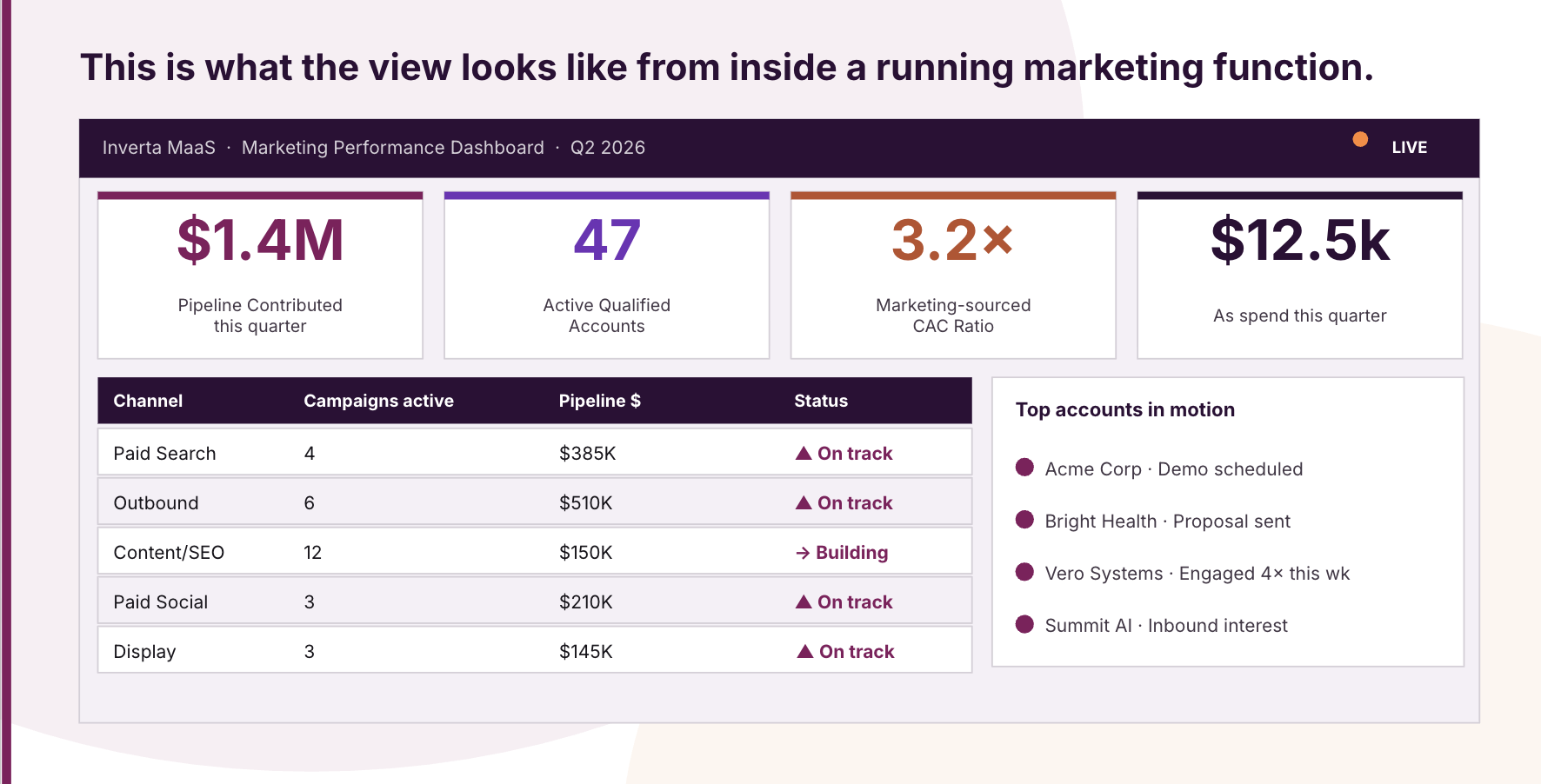
Revenue Operations. Lead routing, CRM hygiene, attribution modeling, and reporting infrastructure. This is the layer that makes everything else measurable — and it's where most fragmented agency setups break down completely.
AI and agentic infrastructure. Automated research, signal capture, content variation, and campaign analysis. Your marketing function runs continuously, not just when a human has bandwidth.
The comparison that changes the math
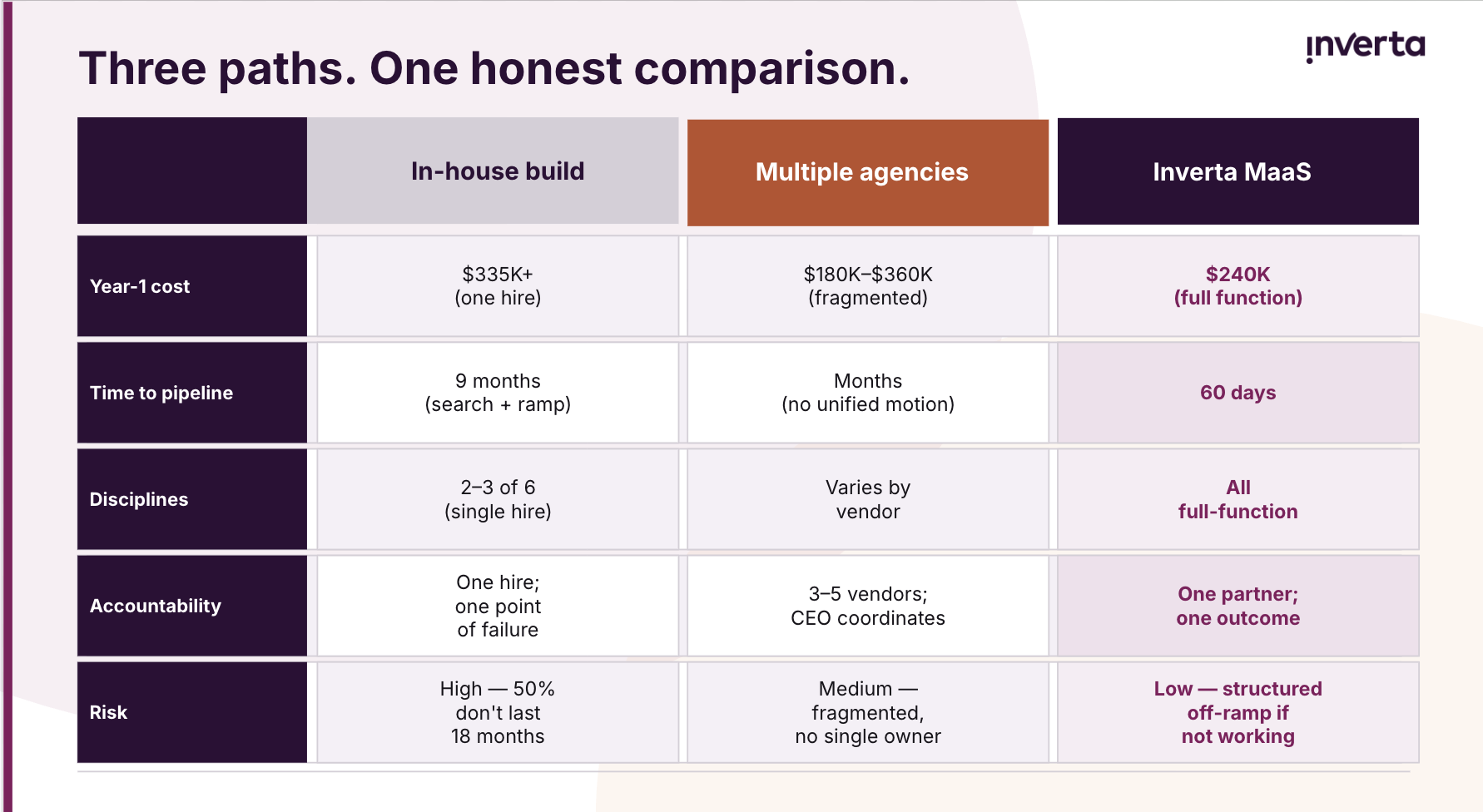
Most growth-stage CEOs frame the pricing decision as: agency retainer versus in-house hire. Presented that way, the in-house hire often wins on the intuitive math — "for what I'd pay an agency, I can hire someone who's fully committed to my company."
That intuition is understandable, but it skips a crucial step. A single in-house hire — even an experienced head of marketing — is one person. One person cannot simultaneously run demand gen, own content strategy, manage RevOps, develop the messaging architecture, and build the AI infrastructure. They need a team. And building that team takes 12–18 months and $600K–$900K in fully-loaded headcount.
The honest comparison isn't Inverta versus one hire. It's Inverta versus the full marketing organization you'd need to build to match the capability — and the 12–18 month timeline to build it.
What "Month 1" actually means
When we say Inverta activates in Month 1, we mean that literally. We mean that we dig in and build the strategy. We mean your marketing function is scoped— campaigns running, content publishing, RevOps configured, reporting in place — within the first 30 days. And then we get to work building pipeline.
This is possible because the Inverta model isn't built on staffing. It's built on infrastructure. The team, the tools, the playbooks, and the AI layer are built and activated for your specific business. You're not hiring a person who needs to ramp — you're plugging into a machine that's already running.
For context: the average time from signing a senior marketing leader to meaningful contribution is 6 months. During those 6 months at $20,000 per month with Inverta, you have a fully operational marketing function. The pipeline comparison isn't close.
You're not hiring a person who needs to ramp. You're plugging into a machine that's already running.
Who this is right for (and when it isn't)
Transparent pricing for marketing services means being honest about fit.
The Inverta MaaS model is designed for growth-stage B2B companies — typically $10M–$50M in revenue — that need a functional marketing organization but aren't positioned to build one in-house yet. Companies where the CEO is currently the de facto head of marketing. Companies that have tried point solutions and ended up with fragmented execution that doesn't add up to pipeline.
If you have a 15-person marketing team and a CMO in seat, you probably don't need MaaS. You need different things — specialists that can fill gaps in resourcing or expertise (and Inverta does that, too!)
But if you're a B2B company in the $10M–$50M range trying to figure out whether to hire, go fractional, or engage an agency — and you keep running the math and not loving the answer — the question worth asking is whether any of those options actually gives you what you need, or just gives you part of it.
The question isn't what marketing agencies charge per month. It's what a functional marketing organization costs — and how fast you can have one.
$20,000 per month. Full function. Month 1. No setup fees.
See what that looks like for your company →
About the author
Service page feature

Demand gen


Marketing agency pricing is one of the most deliberately opaque topics in B2B. Ask ten agencies what they charge, and you'll get ten different frameworks — retainers, project fees, hourly blended rates, performance bonuses, setup fees, and minimum commitments wrapped in enough nuance to make a CFO's eye twitch.
This article doesn't do that. We're going to tell you exactly what $20,000 per month buys with Inverta, why that number is structured the way it is, and how it compares honestly to the alternatives most growth-stage CEOs are evaluating. If you came here looking for transparent marketing services pricing, this is it.
What marketing agencies actually charge — and what you get
Before we make the case for anything, let's establish a baseline. What does a typical digital marketing agency cost?
The range is enormous, which is part of the problem. Digital marketing agency prices vary by specialization, geography, size, and scope. But here's a fair summary of what most B2B companies encounter when shopping marketing agency pricing:
Content and SEO agencies: $3,000–$10,000 per month. You get blog posts, keyword research, and monthly reporting. You don't get demand gen, RevOps, paid media, or anything that maps directly to pipeline.
Paid media agencies: $3,000–$8,000 per month plus ad spend. You get campaign management in one channel. You don't get the content to convert the traffic, the RevOps to route the leads, or the strategy to connect it to your actual business goals.
Full-service digital marketing agencies: $8,000–$25,000 per month. You get broader coverage but typically through a generalist team model — an account manager who touches multiple clients, junior coordinators doing the execution, and senior strategists who show up for quarterly reviews.
Specialized B2B demand gen agencies: $10,000–$20,000 per month. Better, but typically narrowly scoped — they own pipeline generation in specific channels, not your entire marketing function.
How much do marketing agencies charge per month across all of these engagements if you're trying to cover your full marketing function? Usually $20,000–$35,000 — and you're still managing three to five different vendor relationships, with no single partner accountable for the whole motion.
The coordination cost nobody prices in
Here's the line item that never appears in a marketing agency pricing deck: your time.
When you're running multiple marketing services vendors — a content agency, a paid media shop, a RevOps consultant, maybe a fractional CMO to coordinate them — someone has to hold the strategy together. Someone has to make sure the content agency's keyword targets align with the paid media agency's ad copy. Someone has to ensure the leads being generated are actually being worked by sales. Someone has to build the reporting that connects all of it.
At most growth-stage companies, that someone is the CEO. Or the VP of Sales doing double duty. Or nobody — in which case you have a collection of agencies producing outputs that don't add up to a pipeline.
This is what digital marketing agency prices don't include: the organizational overhead of making point solutions work together. It's real, it's expensive in CEO hours, and it compounds every month you're trying to run marketing by committee.
The line item that never appears in a marketing agency pricing deck is your time — and it's the most expensive item on the list.
What $20K/month actually buys with Inverta
Inverta's Marketing as a Service model starts at $20,000 per month. No setup fees. No minimum term that locks you into a relationship that isn't working. One monthly investment, one integrated team, one accountable partner.
Here's what that covers:
Strategy and positioning. A senior marketing strategist who owns your messaging architecture, your campaign strategy, and your go-to-market motion. This isn't a quarterly check-in — it's active, continuous strategic leadership.
Demand generation. Paid search, paid social, content, and email — operated as an integrated motion, not as separate channels. Campaigns that are built to generate pipeline, not just traffic.
Content and creative. The assets that support your demand gen motion: the thought leadership that builds credibility in the dark funnel, the conversion content that turns interest into action, and the sales enablement content that accelerates deals in progress.
Revenue Operations. Lead routing, CRM hygiene, attribution modeling, and reporting infrastructure. This is the layer that makes everything else measurable — and it's where most fragmented agency setups break down completely.
AI and agentic infrastructure. Automated research, signal capture, content variation, and campaign analysis. Your marketing function runs continuously, not just when a human has bandwidth.
The comparison that changes the math
Most growth-stage CEOs frame the pricing decision as: agency retainer versus in-house hire. Presented that way, the in-house hire often wins on the intuitive math — "for what I'd pay an agency, I can hire someone who's fully committed to my company."
That intuition is understandable, but it skips a crucial step. A single in-house hire — even an experienced head of marketing — is one person. One person cannot simultaneously run demand gen, own content strategy, manage RevOps, develop the messaging architecture, and build the AI infrastructure. They need a team. And building that team takes 12–18 months and $600K–$900K in fully-loaded headcount.
The honest comparison isn't Inverta versus one hire. It's Inverta versus the full marketing organization you'd need to build to match the capability — and the 12–18 month timeline to build it.
What "Month 1" actually means
When we say Inverta activates in Month 1, we mean that literally. We mean that we dig in and build the strategy. We mean your marketing function is scoped— campaigns running, content publishing, RevOps configured, reporting in place — within the first 30 days. And then we get to work building pipeline.
This is possible because the Inverta model isn't built on staffing. It's built on infrastructure. The team, the tools, the playbooks, and the AI layer are built and activated for your specific business. You're not hiring a person who needs to ramp — you're plugging into a machine that's already running.
For context: the average time from signing a senior marketing leader to meaningful contribution is 6 months. During those 6 months at $20,000 per month with Inverta, you have a fully operational marketing function. The pipeline comparison isn't close.
You're not hiring a person who needs to ramp. You're plugging into a machine that's already running.
Who this is right for (and when it isn't)
Transparent pricing for marketing services means being honest about fit.
The Inverta MaaS model is designed for growth-stage B2B companies — typically $10M–$50M in revenue — that need a functional marketing organization but aren't positioned to build one in-house yet. Companies where the CEO is currently the de facto head of marketing. Companies that have tried point solutions and ended up with fragmented execution that doesn't add up to pipeline.
If you have a 15-person marketing team and a CMO in seat, you probably don't need MaaS. You need different things — specialists that can fill gaps in resourcing or expertise (and Inverta does that, too!)
But if you're a B2B company in the $10M–$50M range trying to figure out whether to hire, go fractional, or engage an agency — and you keep running the math and not loving the answer — the question worth asking is whether any of those options actually gives you what you need, or just gives you part of it.
The question isn't what marketing agencies charge per month. It's what a functional marketing organization costs — and how fast you can have one.
$20,000 per month. Full function. Month 1. No setup fees.
See what that looks like for your company →
Resources
About the author
Service page feature
Demand gen
Proof: what $20K/month gets you


Speakers
Other helpful resources
Marketing agency pricing is one of the most deliberately opaque topics in B2B. Ask ten agencies what they charge, and you'll get ten different frameworks — retainers, project fees, hourly blended rates, performance bonuses, setup fees, and minimum commitments wrapped in enough nuance to make a CFO's eye twitch.
This article doesn't do that. We're going to tell you exactly what $20,000 per month buys with Inverta, why that number is structured the way it is, and how it compares honestly to the alternatives most growth-stage CEOs are evaluating. If you came here looking for transparent marketing services pricing, this is it.
What marketing agencies actually charge — and what you get
Before we make the case for anything, let's establish a baseline. What does a typical digital marketing agency cost?
The range is enormous, which is part of the problem. Digital marketing agency prices vary by specialization, geography, size, and scope. But here's a fair summary of what most B2B companies encounter when shopping marketing agency pricing:
Content and SEO agencies: $3,000–$10,000 per month. You get blog posts, keyword research, and monthly reporting. You don't get demand gen, RevOps, paid media, or anything that maps directly to pipeline.
Paid media agencies: $3,000–$8,000 per month plus ad spend. You get campaign management in one channel. You don't get the content to convert the traffic, the RevOps to route the leads, or the strategy to connect it to your actual business goals.
Full-service digital marketing agencies: $8,000–$25,000 per month. You get broader coverage but typically through a generalist team model — an account manager who touches multiple clients, junior coordinators doing the execution, and senior strategists who show up for quarterly reviews.
Specialized B2B demand gen agencies: $10,000–$20,000 per month. Better, but typically narrowly scoped — they own pipeline generation in specific channels, not your entire marketing function.
How much do marketing agencies charge per month across all of these engagements if you're trying to cover your full marketing function? Usually $20,000–$35,000 — and you're still managing three to five different vendor relationships, with no single partner accountable for the whole motion.
The coordination cost nobody prices in
Here's the line item that never appears in a marketing agency pricing deck: your time.
When you're running multiple marketing services vendors — a content agency, a paid media shop, a RevOps consultant, maybe a fractional CMO to coordinate them — someone has to hold the strategy together. Someone has to make sure the content agency's keyword targets align with the paid media agency's ad copy. Someone has to ensure the leads being generated are actually being worked by sales. Someone has to build the reporting that connects all of it.
At most growth-stage companies, that someone is the CEO. Or the VP of Sales doing double duty. Or nobody — in which case you have a collection of agencies producing outputs that don't add up to a pipeline.
This is what digital marketing agency prices don't include: the organizational overhead of making point solutions work together. It's real, it's expensive in CEO hours, and it compounds every month you're trying to run marketing by committee.
The line item that never appears in a marketing agency pricing deck is your time — and it's the most expensive item on the list.
What $20K/month actually buys with Inverta
Inverta's Marketing as a Service model starts at $20,000 per month. No setup fees. No minimum term that locks you into a relationship that isn't working. One monthly investment, one integrated team, one accountable partner.
Here's what that covers:
Strategy and positioning. A senior marketing strategist who owns your messaging architecture, your campaign strategy, and your go-to-market motion. This isn't a quarterly check-in — it's active, continuous strategic leadership.
Demand generation. Paid search, paid social, content, and email — operated as an integrated motion, not as separate channels. Campaigns that are built to generate pipeline, not just traffic.
Content and creative. The assets that support your demand gen motion: the thought leadership that builds credibility in the dark funnel, the conversion content that turns interest into action, and the sales enablement content that accelerates deals in progress.
Revenue Operations. Lead routing, CRM hygiene, attribution modeling, and reporting infrastructure. This is the layer that makes everything else measurable — and it's where most fragmented agency setups break down completely.
AI and agentic infrastructure. Automated research, signal capture, content variation, and campaign analysis. Your marketing function runs continuously, not just when a human has bandwidth.
The comparison that changes the math
Most growth-stage CEOs frame the pricing decision as: agency retainer versus in-house hire. Presented that way, the in-house hire often wins on the intuitive math — "for what I'd pay an agency, I can hire someone who's fully committed to my company."
That intuition is understandable, but it skips a crucial step. A single in-house hire — even an experienced head of marketing — is one person. One person cannot simultaneously run demand gen, own content strategy, manage RevOps, develop the messaging architecture, and build the AI infrastructure. They need a team. And building that team takes 12–18 months and $600K–$900K in fully-loaded headcount.
The honest comparison isn't Inverta versus one hire. It's Inverta versus the full marketing organization you'd need to build to match the capability — and the 12–18 month timeline to build it.
What "Month 1" actually means
When we say Inverta activates in Month 1, we mean that literally. We mean that we dig in and build the strategy. We mean your marketing function is scoped— campaigns running, content publishing, RevOps configured, reporting in place — within the first 30 days. And then we get to work building pipeline.
This is possible because the Inverta model isn't built on staffing. It's built on infrastructure. The team, the tools, the playbooks, and the AI layer are built and activated for your specific business. You're not hiring a person who needs to ramp — you're plugging into a machine that's already running.
For context: the average time from signing a senior marketing leader to meaningful contribution is 6 months. During those 6 months at $20,000 per month with Inverta, you have a fully operational marketing function. The pipeline comparison isn't close.
You're not hiring a person who needs to ramp. You're plugging into a machine that's already running.
Who this is right for (and when it isn't)
Transparent pricing for marketing services means being honest about fit.
The Inverta MaaS model is designed for growth-stage B2B companies — typically $10M–$50M in revenue — that need a functional marketing organization but aren't positioned to build one in-house yet. Companies where the CEO is currently the de facto head of marketing. Companies that have tried point solutions and ended up with fragmented execution that doesn't add up to pipeline.
If you have a 15-person marketing team and a CMO in seat, you probably don't need MaaS. You need different things — specialists that can fill gaps in resourcing or expertise (and Inverta does that, too!)
But if you're a B2B company in the $10M–$50M range trying to figure out whether to hire, go fractional, or engage an agency — and you keep running the math and not loving the answer — the question worth asking is whether any of those options actually gives you what you need, or just gives you part of it.
The question isn't what marketing agencies charge per month. It's what a functional marketing organization costs — and how fast you can have one.
$20,000 per month. Full function. Month 1. No setup fees.
See what that looks like for your company →
About the author
Service page feature