How to transition to buying groups—a step-by-step guide
Sending individualized messages decreases the odds of a purchase by 59%. Uh oh. Whereas consensus content targeted at getting the buying group to agree increases the odds of a sale 2.5x. In this guide, how to make that transition.


In partnership with:
Featuring
Featuring
How are you going to stand out in 2026?
Buyers are in control of the buying process. Over 70% of it is happening online. And they are putting companies on their short list of vendors that provide value and establish trust with their content.
How are you accounting for this in your 2026 strategy?
You need to stand out. To make sure your buyers notice you. Let us help you build that into your strategy for next year -->


The Revenue Marketer

How to transition to buying groups—a step-by-step guide
Still chasing 10% efficiency gains?
2023-2025 were the years of experimentation with AI. 2026 is the year to make it transformative. If you're still trying to figure out the strategic advantage AI will bring to your team, we're here to help!

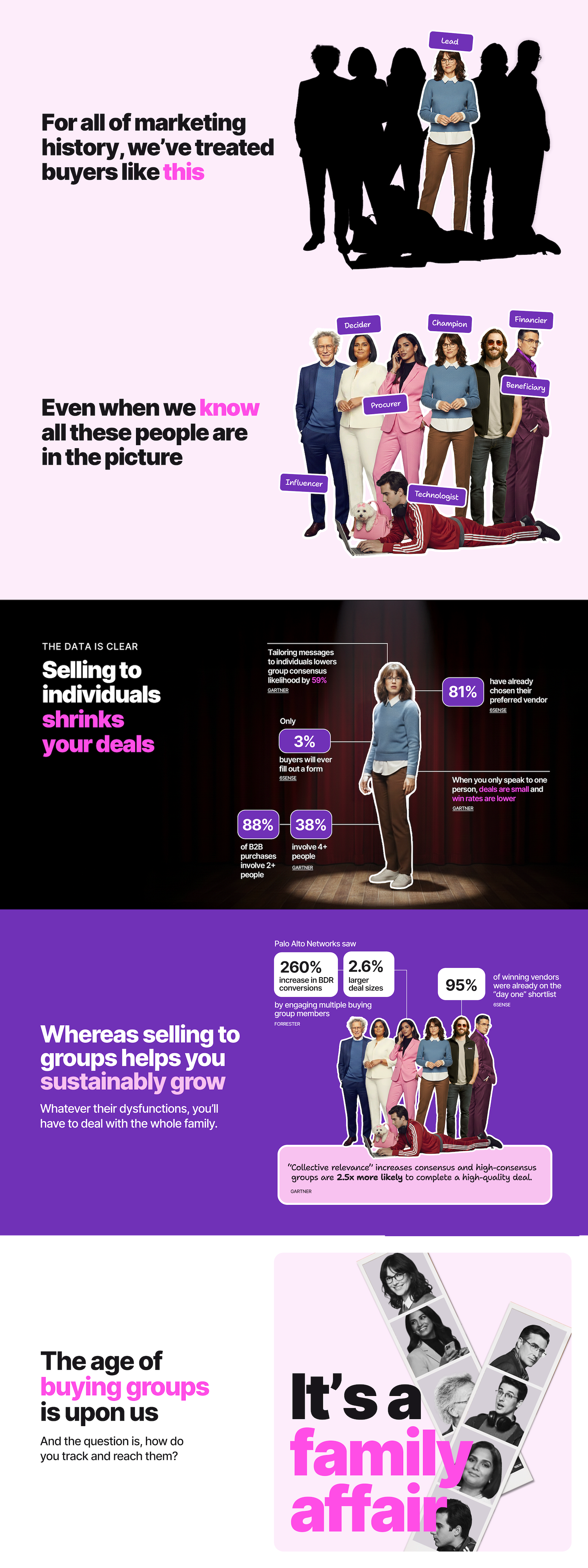
Quick synopsis: Get your families to agree
Revenue is created when buying groups reach alignment. If you recall nothing else from this guide, make it that simple idea. Get evaluators to agree. Every part of your go-to-market must be re-geared to support that.
Now on to the guide.
What's inside
- The buying group shift isn't just cosmetic
- You'll need a whole new dashboard
- The 7 steps to transformation
- Figure out who's on the buying team
- Listen for group buying signals (not just leads)
- Make it easier for buyers to research you
- Write content that unites, not divides
- Align your internal teams
- Use technology and data to show the whole picture
- Grade your team on new metrics
If you'd rather download and share, you can get the full pdf here.
The buying group shift is not cosmetic. It alters how you operate
Yes, the buying group idea makes for a compelling slide deck. But what do you do once the presentation ends? That’s when the real thinking begins. If you believe that buying decisions are made by groups, not individuals, you realize you can’t just change a metric. You must change how work flows through your entire go-to-market engine.
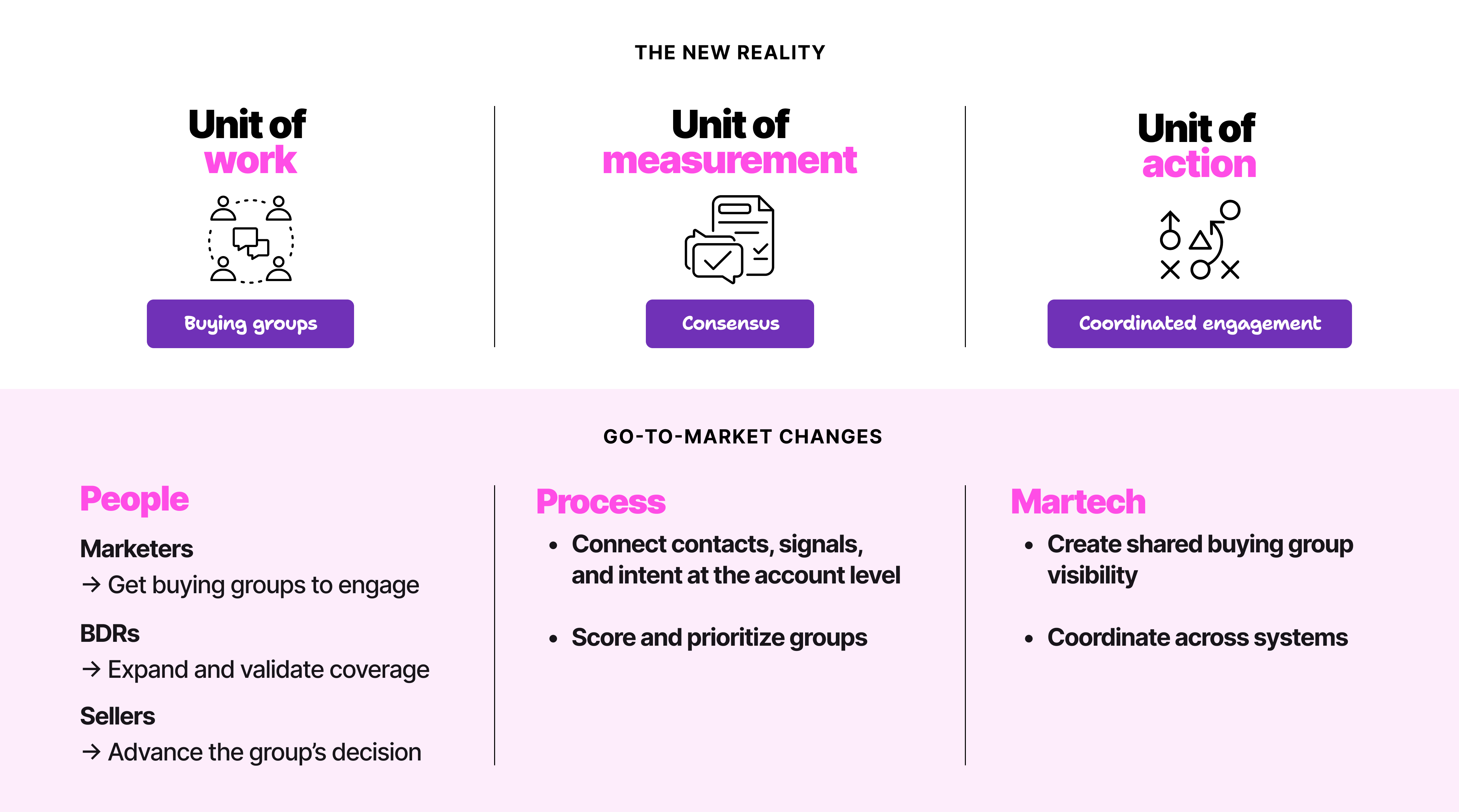
Buying groups transformation is a change at all three layers:
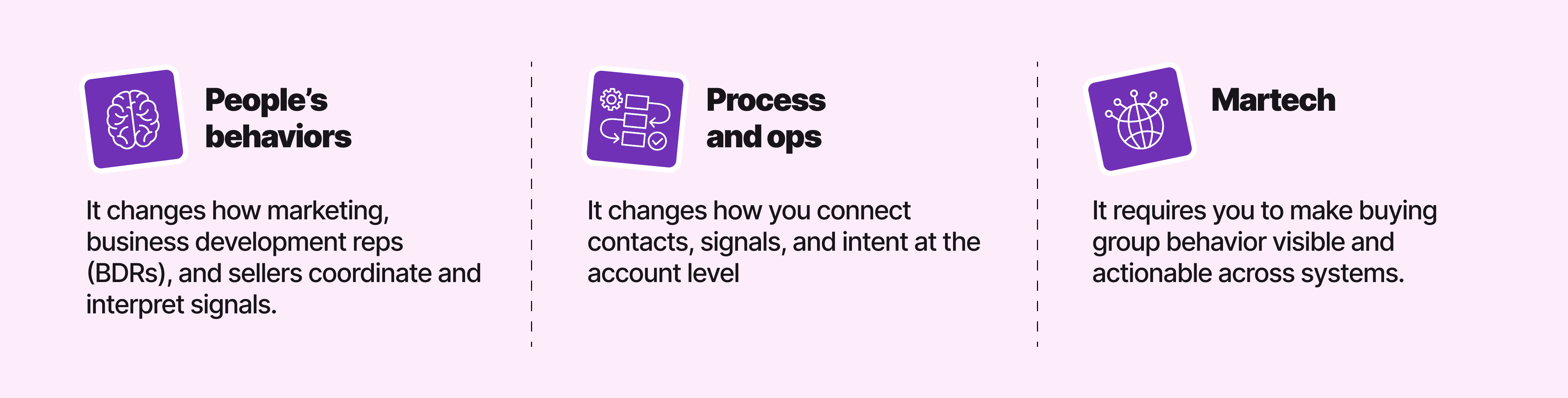
Many teams stop short and treat it as a mere renaming exercise. They say, “We’ll swap MQLs for MQAs.” But that doesn’t work. An account has 10 contacts. Can BDRs really make 10x more calls? How will you message the entire group?
Questions to ask yourself as you read:
- What does a handoff mean when multiple contacts are engaged?
- How do BDRs work differently when the goal is group coverage, not speed to lead?
- How do contacts relate to opportunities when no single person “owns” the decision?
- Which signals indicate buying group momentum versus isolated curiosity?
- How do you identify roles in the decision, not just job titles in a database?
- How does content help a group reach consensus, not just persuade one champion?
These are operational and philosophical questions. If you don’t answer them intentionally, your martech will answer them for you, haphazardly. That’s why it’s so important you plan. You can run a pilot, but you must do so knowing the end state and measurements.
One thing we are sure of is that group metrics beat lead metrics head to head. If you implement group metrics, they will be so much more useful to marketers and sellers that the lead ones will fall away. MQLs will remain, but only as a light signal.
This transformation is not easy. But if you succeed, you can achieve newfound relevance. You help entire buying groups, not lone individuals, make a confident, collective decision in your favor.
Wait. How is this different from ABM?
ABM applies buying group logic to just a handpicked set of accounts. Whereas the buying group transformation means updating your entire revenue engine: inbound, outbound, targeted, and untargeted. Buying group transformation creates a foundation for ABM. This improves ABM because it addresses the hidden blocker: group consensus.

How to apply buying groups to ABM →
You’ll need a new buying group dashboard, not just another performance report
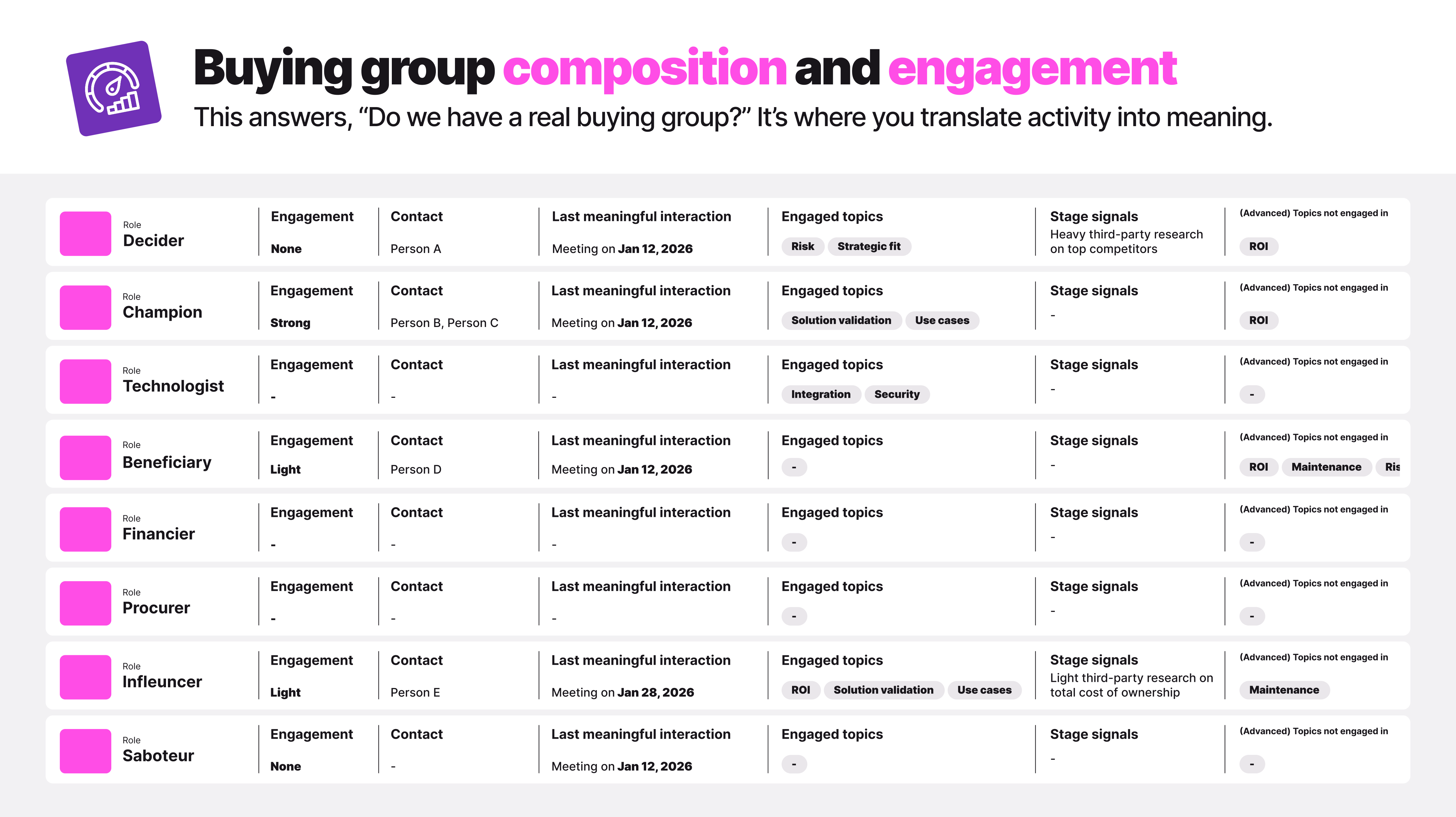
By the end of this transition, your dashboard should no longer answer “What did Marketing do?” It should answer “Is this account ready to decide and do we understand the people involved?”
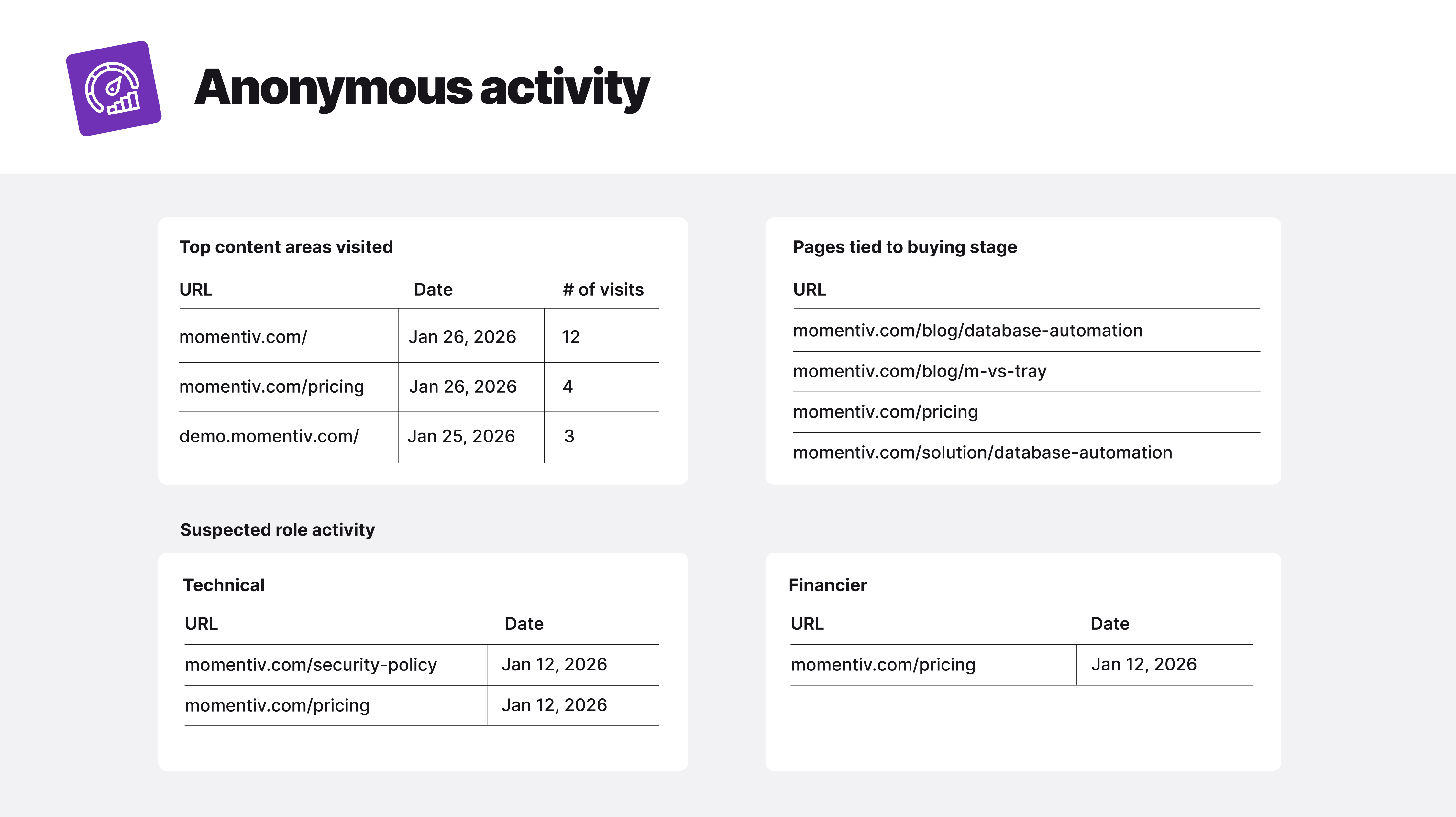
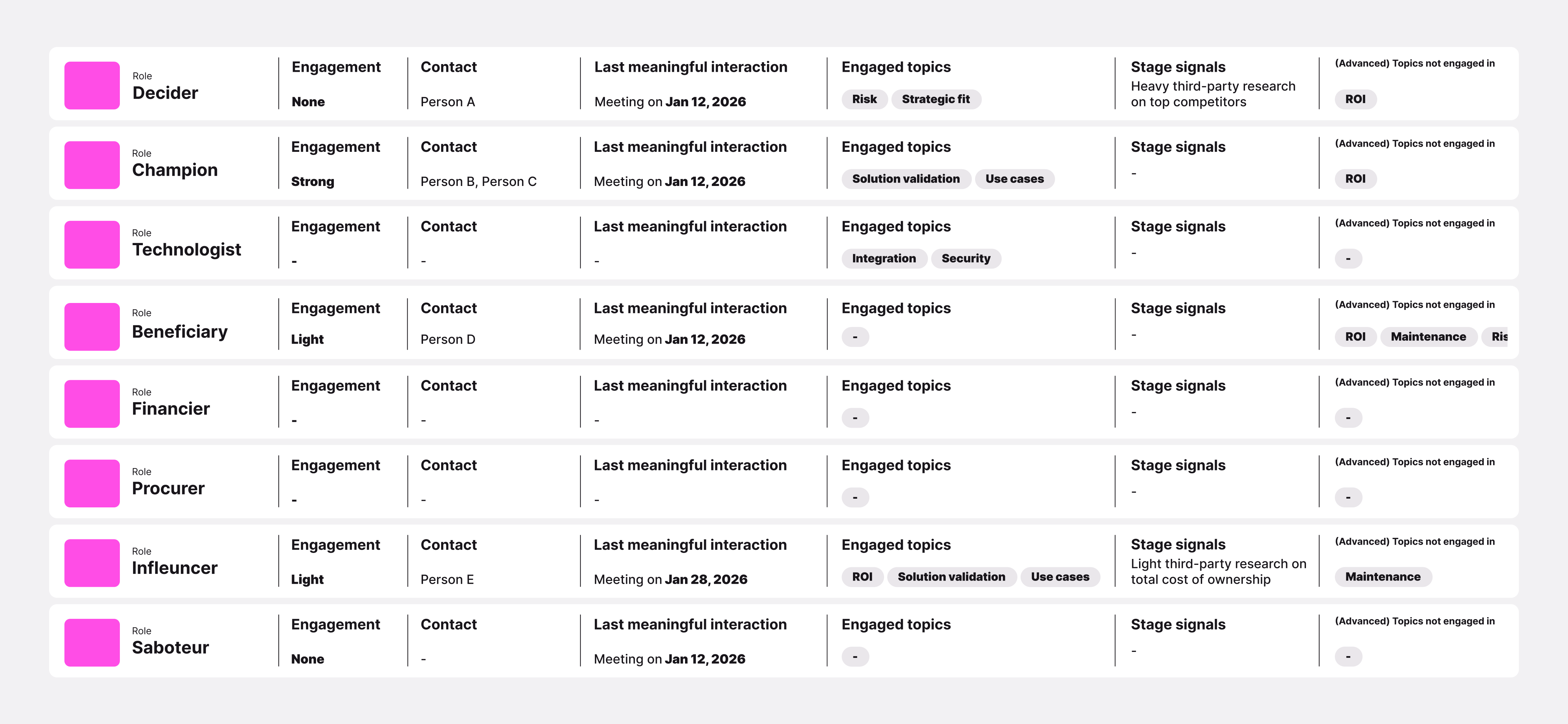
Your buying group dashboard should show buying groups, and how complete they are: which roles are missing, who is engaged, how intent and engagement are aligning, and what action will help the group advance. It replaces lead volume with metrics that offer insight into account and people dynamics, which get closer to the truth.
The dashboard answers:
- Who is involved?
- Are the right roles engaged?
- Is alignment forming or breaking down?
- What should sales and marketing do next together?
Whether it lives in an ABM platform, CRM, or analytics tool, the goal is the same: one shared view of buying group readiness that marketing, BDRs and sales trust and act on together.

The 7 buying group transformation steps
Aka, how to deal with the whole family.
1. Figure out who's on the buying team
This guide assumes you know what type of companies you are targeting. With that foundation, assess the roles in your typical buying group.
Do you know your target company’s typical roles? (IT, finance, user, etc.) Can your systems actually see when multiple people from different roles show interest?
Note that “role” is just a role someone plays in the evaluation—it is not their title. Roles can change. One person can play multiple. Multiple people can play one. In one evaluation, the head of infrastructure, the app developer, and the IT manager could all play the “champion” role together. In another evaluation, the CFO could start out as your decider, then hand things off to the chief people officer.

Don’t settle for just emails and titles
To write meaningful messages, you need more clues than you’ll ever get from owned properties and form fills alone. Account-level intent was a start—it told you a company was in-market. But it left you guessing about who was actually doing the research and what they cared about. You'd prioritize an account, then waste cycles reaching out blindly, hoping you'd land on the right person with the right message.
Now, you can go deeper. Buying Group Intent reveals which personas are researching, what topics they are exploring, and what research stage they're in. Better yet, you can uncover additional roles showing strong signals who can influence or block a deal. With the data at your fingertips you can personalize outreach based on what each decision-maker cares about.
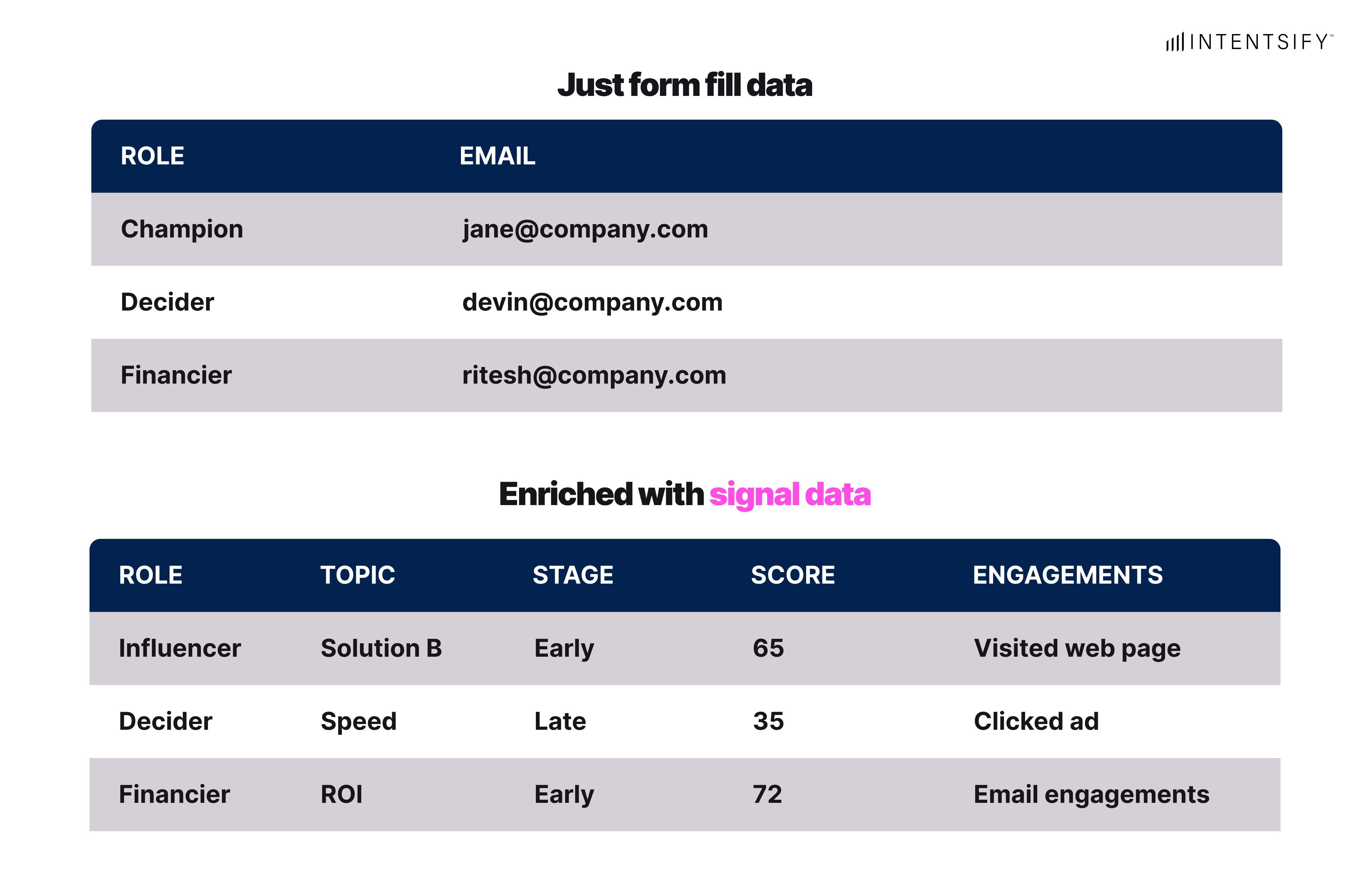
Knowing who’s involved helps you go from lower to higher-order marketing. You can add far more value.
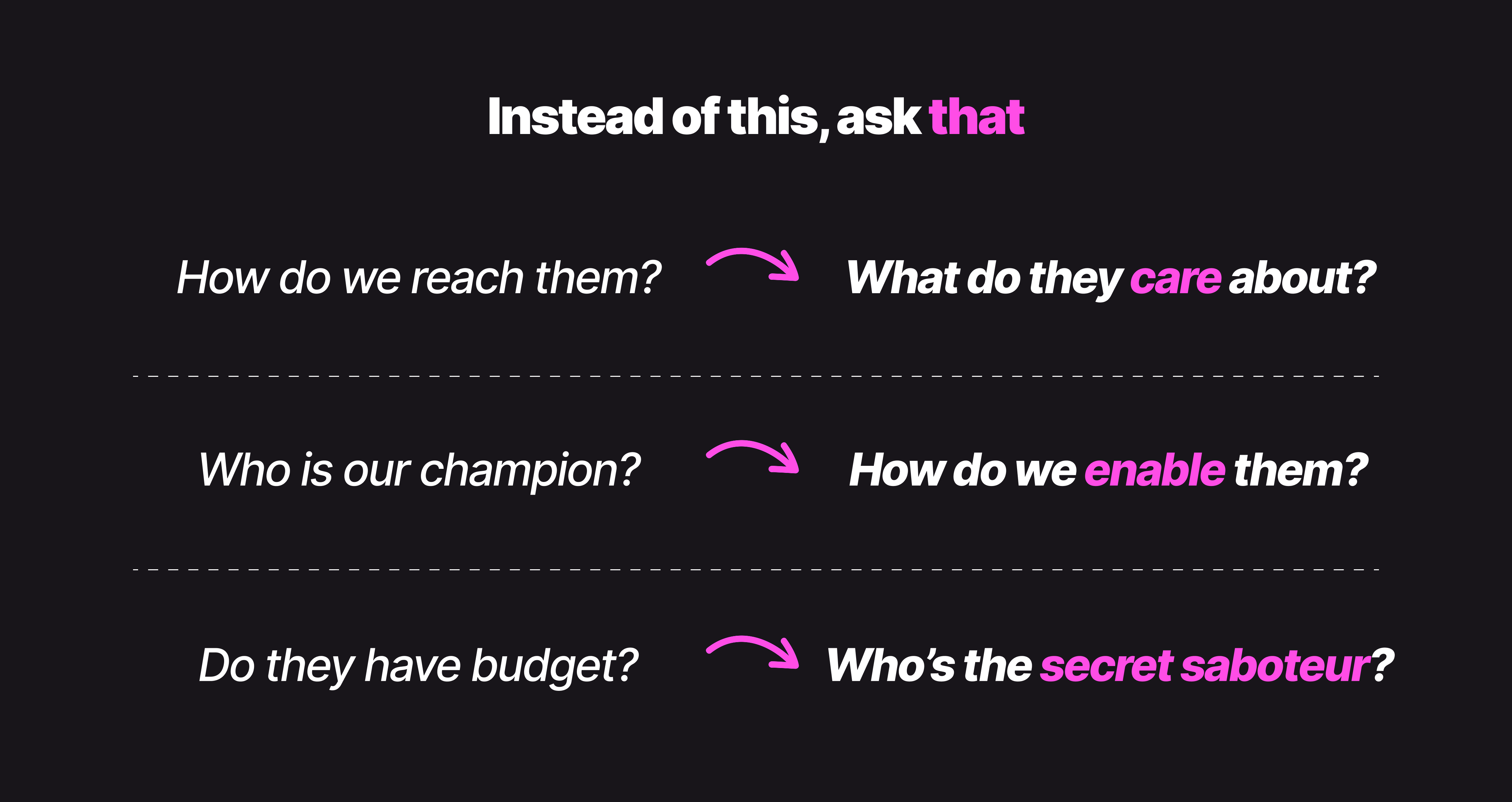
💡 Use automations to add new contacts
Sales is as unlikely as ever to mark buying group’s profiles in the CRM. Use your BDR team and workflow automations to detect leads and contacts from that same account, and associate them. Or, scan inboxes and calendars automatically.
How do I figure out who’s in our buying groups?
Talk to people in sales, product marketing, customer success, and customer research. Ask them:
- Who’s typically involved in a deal?
- What role do they each play?
- Who helps?
- Who harms?
- Who do you have to work to convince?
- What are each of their interests and objections?
- Who do we know signs off, but we never interact with?
Also consider mapping all the steps that occurred in 5-10 recent deals, and noting the various roles people seemed to play. For example, the decider delegates final negotiating authority to procurement, who nobody ever talked to.
Use this information to sort people in the common roles. If yours don’t fit the seven proposed in this guide, customize them. Turn the result into a slide showing each role’s motives, needs, and objections. Then, back-test your findings: Of the prior deals, did engaging more buyers earlier speed up the cycle or increase the value?
💡 Start measuring buying group completeness
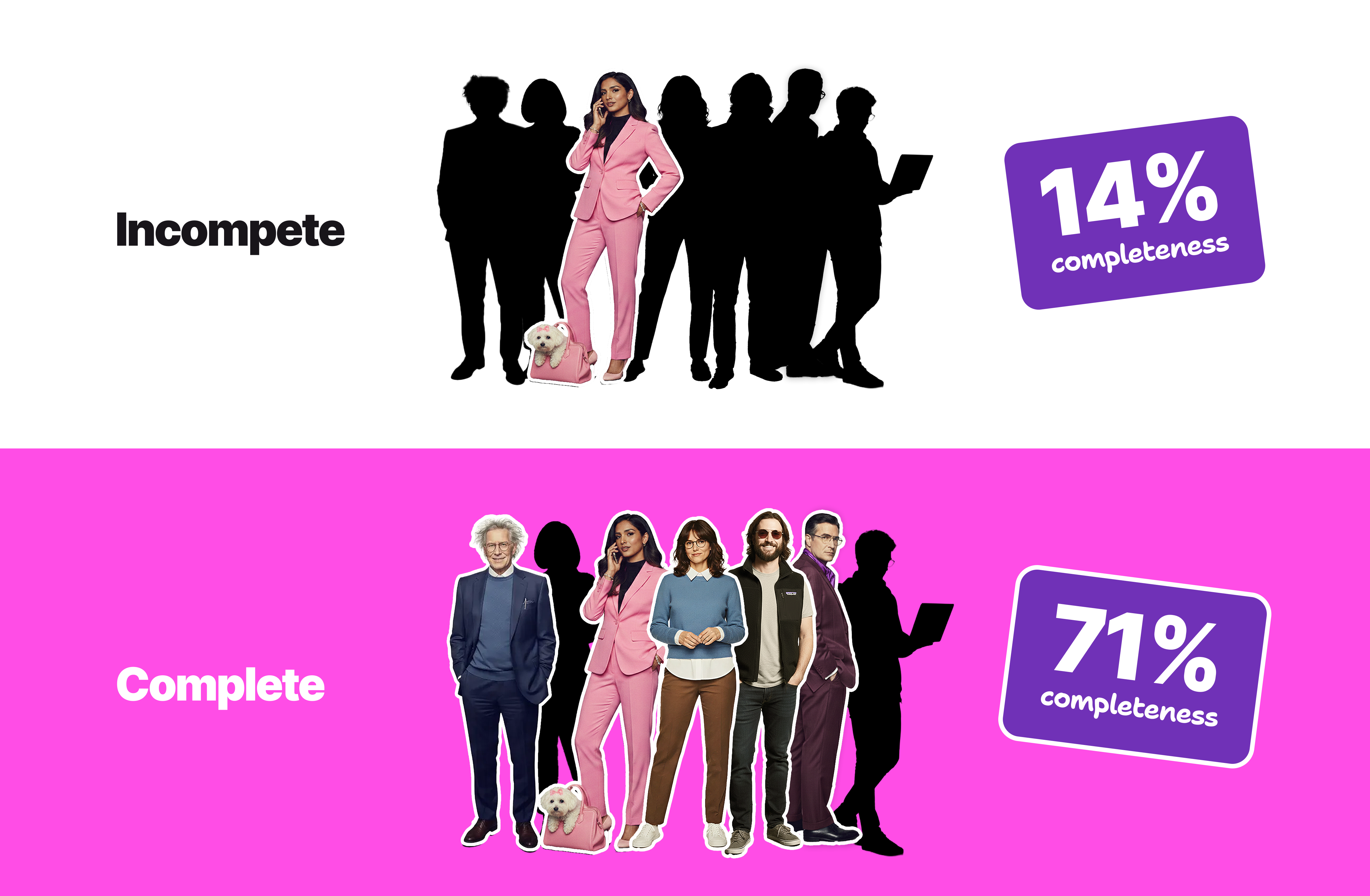
If you know your typical buying group is 7 roles, and you have 5 roles attached to an account, you have 71% completeness, which is probably good. That is likely correlated with deal success and size.
Note: Count the roles, not the titles. If you have 3 contacts attached, but if they are all champions, you only have 1 out of 7 roles. Work to unmask that group.
2. Listen for group buying signals (not just leads)
Are you set up to capture all the clues that a group is interested? This includes anonymous website visits, intent data from other sites, and multiple contacts from the same company.
New signals are vital because sometimes, companies make a big announcement that they’re moving to MQAs or buying groups, but the only team member whose job changes is the BDR. Marketing asks them to start calling three people at each account, and it breaks down.
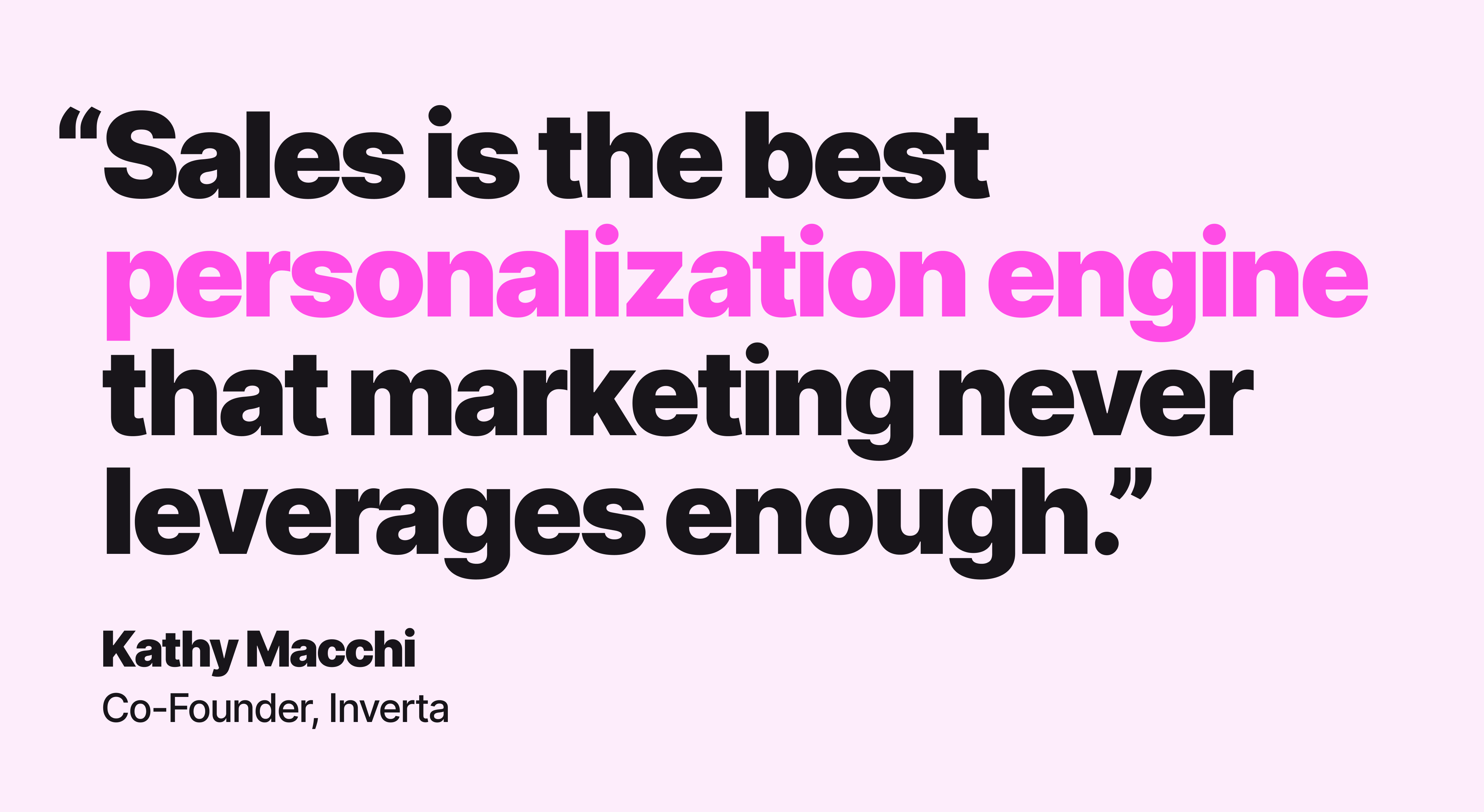
“Everyone’s job must change with the new model, and new metrics help everyone update their roles, thinking, and processes,” says Kathy Macchi, Inverta Co-Founder. “You need the data for sales, marketing, BDRs, and success to each see their impact.”
The new buying group metrics
- Web intent per contact and account
- Web engagement per contact and account
- Reply signals
- % meetings held
- Speed to meeting
- Stage progression (opportunity and champion)
- Buying group engagement (weighted sum of all engagement)
- Product adoption
- Product experience
- Product adoption
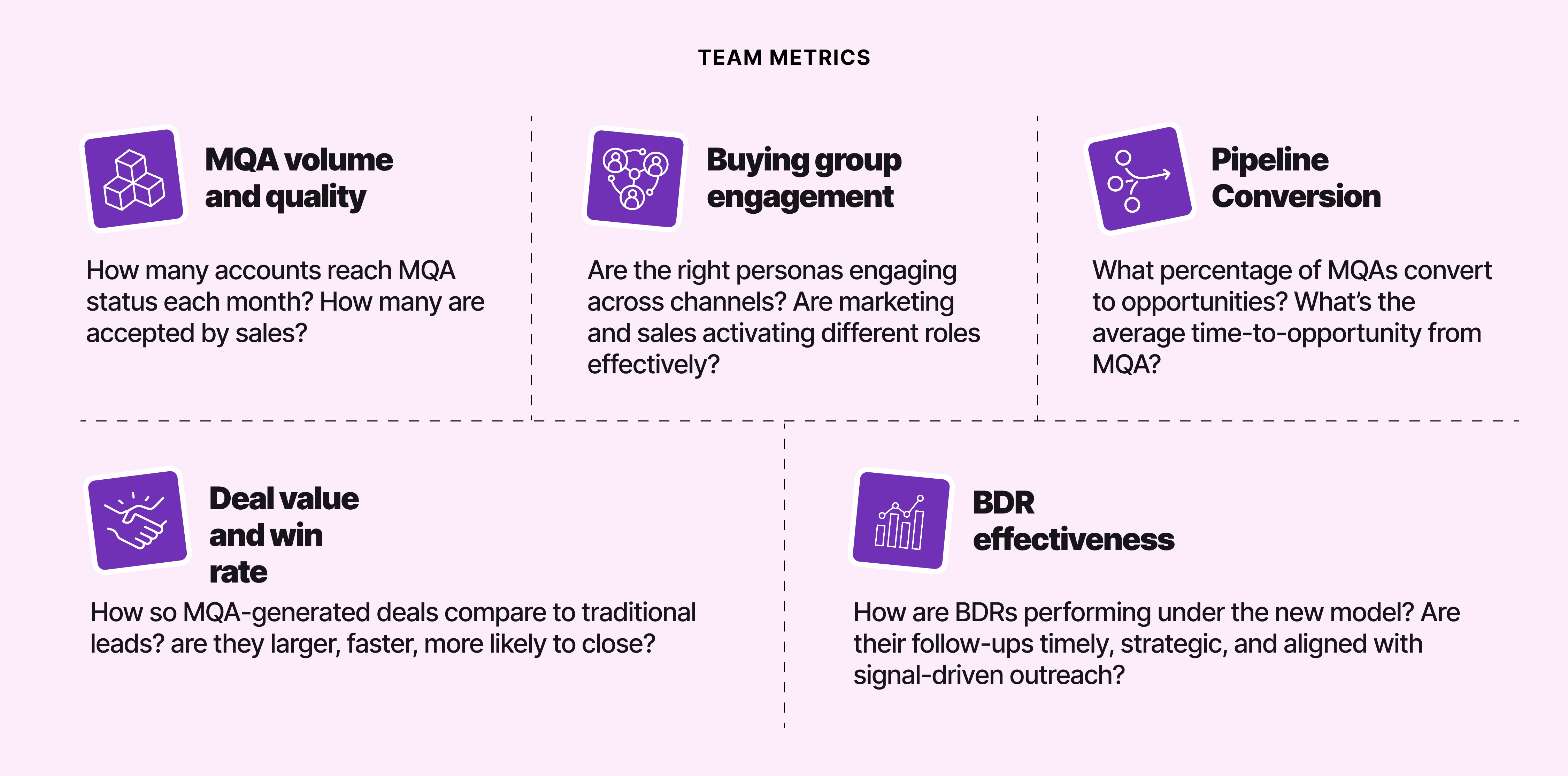
Note that these metrics imply a real mindset shift—toward proactive marketing. Rather than waiting for buying groups to reveal themselves, you work to identify accounts scoring highly and engage all those missing people to “complete” the opportunity.
In this new convention, marketing is:
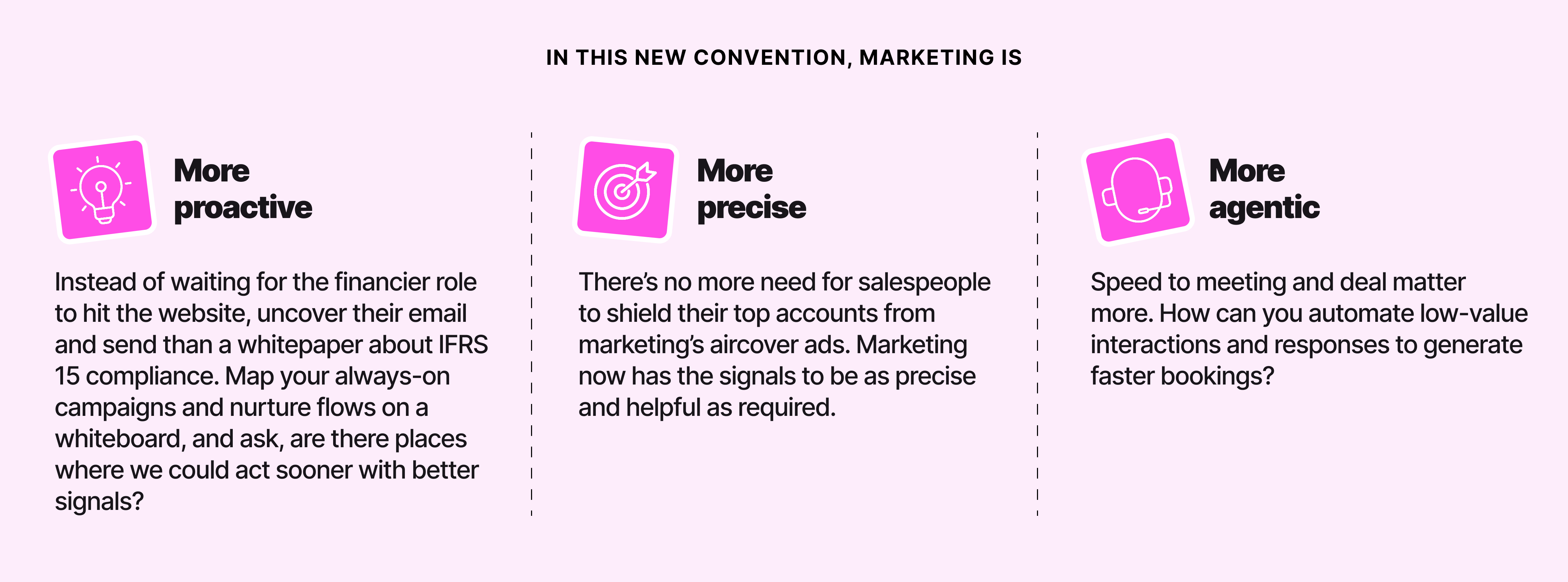
You’ll know this is working when traffic is down, but meeting quality is up.
💡 Set up early account warnings
If an opportunity has a low score and completeness, consider creating a “warning” indicator in the CRM that says, “This deal is unlikely to close soon. Engage the contacts or deprioritize it.”
3. Make it easier for buyers to research you
Content was always about enabling buyers. But now, it’s about helping the committee achieve consensus with less work.
We’ve all read the Gartner research about how difficult it is to buy these days. Content is your buyer experience. A good experience is easy and intuitive. Do you make it easy for buyers to find the information they need anonymously? Or are you hiding all your best content behind forms, driving them away? And potentially blocking large language models (LLMs) from understanding your product?
This question is newly relevant, as your buyers are now evaluating with LLMs. If your content is CAPTCHA-protected, it’s invisible. Which means the LLM will draw information from Reddit or competitors. And be careful what you put out there. One tech company we know made a big splash with an April Fools’ campaign about them shutting down. ChatGPT now tells people they went out of business.
Consider splitting key assets into multiple formats: dense, information-rich checklists for the LLMs, and the clever, creative wrapper for people.
Developers have spent a long time making the web inaccessible to bots. Smart marketers are rapidly reversing that.” - Jessica Fewless, VP of Marketing and Partnerships, Inverta
Only “gate” for the buyer’s benefit
You can gate webinars because you need that person’s email to send reminders. Or, ask for it if they sign up for an email-only course. But if all the gate does is introduce friction, reconsider it. (There will of course be exceptions.)
Consider your distributed reputation
Your brand is now what people say about you on Reddit, G2, and social media, where LLMs draw most of their cited answers. How are you ensuring that what everyone says is consistent and repetitive?
Consider making your pricing public
Buyers only engage sales 70% of the way through the cycle and any LLMs are giving them your pricing based on what others have written. Own the conversation. Make your pricing as public as is practical.
💡 Create a buyer persona for LLMs
Buyers are researching you with AI, and their AI—and soon-to-be agents—think differently. Create a persona for what AI assistants need.
4. Write content that unites, not divides
Buying group marketing raises a curious question: Who are you supposed to personalize to, and when? Does your content speak to only one role? Or does it help the whole group get on the same page?
The answer is both, at different times. Gartner research is definitive on this subject: You need role-specific content to get people into a buying cycle, then consensus content to get them all to agree. Possibly, even content that outright says, “Go meet with IT, here are talking points.”
If you don’t create consensus, you stoke existing conflicts. Gartner finds that too much individual relevance messaging lowers the likelihood they decide by 59%.


💡 Consider creating intra-role personas
How do each of the roles interact? Conflict? Those are areas you should create content for to help them.
Don’t forget: Humans want to buy from humans
With so much automation, it’s easy to default to digital-only experiences. But physical gifts create a welcome surprise-and-delight moment. They cut through the noise, drive real recall, and remind buyers there’s a team of humans behind the brand.

5. Align your internal teams
Once you’ve made sense of how the new buying group method works, you need marketers, sellers, BDRs, and ops people working in unison with the same definitions and goals.
Otherwise, you run the risk of making the big announcement and then everyone reverts to their old ways. And perhaps treats every account like it’s just three leads in a trenchcoat.
Be clear on what’s changed:
- You will focus on MQAs—And deprioritize MQLs. There is no sensible conversion between them. You’ll simply have to run a pilot to see what MQAs mean in terms of closes and revenue.
- You must document the specific role changes—A company we know launched their buying group transition without talking to BDRs. They didn’t realize it took BDRs one hour to dig through Salesforce, Demandbase, and LinkedIn to qualify an account. The new marketing plan asked them to research hundreds of accounts. It wasn’t sustainable.
- You need an MQA inspection process—Set up inspection points at the most important stages of the buyer’s journey, like an assembly line.
- You must continually resell the transition—Don’t assume the change will stick. Each quarter, dust off the materials and refresh everyone on the purpose of the switch.
Read more: Shift from MQL to MQA →
Are your teams ready to leave the volume mindset behind?
We cannot overstate this: Your teams will need playbooks, rules, resources, and software setting updates to actually change. If people do not see it working immediately—especially salespeople and BDRs—they will panic and revert. Sales will push BDRs to treat accounts like leads and finance will revert to measuring MQLs. It may look like things failed even though nobody actually tried.

🗓️ Set up a weekly buying group sync
It functions like office hours. People join and share what is or is not working, and in the moment, you make plans and assign actions. This is crucial—without this feedback, you can’t iterate.
→ How marketing changes
Marketing switches from generating leads to orchestrating the entire account journey. They transition from a lead factory to a media outfit that aims to unmask hidden buyer roles and help that whole group move from self interest to consensus.
- Establish roles with a framework like RACI.
- Divide up sequential tasks: brand, demand, etc.
Without clear roles, people will step on each other’s work. Digital and field teams will run overlapping and disparate campaigns, and product marketing will create its own content.

→ How the BDR role changes
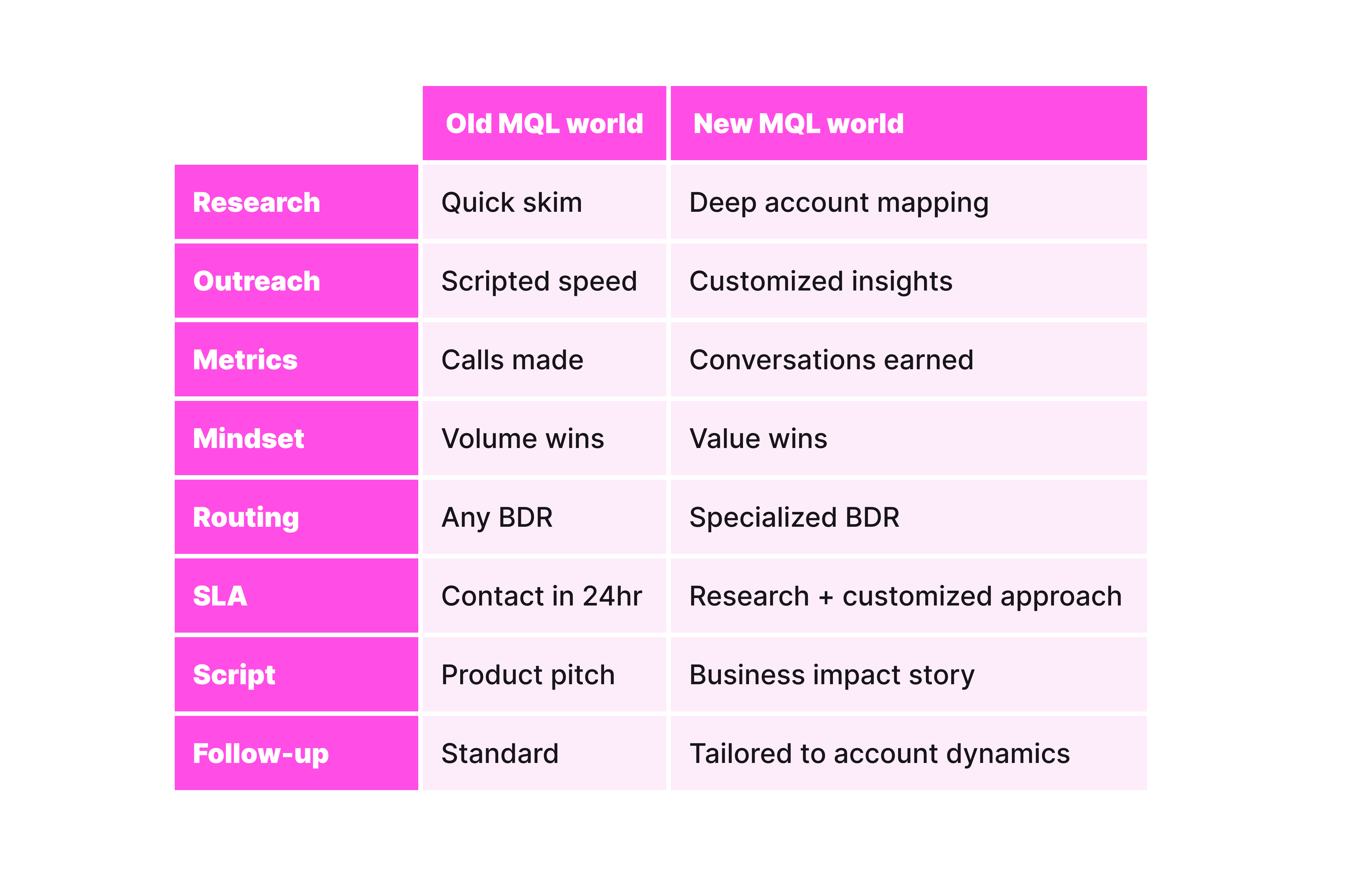
BDRs switch from being speed dialers to account strategists. They’re there to ensure AI account research doesn’t go off the rails, that they learn enough about accounts to influence individual roles, and get multi-threaded.
- Teach them to use AI to scale (and check) research.
- Triage accounts manually until you can automate.
- Focus on MQA quality, not quantity.
- Route MQAs based on rep specialty.
- Incentivize “completing” the whole buying group.
→ How sales changes
Sellers need to think in terms of winning the entire buying group over. They can no longer just talk to their champion. This means they need intel on those roles and instead of just pushing to secure budget and timing, secure a way to talk to all those other roles.
- Focus on buying group awareness and coverage.
- Identify and confirm the roles present.
- Identify and address saboteurs early.
- Focus more on cross-sell and upsell.
6. Use technology and data to show the whole picture
The buying group revenue transition is highly dependent upon your ops teams.
Most martech systems don’t currently support this transition one-to-one, which means there are thousands of potential ways to configure the buying group change.
Schedule time with the operations team early to discuss:
- What is the definition of an MQA?
- What happens when you de-prioritize an MQA?
- What happens when you disqualify an MQA?
- What is the single source of buyer truth?
- Where will you build your unified dashboard?
- If a BDR accepts a lead, do they receive others on the opportunity too?
- Do you send an alert when roles are added to an opportunity?
- Who will you retarget based on what account scores?
Have them audit your technology for readiness. Does your tech stack actually show you these group-level insights? Can your team easily see when an account is rising and who's involved?
Consider:
- Delivering account insights to BDRs/sales to improve reactions and relevance.
- Recognizing and routing MQAs separately.
- Tracking buying committee engagement visually.
- Auto-triggering tasks when high-intent signals pop.
- A manual “fast track” setting switch that reps can flip.
Read more: A practical MQA transition guide →
7. Grade your team on new metrics
New methods call for new metrics. Before proceeding, be certain they are set up to actually show the difference.
Have you changed how you evaluate your team's performance? Are BDRs compensated on account-level qualification? Is marketing comped on pipeline contribution, not lead volume? Does sales get higher multipliers when they win bigger multi-year deals that are the result of buying group consensus?
Consider:
- Weekly quickfire standups (marketing + BDRs).
- Bi-weekly reviews with sales leaders.
- Monthly "what's working, what's not" summits.
- A dedicated Slack channel for instant feedback.
Gather intra-team feedback:
- How deep was engagement across the account?
- How did sales rate MQA quality?
- How many MQAs turned into real opportunities?
- Did MQAs move faster than old-school MQLs?
- How much revenue did they actually touch?
Welcome to the buying group family
Buying groups are a transformation you cannot sleep on. The longer you continue to deal with everyone as an individual, the more you’ll miss out on all the messy overlaps and internal conflicts among those silent other roles who all could be playing saboteurs—and shrinking your deals.
It’s time to push your people, processes, and platforms to reflect today’s buying reality. It’s time to accept that buying is a family affair.
We have also built an entire resource hub with templates, checklists, webinars and more to help you make the move to buying groups.
About the author
Service page feature

Demand gen


Quick synopsis: Get your families to agree
Revenue is created when buying groups reach alignment. If you recall nothing else from this guide, make it that simple idea. Get evaluators to agree. Every part of your go-to-market must be re-geared to support that.
Now on to the guide.
What's inside
- The buying group shift isn't just cosmetic
- You'll need a whole new dashboard
- The 7 steps to transformation
- Figure out who's on the buying team
- Listen for group buying signals (not just leads)
- Make it easier for buyers to research you
- Write content that unites, not divides
- Align your internal teams
- Use technology and data to show the whole picture
- Grade your team on new metrics
If you'd rather download and share, you can get the full pdf here.
The buying group shift is not cosmetic. It alters how you operate
Yes, the buying group idea makes for a compelling slide deck. But what do you do once the presentation ends? That’s when the real thinking begins. If you believe that buying decisions are made by groups, not individuals, you realize you can’t just change a metric. You must change how work flows through your entire go-to-market engine.
Buying groups transformation is a change at all three layers:
Many teams stop short and treat it as a mere renaming exercise. They say, “We’ll swap MQLs for MQAs.” But that doesn’t work. An account has 10 contacts. Can BDRs really make 10x more calls? How will you message the entire group?
Questions to ask yourself as you read:
- What does a handoff mean when multiple contacts are engaged?
- How do BDRs work differently when the goal is group coverage, not speed to lead?
- How do contacts relate to opportunities when no single person “owns” the decision?
- Which signals indicate buying group momentum versus isolated curiosity?
- How do you identify roles in the decision, not just job titles in a database?
- How does content help a group reach consensus, not just persuade one champion?
These are operational and philosophical questions. If you don’t answer them intentionally, your martech will answer them for you, haphazardly. That’s why it’s so important you plan. You can run a pilot, but you must do so knowing the end state and measurements.
One thing we are sure of is that group metrics beat lead metrics head to head. If you implement group metrics, they will be so much more useful to marketers and sellers that the lead ones will fall away. MQLs will remain, but only as a light signal.
This transformation is not easy. But if you succeed, you can achieve newfound relevance. You help entire buying groups, not lone individuals, make a confident, collective decision in your favor.
Wait. How is this different from ABM?
ABM applies buying group logic to just a handpicked set of accounts. Whereas the buying group transformation means updating your entire revenue engine: inbound, outbound, targeted, and untargeted. Buying group transformation creates a foundation for ABM. This improves ABM because it addresses the hidden blocker: group consensus.
How to apply buying groups to ABM →
You’ll need a new buying group dashboard, not just another performance report
By the end of this transition, your dashboard should no longer answer “What did Marketing do?” It should answer “Is this account ready to decide and do we understand the people involved?”
Your buying group dashboard should show buying groups, and how complete they are: which roles are missing, who is engaged, how intent and engagement are aligning, and what action will help the group advance. It replaces lead volume with metrics that offer insight into account and people dynamics, which get closer to the truth.
The dashboard answers:
- Who is involved?
- Are the right roles engaged?
- Is alignment forming or breaking down?
- What should sales and marketing do next together?
Whether it lives in an ABM platform, CRM, or analytics tool, the goal is the same: one shared view of buying group readiness that marketing, BDRs and sales trust and act on together.
The 7 buying group transformation steps
Aka, how to deal with the whole family.
1. Figure out who's on the buying team
This guide assumes you know what type of companies you are targeting. With that foundation, assess the roles in your typical buying group.
Do you know your target company’s typical roles? (IT, finance, user, etc.) Can your systems actually see when multiple people from different roles show interest?
Note that “role” is just a role someone plays in the evaluation—it is not their title. Roles can change. One person can play multiple. Multiple people can play one. In one evaluation, the head of infrastructure, the app developer, and the IT manager could all play the “champion” role together. In another evaluation, the CFO could start out as your decider, then hand things off to the chief people officer.
Don’t settle for just emails and titles
To write meaningful messages, you need more clues than you’ll ever get from owned properties and form fills alone. Account-level intent was a start—it told you a company was in-market. But it left you guessing about who was actually doing the research and what they cared about. You'd prioritize an account, then waste cycles reaching out blindly, hoping you'd land on the right person with the right message.
Now, you can go deeper. Buying Group Intent reveals which personas are researching, what topics they are exploring, and what research stage they're in. Better yet, you can uncover additional roles showing strong signals who can influence or block a deal. With the data at your fingertips you can personalize outreach based on what each decision-maker cares about.
Knowing who’s involved helps you go from lower to higher-order marketing. You can add far more value.
💡 Use automations to add new contacts
Sales is as unlikely as ever to mark buying group’s profiles in the CRM. Use your BDR team and workflow automations to detect leads and contacts from that same account, and associate them. Or, scan inboxes and calendars automatically.
How do I figure out who’s in our buying groups?
Talk to people in sales, product marketing, customer success, and customer research. Ask them:
- Who’s typically involved in a deal?
- What role do they each play?
- Who helps?
- Who harms?
- Who do you have to work to convince?
- What are each of their interests and objections?
- Who do we know signs off, but we never interact with?
Also consider mapping all the steps that occurred in 5-10 recent deals, and noting the various roles people seemed to play. For example, the decider delegates final negotiating authority to procurement, who nobody ever talked to.
Use this information to sort people in the common roles. If yours don’t fit the seven proposed in this guide, customize them. Turn the result into a slide showing each role’s motives, needs, and objections. Then, back-test your findings: Of the prior deals, did engaging more buyers earlier speed up the cycle or increase the value?
💡 Start measuring buying group completeness
If you know your typical buying group is 7 roles, and you have 5 roles attached to an account, you have 71% completeness, which is probably good. That is likely correlated with deal success and size.
Note: Count the roles, not the titles. If you have 3 contacts attached, but if they are all champions, you only have 1 out of 7 roles. Work to unmask that group.
2. Listen for group buying signals (not just leads)
Are you set up to capture all the clues that a group is interested? This includes anonymous website visits, intent data from other sites, and multiple contacts from the same company.
New signals are vital because sometimes, companies make a big announcement that they’re moving to MQAs or buying groups, but the only team member whose job changes is the BDR. Marketing asks them to start calling three people at each account, and it breaks down.
“Everyone’s job must change with the new model, and new metrics help everyone update their roles, thinking, and processes,” says Kathy Macchi, Inverta Co-Founder. “You need the data for sales, marketing, BDRs, and success to each see their impact.”
The new buying group metrics
- Web intent per contact and account
- Web engagement per contact and account
- Reply signals
- % meetings held
- Speed to meeting
- Stage progression (opportunity and champion)
- Buying group engagement (weighted sum of all engagement)
- Product adoption
- Product experience
- Product adoption
Note that these metrics imply a real mindset shift—toward proactive marketing. Rather than waiting for buying groups to reveal themselves, you work to identify accounts scoring highly and engage all those missing people to “complete” the opportunity.
In this new convention, marketing is:
You’ll know this is working when traffic is down, but meeting quality is up.
💡 Set up early account warnings
If an opportunity has a low score and completeness, consider creating a “warning” indicator in the CRM that says, “This deal is unlikely to close soon. Engage the contacts or deprioritize it.”
3. Make it easier for buyers to research you
Content was always about enabling buyers. But now, it’s about helping the committee achieve consensus with less work.
We’ve all read the Gartner research about how difficult it is to buy these days. Content is your buyer experience. A good experience is easy and intuitive. Do you make it easy for buyers to find the information they need anonymously? Or are you hiding all your best content behind forms, driving them away? And potentially blocking large language models (LLMs) from understanding your product?
This question is newly relevant, as your buyers are now evaluating with LLMs. If your content is CAPTCHA-protected, it’s invisible. Which means the LLM will draw information from Reddit or competitors. And be careful what you put out there. One tech company we know made a big splash with an April Fools’ campaign about them shutting down. ChatGPT now tells people they went out of business.
Consider splitting key assets into multiple formats: dense, information-rich checklists for the LLMs, and the clever, creative wrapper for people.
Developers have spent a long time making the web inaccessible to bots. Smart marketers are rapidly reversing that.” - Jessica Fewless, VP of Marketing and Partnerships, Inverta
Only “gate” for the buyer’s benefit
You can gate webinars because you need that person’s email to send reminders. Or, ask for it if they sign up for an email-only course. But if all the gate does is introduce friction, reconsider it. (There will of course be exceptions.)
Consider your distributed reputation
Your brand is now what people say about you on Reddit, G2, and social media, where LLMs draw most of their cited answers. How are you ensuring that what everyone says is consistent and repetitive?
Consider making your pricing public
Buyers only engage sales 70% of the way through the cycle and any LLMs are giving them your pricing based on what others have written. Own the conversation. Make your pricing as public as is practical.
💡 Create a buyer persona for LLMs
Buyers are researching you with AI, and their AI—and soon-to-be agents—think differently. Create a persona for what AI assistants need.
4. Write content that unites, not divides
Buying group marketing raises a curious question: Who are you supposed to personalize to, and when? Does your content speak to only one role? Or does it help the whole group get on the same page?
The answer is both, at different times. Gartner research is definitive on this subject: You need role-specific content to get people into a buying cycle, then consensus content to get them all to agree. Possibly, even content that outright says, “Go meet with IT, here are talking points.”
If you don’t create consensus, you stoke existing conflicts. Gartner finds that too much individual relevance messaging lowers the likelihood they decide by 59%.
💡 Consider creating intra-role personas
How do each of the roles interact? Conflict? Those are areas you should create content for to help them.
Don’t forget: Humans want to buy from humans
With so much automation, it’s easy to default to digital-only experiences. But physical gifts create a welcome surprise-and-delight moment. They cut through the noise, drive real recall, and remind buyers there’s a team of humans behind the brand.
5. Align your internal teams
Once you’ve made sense of how the new buying group method works, you need marketers, sellers, BDRs, and ops people working in unison with the same definitions and goals.
Otherwise, you run the risk of making the big announcement and then everyone reverts to their old ways. And perhaps treats every account like it’s just three leads in a trenchcoat.
Be clear on what’s changed:
- You will focus on MQAs—And deprioritize MQLs. There is no sensible conversion between them. You’ll simply have to run a pilot to see what MQAs mean in terms of closes and revenue.
- You must document the specific role changes—A company we know launched their buying group transition without talking to BDRs. They didn’t realize it took BDRs one hour to dig through Salesforce, Demandbase, and LinkedIn to qualify an account. The new marketing plan asked them to research hundreds of accounts. It wasn’t sustainable.
- You need an MQA inspection process—Set up inspection points at the most important stages of the buyer’s journey, like an assembly line.
- You must continually resell the transition—Don’t assume the change will stick. Each quarter, dust off the materials and refresh everyone on the purpose of the switch.
Read more: Shift from MQL to MQA →
Are your teams ready to leave the volume mindset behind?
We cannot overstate this: Your teams will need playbooks, rules, resources, and software setting updates to actually change. If people do not see it working immediately—especially salespeople and BDRs—they will panic and revert. Sales will push BDRs to treat accounts like leads and finance will revert to measuring MQLs. It may look like things failed even though nobody actually tried.
🗓️ Set up a weekly buying group sync
It functions like office hours. People join and share what is or is not working, and in the moment, you make plans and assign actions. This is crucial—without this feedback, you can’t iterate.
→ How marketing changes
Marketing switches from generating leads to orchestrating the entire account journey. They transition from a lead factory to a media outfit that aims to unmask hidden buyer roles and help that whole group move from self interest to consensus.
- Establish roles with a framework like RACI.
- Divide up sequential tasks: brand, demand, etc.
Without clear roles, people will step on each other’s work. Digital and field teams will run overlapping and disparate campaigns, and product marketing will create its own content.
→ How the BDR role changes
BDRs switch from being speed dialers to account strategists. They’re there to ensure AI account research doesn’t go off the rails, that they learn enough about accounts to influence individual roles, and get multi-threaded.
- Teach them to use AI to scale (and check) research.
- Triage accounts manually until you can automate.
- Focus on MQA quality, not quantity.
- Route MQAs based on rep specialty.
- Incentivize “completing” the whole buying group.
→ How sales changes
Sellers need to think in terms of winning the entire buying group over. They can no longer just talk to their champion. This means they need intel on those roles and instead of just pushing to secure budget and timing, secure a way to talk to all those other roles.
- Focus on buying group awareness and coverage.
- Identify and confirm the roles present.
- Identify and address saboteurs early.
- Focus more on cross-sell and upsell.
6. Use technology and data to show the whole picture
The buying group revenue transition is highly dependent upon your ops teams.
Most martech systems don’t currently support this transition one-to-one, which means there are thousands of potential ways to configure the buying group change.
Schedule time with the operations team early to discuss:
- What is the definition of an MQA?
- What happens when you de-prioritize an MQA?
- What happens when you disqualify an MQA?
- What is the single source of buyer truth?
- Where will you build your unified dashboard?
- If a BDR accepts a lead, do they receive others on the opportunity too?
- Do you send an alert when roles are added to an opportunity?
- Who will you retarget based on what account scores?
Have them audit your technology for readiness. Does your tech stack actually show you these group-level insights? Can your team easily see when an account is rising and who's involved?
Consider:
- Delivering account insights to BDRs/sales to improve reactions and relevance.
- Recognizing and routing MQAs separately.
- Tracking buying committee engagement visually.
- Auto-triggering tasks when high-intent signals pop.
- A manual “fast track” setting switch that reps can flip.
Read more: A practical MQA transition guide →
7. Grade your team on new metrics
New methods call for new metrics. Before proceeding, be certain they are set up to actually show the difference.
Have you changed how you evaluate your team's performance? Are BDRs compensated on account-level qualification? Is marketing comped on pipeline contribution, not lead volume? Does sales get higher multipliers when they win bigger multi-year deals that are the result of buying group consensus?
Consider:
- Weekly quickfire standups (marketing + BDRs).
- Bi-weekly reviews with sales leaders.
- Monthly "what's working, what's not" summits.
- A dedicated Slack channel for instant feedback.
Gather intra-team feedback:
- How deep was engagement across the account?
- How did sales rate MQA quality?
- How many MQAs turned into real opportunities?
- Did MQAs move faster than old-school MQLs?
- How much revenue did they actually touch?
Welcome to the buying group family
Buying groups are a transformation you cannot sleep on. The longer you continue to deal with everyone as an individual, the more you’ll miss out on all the messy overlaps and internal conflicts among those silent other roles who all could be playing saboteurs—and shrinking your deals.
It’s time to push your people, processes, and platforms to reflect today’s buying reality. It’s time to accept that buying is a family affair.
We have also built an entire resource hub with templates, checklists, webinars and more to help you make the move to buying groups.
Resources
About the author
Service page feature
Demand gen
How to transition to buying groups—a step-by-step guide

Speakers
Other helpful resources
Quick synopsis: Get your families to agree
Revenue is created when buying groups reach alignment. If you recall nothing else from this guide, make it that simple idea. Get evaluators to agree. Every part of your go-to-market must be re-geared to support that.
Now on to the guide.
What's inside
- The buying group shift isn't just cosmetic
- You'll need a whole new dashboard
- The 7 steps to transformation
- Figure out who's on the buying team
- Listen for group buying signals (not just leads)
- Make it easier for buyers to research you
- Write content that unites, not divides
- Align your internal teams
- Use technology and data to show the whole picture
- Grade your team on new metrics
If you'd rather download and share, you can get the full pdf here.
The buying group shift is not cosmetic. It alters how you operate
Yes, the buying group idea makes for a compelling slide deck. But what do you do once the presentation ends? That’s when the real thinking begins. If you believe that buying decisions are made by groups, not individuals, you realize you can’t just change a metric. You must change how work flows through your entire go-to-market engine.
Buying groups transformation is a change at all three layers:
Many teams stop short and treat it as a mere renaming exercise. They say, “We’ll swap MQLs for MQAs.” But that doesn’t work. An account has 10 contacts. Can BDRs really make 10x more calls? How will you message the entire group?
Questions to ask yourself as you read:
- What does a handoff mean when multiple contacts are engaged?
- How do BDRs work differently when the goal is group coverage, not speed to lead?
- How do contacts relate to opportunities when no single person “owns” the decision?
- Which signals indicate buying group momentum versus isolated curiosity?
- How do you identify roles in the decision, not just job titles in a database?
- How does content help a group reach consensus, not just persuade one champion?
These are operational and philosophical questions. If you don’t answer them intentionally, your martech will answer them for you, haphazardly. That’s why it’s so important you plan. You can run a pilot, but you must do so knowing the end state and measurements.
One thing we are sure of is that group metrics beat lead metrics head to head. If you implement group metrics, they will be so much more useful to marketers and sellers that the lead ones will fall away. MQLs will remain, but only as a light signal.
This transformation is not easy. But if you succeed, you can achieve newfound relevance. You help entire buying groups, not lone individuals, make a confident, collective decision in your favor.
Wait. How is this different from ABM?
ABM applies buying group logic to just a handpicked set of accounts. Whereas the buying group transformation means updating your entire revenue engine: inbound, outbound, targeted, and untargeted. Buying group transformation creates a foundation for ABM. This improves ABM because it addresses the hidden blocker: group consensus.
How to apply buying groups to ABM →
You’ll need a new buying group dashboard, not just another performance report
By the end of this transition, your dashboard should no longer answer “What did Marketing do?” It should answer “Is this account ready to decide and do we understand the people involved?”
Your buying group dashboard should show buying groups, and how complete they are: which roles are missing, who is engaged, how intent and engagement are aligning, and what action will help the group advance. It replaces lead volume with metrics that offer insight into account and people dynamics, which get closer to the truth.
The dashboard answers:
- Who is involved?
- Are the right roles engaged?
- Is alignment forming or breaking down?
- What should sales and marketing do next together?
Whether it lives in an ABM platform, CRM, or analytics tool, the goal is the same: one shared view of buying group readiness that marketing, BDRs and sales trust and act on together.
The 7 buying group transformation steps
Aka, how to deal with the whole family.
1. Figure out who's on the buying team
This guide assumes you know what type of companies you are targeting. With that foundation, assess the roles in your typical buying group.
Do you know your target company’s typical roles? (IT, finance, user, etc.) Can your systems actually see when multiple people from different roles show interest?
Note that “role” is just a role someone plays in the evaluation—it is not their title. Roles can change. One person can play multiple. Multiple people can play one. In one evaluation, the head of infrastructure, the app developer, and the IT manager could all play the “champion” role together. In another evaluation, the CFO could start out as your decider, then hand things off to the chief people officer.
Don’t settle for just emails and titles
To write meaningful messages, you need more clues than you’ll ever get from owned properties and form fills alone. Account-level intent was a start—it told you a company was in-market. But it left you guessing about who was actually doing the research and what they cared about. You'd prioritize an account, then waste cycles reaching out blindly, hoping you'd land on the right person with the right message.
Now, you can go deeper. Buying Group Intent reveals which personas are researching, what topics they are exploring, and what research stage they're in. Better yet, you can uncover additional roles showing strong signals who can influence or block a deal. With the data at your fingertips you can personalize outreach based on what each decision-maker cares about.
Knowing who’s involved helps you go from lower to higher-order marketing. You can add far more value.
💡 Use automations to add new contacts
Sales is as unlikely as ever to mark buying group’s profiles in the CRM. Use your BDR team and workflow automations to detect leads and contacts from that same account, and associate them. Or, scan inboxes and calendars automatically.
How do I figure out who’s in our buying groups?
Talk to people in sales, product marketing, customer success, and customer research. Ask them:
- Who’s typically involved in a deal?
- What role do they each play?
- Who helps?
- Who harms?
- Who do you have to work to convince?
- What are each of their interests and objections?
- Who do we know signs off, but we never interact with?
Also consider mapping all the steps that occurred in 5-10 recent deals, and noting the various roles people seemed to play. For example, the decider delegates final negotiating authority to procurement, who nobody ever talked to.
Use this information to sort people in the common roles. If yours don’t fit the seven proposed in this guide, customize them. Turn the result into a slide showing each role’s motives, needs, and objections. Then, back-test your findings: Of the prior deals, did engaging more buyers earlier speed up the cycle or increase the value?
💡 Start measuring buying group completeness
If you know your typical buying group is 7 roles, and you have 5 roles attached to an account, you have 71% completeness, which is probably good. That is likely correlated with deal success and size.
Note: Count the roles, not the titles. If you have 3 contacts attached, but if they are all champions, you only have 1 out of 7 roles. Work to unmask that group.
2. Listen for group buying signals (not just leads)
Are you set up to capture all the clues that a group is interested? This includes anonymous website visits, intent data from other sites, and multiple contacts from the same company.
New signals are vital because sometimes, companies make a big announcement that they’re moving to MQAs or buying groups, but the only team member whose job changes is the BDR. Marketing asks them to start calling three people at each account, and it breaks down.
“Everyone’s job must change with the new model, and new metrics help everyone update their roles, thinking, and processes,” says Kathy Macchi, Inverta Co-Founder. “You need the data for sales, marketing, BDRs, and success to each see their impact.”
The new buying group metrics
- Web intent per contact and account
- Web engagement per contact and account
- Reply signals
- % meetings held
- Speed to meeting
- Stage progression (opportunity and champion)
- Buying group engagement (weighted sum of all engagement)
- Product adoption
- Product experience
- Product adoption
Note that these metrics imply a real mindset shift—toward proactive marketing. Rather than waiting for buying groups to reveal themselves, you work to identify accounts scoring highly and engage all those missing people to “complete” the opportunity.
In this new convention, marketing is:
You’ll know this is working when traffic is down, but meeting quality is up.
💡 Set up early account warnings
If an opportunity has a low score and completeness, consider creating a “warning” indicator in the CRM that says, “This deal is unlikely to close soon. Engage the contacts or deprioritize it.”
3. Make it easier for buyers to research you
Content was always about enabling buyers. But now, it’s about helping the committee achieve consensus with less work.
We’ve all read the Gartner research about how difficult it is to buy these days. Content is your buyer experience. A good experience is easy and intuitive. Do you make it easy for buyers to find the information they need anonymously? Or are you hiding all your best content behind forms, driving them away? And potentially blocking large language models (LLMs) from understanding your product?
This question is newly relevant, as your buyers are now evaluating with LLMs. If your content is CAPTCHA-protected, it’s invisible. Which means the LLM will draw information from Reddit or competitors. And be careful what you put out there. One tech company we know made a big splash with an April Fools’ campaign about them shutting down. ChatGPT now tells people they went out of business.
Consider splitting key assets into multiple formats: dense, information-rich checklists for the LLMs, and the clever, creative wrapper for people.
Developers have spent a long time making the web inaccessible to bots. Smart marketers are rapidly reversing that.” - Jessica Fewless, VP of Marketing and Partnerships, Inverta
Only “gate” for the buyer’s benefit
You can gate webinars because you need that person’s email to send reminders. Or, ask for it if they sign up for an email-only course. But if all the gate does is introduce friction, reconsider it. (There will of course be exceptions.)
Consider your distributed reputation
Your brand is now what people say about you on Reddit, G2, and social media, where LLMs draw most of their cited answers. How are you ensuring that what everyone says is consistent and repetitive?
Consider making your pricing public
Buyers only engage sales 70% of the way through the cycle and any LLMs are giving them your pricing based on what others have written. Own the conversation. Make your pricing as public as is practical.
💡 Create a buyer persona for LLMs
Buyers are researching you with AI, and their AI—and soon-to-be agents—think differently. Create a persona for what AI assistants need.
4. Write content that unites, not divides
Buying group marketing raises a curious question: Who are you supposed to personalize to, and when? Does your content speak to only one role? Or does it help the whole group get on the same page?
The answer is both, at different times. Gartner research is definitive on this subject: You need role-specific content to get people into a buying cycle, then consensus content to get them all to agree. Possibly, even content that outright says, “Go meet with IT, here are talking points.”
If you don’t create consensus, you stoke existing conflicts. Gartner finds that too much individual relevance messaging lowers the likelihood they decide by 59%.
💡 Consider creating intra-role personas
How do each of the roles interact? Conflict? Those are areas you should create content for to help them.
Don’t forget: Humans want to buy from humans
With so much automation, it’s easy to default to digital-only experiences. But physical gifts create a welcome surprise-and-delight moment. They cut through the noise, drive real recall, and remind buyers there’s a team of humans behind the brand.
5. Align your internal teams
Once you’ve made sense of how the new buying group method works, you need marketers, sellers, BDRs, and ops people working in unison with the same definitions and goals.
Otherwise, you run the risk of making the big announcement and then everyone reverts to their old ways. And perhaps treats every account like it’s just three leads in a trenchcoat.
Be clear on what’s changed:
- You will focus on MQAs—And deprioritize MQLs. There is no sensible conversion between them. You’ll simply have to run a pilot to see what MQAs mean in terms of closes and revenue.
- You must document the specific role changes—A company we know launched their buying group transition without talking to BDRs. They didn’t realize it took BDRs one hour to dig through Salesforce, Demandbase, and LinkedIn to qualify an account. The new marketing plan asked them to research hundreds of accounts. It wasn’t sustainable.
- You need an MQA inspection process—Set up inspection points at the most important stages of the buyer’s journey, like an assembly line.
- You must continually resell the transition—Don’t assume the change will stick. Each quarter, dust off the materials and refresh everyone on the purpose of the switch.
Read more: Shift from MQL to MQA →
Are your teams ready to leave the volume mindset behind?
We cannot overstate this: Your teams will need playbooks, rules, resources, and software setting updates to actually change. If people do not see it working immediately—especially salespeople and BDRs—they will panic and revert. Sales will push BDRs to treat accounts like leads and finance will revert to measuring MQLs. It may look like things failed even though nobody actually tried.
🗓️ Set up a weekly buying group sync
It functions like office hours. People join and share what is or is not working, and in the moment, you make plans and assign actions. This is crucial—without this feedback, you can’t iterate.
→ How marketing changes
Marketing switches from generating leads to orchestrating the entire account journey. They transition from a lead factory to a media outfit that aims to unmask hidden buyer roles and help that whole group move from self interest to consensus.
- Establish roles with a framework like RACI.
- Divide up sequential tasks: brand, demand, etc.
Without clear roles, people will step on each other’s work. Digital and field teams will run overlapping and disparate campaigns, and product marketing will create its own content.
→ How the BDR role changes
BDRs switch from being speed dialers to account strategists. They’re there to ensure AI account research doesn’t go off the rails, that they learn enough about accounts to influence individual roles, and get multi-threaded.
- Teach them to use AI to scale (and check) research.
- Triage accounts manually until you can automate.
- Focus on MQA quality, not quantity.
- Route MQAs based on rep specialty.
- Incentivize “completing” the whole buying group.
→ How sales changes
Sellers need to think in terms of winning the entire buying group over. They can no longer just talk to their champion. This means they need intel on those roles and instead of just pushing to secure budget and timing, secure a way to talk to all those other roles.
- Focus on buying group awareness and coverage.
- Identify and confirm the roles present.
- Identify and address saboteurs early.
- Focus more on cross-sell and upsell.
6. Use technology and data to show the whole picture
The buying group revenue transition is highly dependent upon your ops teams.
Most martech systems don’t currently support this transition one-to-one, which means there are thousands of potential ways to configure the buying group change.
Schedule time with the operations team early to discuss:
- What is the definition of an MQA?
- What happens when you de-prioritize an MQA?
- What happens when you disqualify an MQA?
- What is the single source of buyer truth?
- Where will you build your unified dashboard?
- If a BDR accepts a lead, do they receive others on the opportunity too?
- Do you send an alert when roles are added to an opportunity?
- Who will you retarget based on what account scores?
Have them audit your technology for readiness. Does your tech stack actually show you these group-level insights? Can your team easily see when an account is rising and who's involved?
Consider:
- Delivering account insights to BDRs/sales to improve reactions and relevance.
- Recognizing and routing MQAs separately.
- Tracking buying committee engagement visually.
- Auto-triggering tasks when high-intent signals pop.
- A manual “fast track” setting switch that reps can flip.
Read more: A practical MQA transition guide →
7. Grade your team on new metrics
New methods call for new metrics. Before proceeding, be certain they are set up to actually show the difference.
Have you changed how you evaluate your team's performance? Are BDRs compensated on account-level qualification? Is marketing comped on pipeline contribution, not lead volume? Does sales get higher multipliers when they win bigger multi-year deals that are the result of buying group consensus?
Consider:
- Weekly quickfire standups (marketing + BDRs).
- Bi-weekly reviews with sales leaders.
- Monthly "what's working, what's not" summits.
- A dedicated Slack channel for instant feedback.
Gather intra-team feedback:
- How deep was engagement across the account?
- How did sales rate MQA quality?
- How many MQAs turned into real opportunities?
- Did MQAs move faster than old-school MQLs?
- How much revenue did they actually touch?
Welcome to the buying group family
Buying groups are a transformation you cannot sleep on. The longer you continue to deal with everyone as an individual, the more you’ll miss out on all the messy overlaps and internal conflicts among those silent other roles who all could be playing saboteurs—and shrinking your deals.
It’s time to push your people, processes, and platforms to reflect today’s buying reality. It’s time to accept that buying is a family affair.
We have also built an entire resource hub with templates, checklists, webinars and more to help you make the move to buying groups.
About the author
Service page feature