Sanxing analyzes 4,444 accounts based on ‘mindset’ in 48 hours


In partnership with:
Featuring
Featuring
How are you going to stand out in 2026?
Buyers are in control of the buying process. Over 70% of it is happening online. And they are putting companies on their short list of vendors that provide value and establish trust with their content.
How are you accounting for this in your 2026 strategy?
You need to stand out. To make sure your buyers notice you. Let us help you build that into your strategy for next year -->

Sanxing analyzes 4,444 accounts based on ‘mindset’ in 48 hours
4,444
48 hours
"The Inverta team helped us target accounts based on actual buying intent, which was incredible."

Yoon Kim
The Revenue Marketer

Sanxing analyzes 4,444 accounts based on ‘mindset’ in 48 hours
Still chasing 10% efficiency gains?
2023-2025 were the years of experimentation with AI. 2026 is the year to make it transformative. If you're still trying to figure out the strategic advantage AI will bring to your team, we're here to help!

This electronics giant wanted to increase sales on its smart TV ad network. They manufacture a respectable percentage of all smart TVs globally, which can run ads. They had always resold that ad inventory through third parties. Now they wanted to develop that capability internally, to see if they could more efficiently move downmarket.
You see, large enterprises already knew about Sanxing and those accounts were highly competitive. But there were tens of thousands of mid-market companies that had never considered running ads on connected TVs (CTVs), which presented a whitespace opportunity. Leadership wanted to reach those companies, especially the B2B ones.
The great challenge? Sanxing just didn’t have any of the internal acumen. Their marketers were used to speaking to consumer companies and tended to fumble B2B messages. And in terms of targeting, they didn’t know where to begin. So they called upon Inverta to help them build an account-based motion from scratch.
This is an anonymized case study—the names and logo have changed, the story is real.
Building an account-based motion rapidly, with Gemini
Sanxing’s CTV ad-targeting product is among the best in the industry. Whatever their ad sales teams promised, they could typically deliver. Customer demos tended to go well, even if things weren’t quite framed in business-to-business language. So the Inverta team’s initial assessment was that the product and selling motion were solid.
But how would they get in front of new accounts? And what did they need?
“All Sanxing had was a neatly organized content repository for us to draw from and a target list of thousands of companies that they really knew nothing about,” says Brian Schmid, Inverta Consultant and AI Practice Lead. Sanxing wanted to target based only on firmographics, but Brian knew this wouldn’t give a very helpful view, as it wouldn’t offer any insight into which accounts were in-market and which executives were open to innovative new channels.
Brian and the Inverta team laid out a roadmap for gathering the historical sales and third-party data he and the team would need to build clusters that they could reasonably target. They aimed to target groups of meaningful size, but which shared some important characteristics that kept the message sharp and appealing.
As so often happens, too, Sanxing was in a rush. They’d involved us late and needed results faster and on a tighter budget than was realistic—which is why Brian was involved, as our resident AI expert. He and Erin Rampey, Inverta Client Partner, used Gemini to create tools for themselves:
- Workflow diagrams
- Data transformation tools
- A psychographics enrichment tool
- Agents to run analyses
Those tools allowed them to pull in first-party data from the client's CRM, giving the team a foundation of account-level information to work with. But the reality didn't match expectations. Records were inconsistent, riddled with duplicates, missing key fields, and structured in ways that didn't align with how the data needed to be organized for clustering and analysis. Rather than force a flawed dataset through the process, the team made the call to step back, redesign the ingestion and normalization tools, and reprocess the data from scratch — a setback in timeline, but a decision that ultimately protected the integrity of every downstream deliverable.
With a clean first-party foundation in place, the team then layered in third-party psychographic data to move beyond firmographics and understand what these companies actually care about—their strategic priorities, technology investments, and the business challenges shaping their buying behavior. This combination of internal CRM data and external intent and psychographic signals is what made it possible to cluster accounts not just by size or industry, but by shared needs and content relevance.
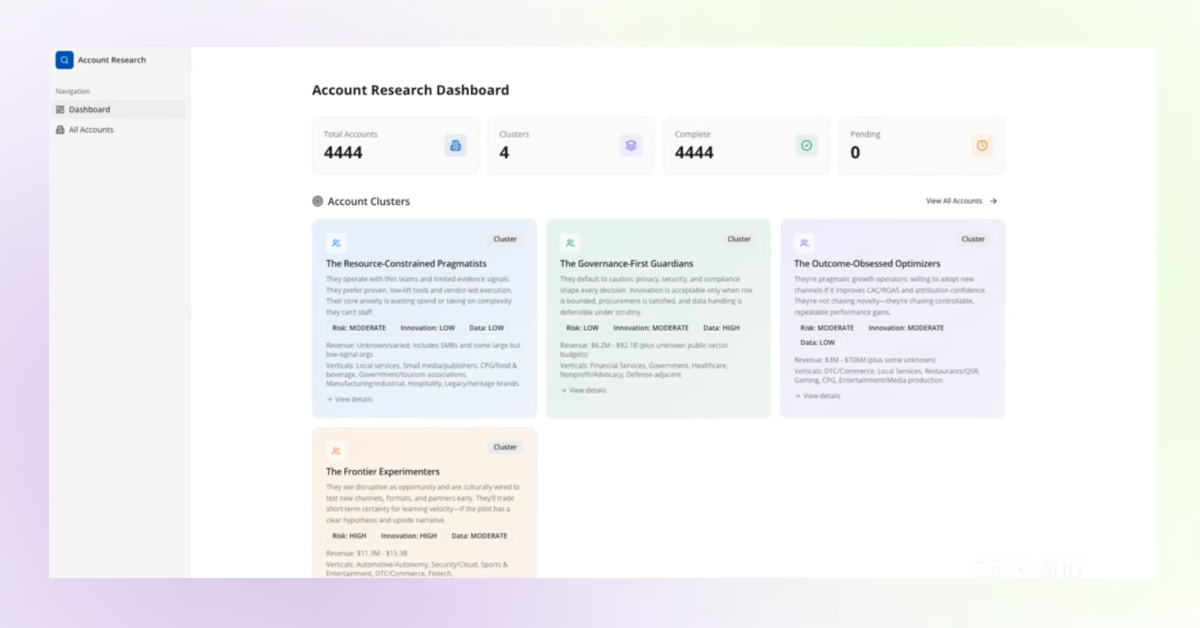
When that all worked, they displayed the results on a Gemini-coded dashboard. This showed account totals, account details, and summaries with commonalities between accounts that made them worth targeting. From that, they selected four clusters.
The result: automated targeting and a flexible list
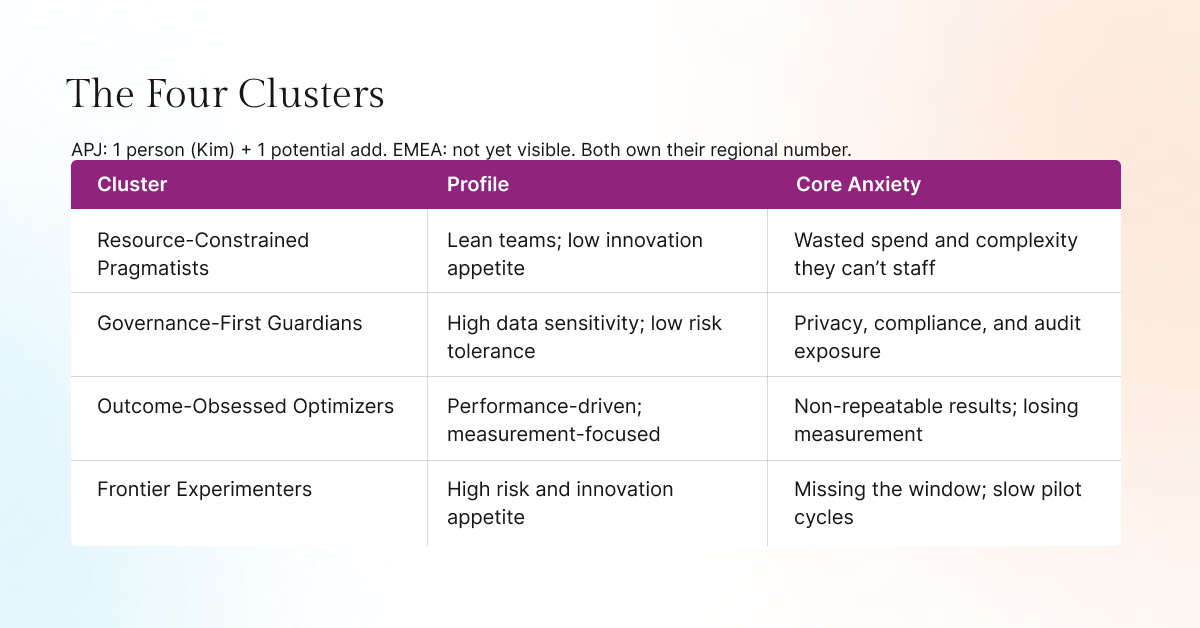
Inverta’s analysis produced four clusters worth targeting that were practical within the client’s time and budget constraints—which seemed to be getting narrower and narrower. Because Erin and Brian had built the dashboard with AI, they could easily tweak the diagrams and explain the decisions that had gone into the selection and update the dashboard mid-meeting.
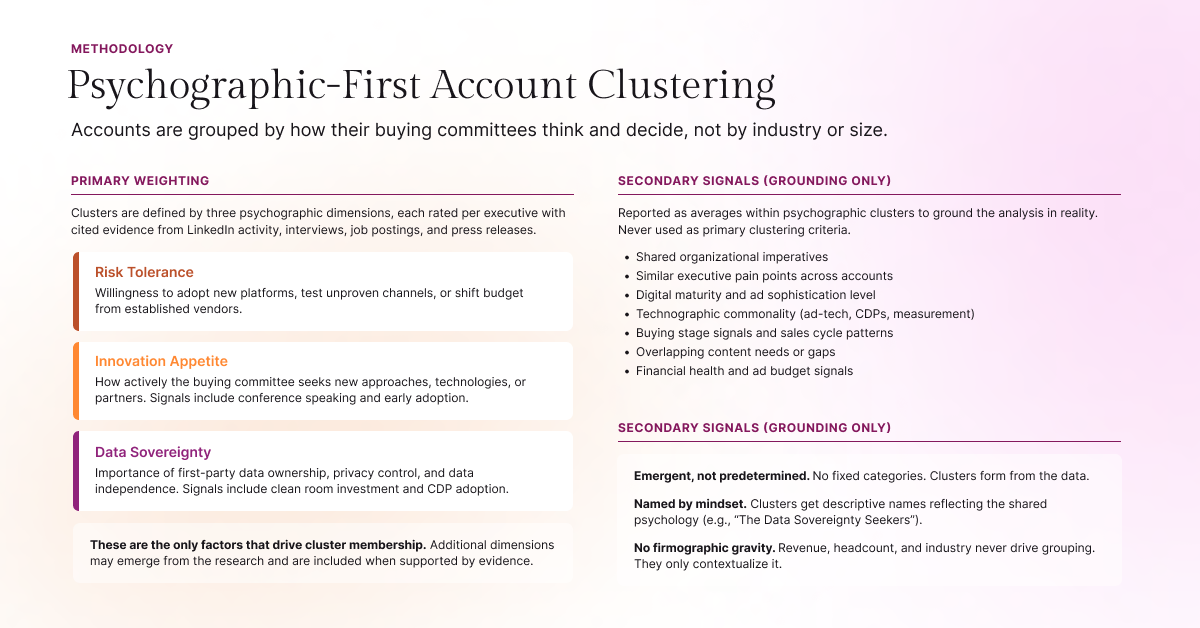
The psychographic data helped them decide cluster membership based on:
- Risk tolerance
- Innovation appetite
- Data sovereignty
They created ratings for each account and for each executive, with evidence to back up that score drawn from their LinkedIn activity, interviews, job postings, and press releases. Erin and Brian used firmographics such as revenue and headcount, but only to contextualize clusters, never to form them.
“We helped them realize that it didn’t really matter if a target was a $1 billion business or a $7 million business, so long as it made decisions the same way,” said Brian. “That’s what was going to make the cluster-level messaging appealing.”
We helped them realize that it didn’t really matter if a target was a $1 billion business or a $7 million business, so long as it made decisions the same way.” - Brian Schmid, AI Practice Lead, Inverta
The resulting clusters were 80% based on account priorities and how they made decisions (shorter cycles), and only 20% on size. It was very different from what Sanxing’s team had produced from their own, and was essentially a “buying group aware” view of their prior list.
Each account had a rating per executive with cited evidence from their LinkedIn activity, interviews, job postings, and press releases.
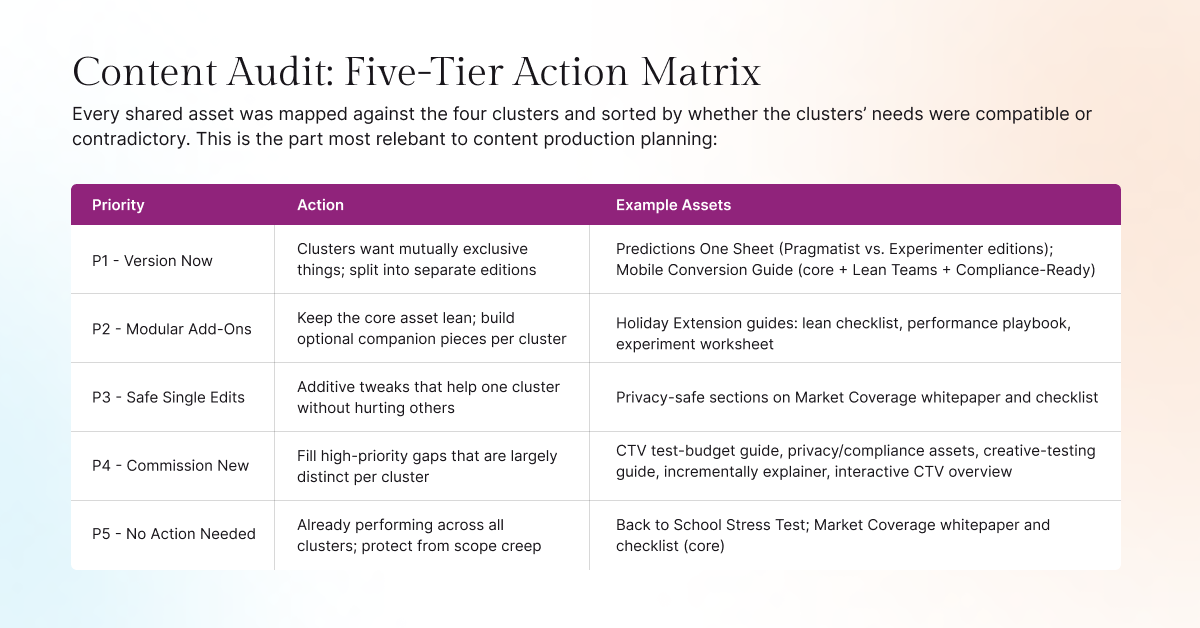
The Inverta team handed over the dashboards so Sanxing could continue to adjust, answer internal questions, and inform its campaigns—which it now had just weeks to get into market.
This is not the UI his team would have built if they had more time, says Brian: “I’ll admit it’s rough, but keep in mind, this was a 30-day sprint to select accounts and move forward with campaigns. It was a strong proof-of-concept of what could exist, and what they could build to refresh the data semi-regularly, and give everyone one view.”
The program is now ongoing
Inverta probably overbuilt some parts of the program—the client was so focused on paid media that they neglected other channels and didn’t get full use of it. At least not immediately. But that’s also part of being a partner and anticipating needs. We built the cluster-selecting system with levers for adjusting the footprint, re-weighting the technographic profile, and asking deeper questions of account and decision-maker psychographics, which they can always return to.
This project met their future needs and created a tool to help them continue expanding when they were ready to return to it.
This was an exercise in helping the team hit a short-term goal, but still helping them build for the future.
About the author
Service page feature

Artificial intelligence


This electronics giant wanted to increase sales on its smart TV ad network. They manufacture a respectable percentage of all smart TVs globally, which can run ads. They had always resold that ad inventory through third parties. Now they wanted to develop that capability internally, to see if they could more efficiently move downmarket.
You see, large enterprises already knew about Sanxing and those accounts were highly competitive. But there were tens of thousands of mid-market companies that had never considered running ads on connected TVs (CTVs), which presented a whitespace opportunity. Leadership wanted to reach those companies, especially the B2B ones.
The great challenge? Sanxing just didn’t have any of the internal acumen. Their marketers were used to speaking to consumer companies and tended to fumble B2B messages. And in terms of targeting, they didn’t know where to begin. So they called upon Inverta to help them build an account-based motion from scratch.
This is an anonymized case study—the names and logo have changed, the story is real.
Building an account-based motion rapidly, with Gemini
Sanxing’s CTV ad-targeting product is among the best in the industry. Whatever their ad sales teams promised, they could typically deliver. Customer demos tended to go well, even if things weren’t quite framed in business-to-business language. So the Inverta team’s initial assessment was that the product and selling motion were solid.
But how would they get in front of new accounts? And what did they need?
“All Sanxing had was a neatly organized content repository for us to draw from and a target list of thousands of companies that they really knew nothing about,” says Brian Schmid, Inverta Consultant and AI Practice Lead. Sanxing wanted to target based only on firmographics, but Brian knew this wouldn’t give a very helpful view, as it wouldn’t offer any insight into which accounts were in-market and which executives were open to innovative new channels.
Brian and the Inverta team laid out a roadmap for gathering the historical sales and third-party data he and the team would need to build clusters that they could reasonably target. They aimed to target groups of meaningful size, but which shared some important characteristics that kept the message sharp and appealing.
As so often happens, too, Sanxing was in a rush. They’d involved us late and needed results faster and on a tighter budget than was realistic—which is why Brian was involved, as our resident AI expert. He and Erin Rampey, Inverta Client Partner, used Gemini to create tools for themselves:
- Workflow diagrams
- Data transformation tools
- A psychographics enrichment tool
- Agents to run analyses
Those tools allowed them to pull in first-party data from the client's CRM, giving the team a foundation of account-level information to work with. But the reality didn't match expectations. Records were inconsistent, riddled with duplicates, missing key fields, and structured in ways that didn't align with how the data needed to be organized for clustering and analysis. Rather than force a flawed dataset through the process, the team made the call to step back, redesign the ingestion and normalization tools, and reprocess the data from scratch — a setback in timeline, but a decision that ultimately protected the integrity of every downstream deliverable.
With a clean first-party foundation in place, the team then layered in third-party psychographic data to move beyond firmographics and understand what these companies actually care about—their strategic priorities, technology investments, and the business challenges shaping their buying behavior. This combination of internal CRM data and external intent and psychographic signals is what made it possible to cluster accounts not just by size or industry, but by shared needs and content relevance.
When that all worked, they displayed the results on a Gemini-coded dashboard. This showed account totals, account details, and summaries with commonalities between accounts that made them worth targeting. From that, they selected four clusters.
The result: automated targeting and a flexible list
Inverta’s analysis produced four clusters worth targeting that were practical within the client’s time and budget constraints—which seemed to be getting narrower and narrower. Because Erin and Brian had built the dashboard with AI, they could easily tweak the diagrams and explain the decisions that had gone into the selection and update the dashboard mid-meeting.
The psychographic data helped them decide cluster membership based on:
- Risk tolerance
- Innovation appetite
- Data sovereignty
They created ratings for each account and for each executive, with evidence to back up that score drawn from their LinkedIn activity, interviews, job postings, and press releases. Erin and Brian used firmographics such as revenue and headcount, but only to contextualize clusters, never to form them.
“We helped them realize that it didn’t really matter if a target was a $1 billion business or a $7 million business, so long as it made decisions the same way,” said Brian. “That’s what was going to make the cluster-level messaging appealing.”
We helped them realize that it didn’t really matter if a target was a $1 billion business or a $7 million business, so long as it made decisions the same way.” - Brian Schmid, AI Practice Lead, Inverta
The resulting clusters were 80% based on account priorities and how they made decisions (shorter cycles), and only 20% on size. It was very different from what Sanxing’s team had produced from their own, and was essentially a “buying group aware” view of their prior list.
Each account had a rating per executive with cited evidence from their LinkedIn activity, interviews, job postings, and press releases.
The Inverta team handed over the dashboards so Sanxing could continue to adjust, answer internal questions, and inform its campaigns—which it now had just weeks to get into market.
This is not the UI his team would have built if they had more time, says Brian: “I’ll admit it’s rough, but keep in mind, this was a 30-day sprint to select accounts and move forward with campaigns. It was a strong proof-of-concept of what could exist, and what they could build to refresh the data semi-regularly, and give everyone one view.”
The program is now ongoing
Inverta probably overbuilt some parts of the program—the client was so focused on paid media that they neglected other channels and didn’t get full use of it. At least not immediately. But that’s also part of being a partner and anticipating needs. We built the cluster-selecting system with levers for adjusting the footprint, re-weighting the technographic profile, and asking deeper questions of account and decision-maker psychographics, which they can always return to.
This project met their future needs and created a tool to help them continue expanding when they were ready to return to it.
This was an exercise in helping the team hit a short-term goal, but still helping them build for the future.
Resources
About the author
Service page feature
Artificial intelligence
Sanxing analyzes 4,444 accounts based on ‘mindset’ in 48 hours

Speakers
Other helpful resources
This electronics giant wanted to increase sales on its smart TV ad network. They manufacture a respectable percentage of all smart TVs globally, which can run ads. They had always resold that ad inventory through third parties. Now they wanted to develop that capability internally, to see if they could more efficiently move downmarket.
You see, large enterprises already knew about Sanxing and those accounts were highly competitive. But there were tens of thousands of mid-market companies that had never considered running ads on connected TVs (CTVs), which presented a whitespace opportunity. Leadership wanted to reach those companies, especially the B2B ones.
The great challenge? Sanxing just didn’t have any of the internal acumen. Their marketers were used to speaking to consumer companies and tended to fumble B2B messages. And in terms of targeting, they didn’t know where to begin. So they called upon Inverta to help them build an account-based motion from scratch.
This is an anonymized case study—the names and logo have changed, the story is real.
Building an account-based motion rapidly, with Gemini
Sanxing’s CTV ad-targeting product is among the best in the industry. Whatever their ad sales teams promised, they could typically deliver. Customer demos tended to go well, even if things weren’t quite framed in business-to-business language. So the Inverta team’s initial assessment was that the product and selling motion were solid.
But how would they get in front of new accounts? And what did they need?
“All Sanxing had was a neatly organized content repository for us to draw from and a target list of thousands of companies that they really knew nothing about,” says Brian Schmid, Inverta Consultant and AI Practice Lead. Sanxing wanted to target based only on firmographics, but Brian knew this wouldn’t give a very helpful view, as it wouldn’t offer any insight into which accounts were in-market and which executives were open to innovative new channels.
Brian and the Inverta team laid out a roadmap for gathering the historical sales and third-party data he and the team would need to build clusters that they could reasonably target. They aimed to target groups of meaningful size, but which shared some important characteristics that kept the message sharp and appealing.
As so often happens, too, Sanxing was in a rush. They’d involved us late and needed results faster and on a tighter budget than was realistic—which is why Brian was involved, as our resident AI expert. He and Erin Rampey, Inverta Client Partner, used Gemini to create tools for themselves:
- Workflow diagrams
- Data transformation tools
- A psychographics enrichment tool
- Agents to run analyses
Those tools allowed them to pull in first-party data from the client's CRM, giving the team a foundation of account-level information to work with. But the reality didn't match expectations. Records were inconsistent, riddled with duplicates, missing key fields, and structured in ways that didn't align with how the data needed to be organized for clustering and analysis. Rather than force a flawed dataset through the process, the team made the call to step back, redesign the ingestion and normalization tools, and reprocess the data from scratch — a setback in timeline, but a decision that ultimately protected the integrity of every downstream deliverable.
With a clean first-party foundation in place, the team then layered in third-party psychographic data to move beyond firmographics and understand what these companies actually care about—their strategic priorities, technology investments, and the business challenges shaping their buying behavior. This combination of internal CRM data and external intent and psychographic signals is what made it possible to cluster accounts not just by size or industry, but by shared needs and content relevance.
When that all worked, they displayed the results on a Gemini-coded dashboard. This showed account totals, account details, and summaries with commonalities between accounts that made them worth targeting. From that, they selected four clusters.
The result: automated targeting and a flexible list
Inverta’s analysis produced four clusters worth targeting that were practical within the client’s time and budget constraints—which seemed to be getting narrower and narrower. Because Erin and Brian had built the dashboard with AI, they could easily tweak the diagrams and explain the decisions that had gone into the selection and update the dashboard mid-meeting.
The psychographic data helped them decide cluster membership based on:
- Risk tolerance
- Innovation appetite
- Data sovereignty
They created ratings for each account and for each executive, with evidence to back up that score drawn from their LinkedIn activity, interviews, job postings, and press releases. Erin and Brian used firmographics such as revenue and headcount, but only to contextualize clusters, never to form them.
“We helped them realize that it didn’t really matter if a target was a $1 billion business or a $7 million business, so long as it made decisions the same way,” said Brian. “That’s what was going to make the cluster-level messaging appealing.”
We helped them realize that it didn’t really matter if a target was a $1 billion business or a $7 million business, so long as it made decisions the same way.” - Brian Schmid, AI Practice Lead, Inverta
The resulting clusters were 80% based on account priorities and how they made decisions (shorter cycles), and only 20% on size. It was very different from what Sanxing’s team had produced from their own, and was essentially a “buying group aware” view of their prior list.
Each account had a rating per executive with cited evidence from their LinkedIn activity, interviews, job postings, and press releases.
The Inverta team handed over the dashboards so Sanxing could continue to adjust, answer internal questions, and inform its campaigns—which it now had just weeks to get into market.
This is not the UI his team would have built if they had more time, says Brian: “I’ll admit it’s rough, but keep in mind, this was a 30-day sprint to select accounts and move forward with campaigns. It was a strong proof-of-concept of what could exist, and what they could build to refresh the data semi-regularly, and give everyone one view.”
The program is now ongoing
Inverta probably overbuilt some parts of the program—the client was so focused on paid media that they neglected other channels and didn’t get full use of it. At least not immediately. But that’s also part of being a partner and anticipating needs. We built the cluster-selecting system with levers for adjusting the footprint, re-weighting the technographic profile, and asking deeper questions of account and decision-maker psychographics, which they can always return to.
This project met their future needs and created a tool to help them continue expanding when they were ready to return to it.
This was an exercise in helping the team hit a short-term goal, but still helping them build for the future.
About the author
Service page feature