Stop guessing which partners are actually driving your pipeline
.svg)

In partnership with:
Featuring
Featuring
How are you going to stand out in 2026?
Buyers are in control of the buying process. Over 70% of it is happening online. And they are putting companies on their short list of vendors that provide value and establish trust with their content.
How are you accounting for this in your 2026 strategy?
You need to stand out. To make sure your buyers notice you. Let us help you build that into your strategy for next year -->

%20(1).webp)

The Revenue Marketer


Stop guessing which partners are actually driving your pipeline
Still chasing 10% efficiency gains?
2023-2025 were the years of experimentation with AI. 2026 is the year to make it transformative. If you're still trying to figure out the strategic advantage AI will bring to your team, we're here to help!

Partner marketing sits around position twenty on most marketing to-do lists. Not because it doesn't matter. Because nobody can prove that it does.
You build the partner portal. You stock it with sales materials. You fund MDF programs that write checks to partners for events, campaigns, and content. Then your CFO asks what any of it produced, and you get back the partner's word for it. Vague sentiments about influence. No real data behind it.
That was the starting point for a recent session Inverta ran alongside our partner at Turtl. Shelly Kulesza, VP of Services at Inverta, and Ben McGill, EVP of Strategic Business Development at Turtl, sat down to talk through where partner programs actually break, and what the fix looks like when you rebuild it right.
Three places. Content, delivery, and reporting. Here's what's wrong with each one, and what to do about it.
Your partner content is technically working and still failing
Walk through how most partner programs hand off content today. A portal. A shared folder. An email with a few links attached as new assets go live. The partner grabs what they need, drops their logo on it, and calls it co-marketing.
That's the whole problem in one sentence. A logo swap is not personalization. The content underneath is identical no matter who receives it, which market they're in, or what they actually care about. A partner selling into healthcare and a partner selling into financial services get the exact same asset, because building it any other way has always meant more budget and more hours nobody has.
The content isn't broken because it's poorly written. It's broken because it was never built to flex.
"I think that that is where the problem sits. It's in the infrastructure of how you think about that content and how it's actually built to be meaningful to the prospect that you and your partner are trying to attract." - Shelly Kulesza, VP of Services, Inverta
The one-size-fits-all motion is dead, and the PDF proves it
Delivery has the same root problem as content, just further downstream. Most programs still push the same static file to every partner, for every prospect, regardless of what that prospect actually needs to see next.
And the file itself hasn't changed much in three decades. The PDF is over thirty years old. It wasn't built for a digital-first buying process, and it doesn't do anything to earn attention in one. Prospects expect an interactive, current experience at the first touch point. Most partner programs are still handing them a flat document instead.
Add in the fact that partner assets rarely get updated once they're published, and you end up with thousands of documents circulating that are outdated the moment a product roadmap or pricing structure shifts.
You can't defend MDF spend with vibes
Here's the piece that turns content and delivery gaps into a budget problem: reporting is how you'd know whether either one is actually working, and most programs have none.
No visibility into engagement means you're guessing which assets are worth funding again. Guessing which partners need more support. Guessing whether last quarter's MDF dollars did anything at all.
That guesswork used to be tolerable. It isn't anymore. CFOs are increasingly making MDF funding conditional on being able to see real attribution, not a partner's self-reported summary. If your CRO asks what the channel is actually doing for pipeline growth and you can't answer with data, that's not a reporting gap. That's a budget line at risk.
You can't run a program anymore that you can't measure.
Personalize by account, not just by partner
The fix on the content side starts with a shift in what "personalized" actually means. Most programs personalize at the partner level: swap the logo, maybe the contact name. That's step one of twelve, not the finish line.
Real personalization happens at the account level. Build content around the partner's specific target, their vertical, their buyer's actual pain points. A healthcare prospect and a financial services prospect should never be reading the same asset with different names dropped in. Budgets are tight and teams are stretched, which is exactly why this has to be built into the infrastructure rather than handled manually, asset by asset.
Build content that updates itself, not campaigns you refresh once a year
On delivery, the winners are moving toward formats that are modular, interactive, and built to flex per audience instead of static and one-size-fits-all. Just as important: content needs to be always on. Pricing changes, case studies age out, product names shift. A library of thousands of assets has to stay current without a manual refresh cycle, or you're back to distributing content nobody should be sending.
Measurement is not a dashboard, it's an improvement mechanism
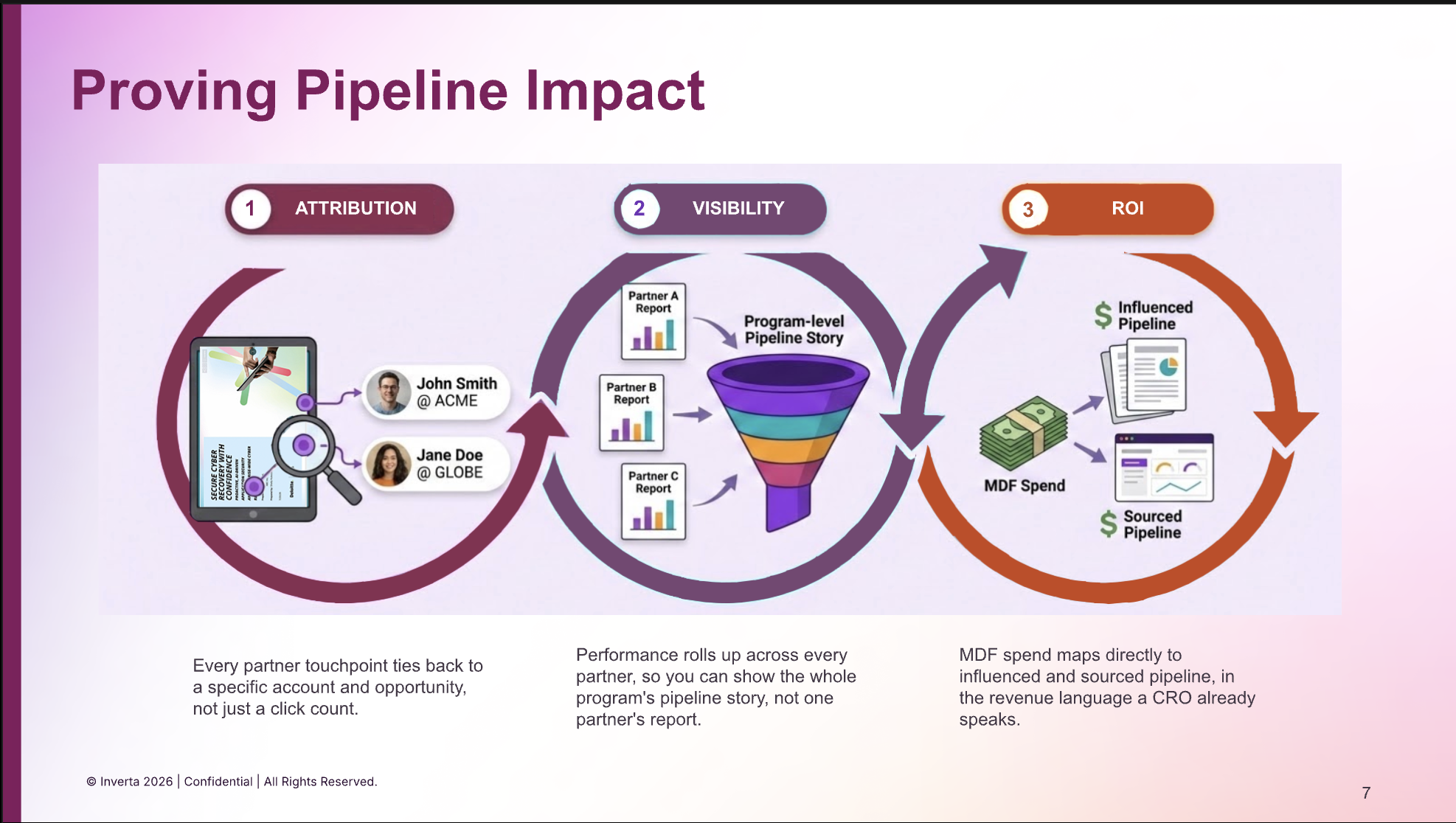
The real value of reporting isn't the dashboard. It's what the dashboard lets you do while a program is still live. When every partner's performance rolls up into one place instead of sitting in a dozen siloed reports you're stitching together by hand, you can see in real time which partners and accounts are actually moving, and shift attention and MDF dollars toward what's working before the quarter closes. That's the difference between reporting on a program after the fact and running one that improves itself as it goes.
And the connection has to go all the way to revenue. If you can tie engagement on a specific asset to a specific deal in the pipeline, attribution stops being a guess and starts being a number your CFO will actually accept.
What this looks like in practice
Ben walked the audience through a live demo of both pieces working together. First, a manually personalized document: a six-chapter go-to-market asset built jointly by an OEM and a partner, with personalization tokens built in for audience, industry, pain points, and case studies. Complete the fields once, and the platform generates a fully branded, tailored version in a matter of seconds.
Then he showed what happens at scale. A CSV of account data, up to 20,000 rows, mapped directly to the same personalization tokens. One batch run, and the platform generated 124 unique, fully personalized documents in a couple of minutes. Each one went from a generic sixteen-chapter master file down to eight sections built specifically for that account's industry, region, and product interest.
The reporting layer is where this earns its keep. Instead of basic opens and clicks, the platform showed reader-level detail: total read time, how many times a specific contact opened the asset, which chapters got attention, and what percentage of the document they actually consumed. One example from the demo: a prospect named Ivan opened the asset four times, spent close to four minutes reading on average, shared it once, and made it through 78 percent of the content. That's not a vague sentiment of influence. That's a specific, defensible signal that a specific person is in market.
Three things to take back to your program
Shelly and Ben closed with three takeaways, and they're worth pulling out on their own:
First, this proves pipeline movement by partner and by program, not just in aggregate, which means you can finally answer your CRO's question about what the channel is actually doing.
Second, it attributes MDF spend directly to pipeline and revenue, which makes the internal case for next quarter's budget far easier to build.
Third, none of this requires a bigger team. Redesigning content as modular and scalable lets you service hundreds or thousands of partners with hyper-personalized content, at a manageable cost, with the resources you already have.
The pace of change here is fast, and it's being pushed by the same pressure every marketing org is feeling: prove it, or lose the budget. Partner marketing doesn't have to stay on an island, guessing at its own value. The programs winning right now are the ones that built the proof in from the start.
Want to see what this could look like for your partner program?
Reach out to Inverta's partner marketing team to talk through where your content, delivery, and reporting are breaking down today.
About the author
Service page feature

Demand gen


Partner marketing sits around position twenty on most marketing to-do lists. Not because it doesn't matter. Because nobody can prove that it does.
You build the partner portal. You stock it with sales materials. You fund MDF programs that write checks to partners for events, campaigns, and content. Then your CFO asks what any of it produced, and you get back the partner's word for it. Vague sentiments about influence. No real data behind it.
That was the starting point for a recent session Inverta ran alongside our partner at Turtl. Shelly Kulesza, VP of Services at Inverta, and Ben McGill, EVP of Strategic Business Development at Turtl, sat down to talk through where partner programs actually break, and what the fix looks like when you rebuild it right.
Three places. Content, delivery, and reporting. Here's what's wrong with each one, and what to do about it.
Your partner content is technically working and still failing
Walk through how most partner programs hand off content today. A portal. A shared folder. An email with a few links attached as new assets go live. The partner grabs what they need, drops their logo on it, and calls it co-marketing.
That's the whole problem in one sentence. A logo swap is not personalization. The content underneath is identical no matter who receives it, which market they're in, or what they actually care about. A partner selling into healthcare and a partner selling into financial services get the exact same asset, because building it any other way has always meant more budget and more hours nobody has.
The content isn't broken because it's poorly written. It's broken because it was never built to flex.
"I think that that is where the problem sits. It's in the infrastructure of how you think about that content and how it's actually built to be meaningful to the prospect that you and your partner are trying to attract." - Shelly Kulesza, VP of Services, Inverta
The one-size-fits-all motion is dead, and the PDF proves it
Delivery has the same root problem as content, just further downstream. Most programs still push the same static file to every partner, for every prospect, regardless of what that prospect actually needs to see next.
And the file itself hasn't changed much in three decades. The PDF is over thirty years old. It wasn't built for a digital-first buying process, and it doesn't do anything to earn attention in one. Prospects expect an interactive, current experience at the first touch point. Most partner programs are still handing them a flat document instead.
Add in the fact that partner assets rarely get updated once they're published, and you end up with thousands of documents circulating that are outdated the moment a product roadmap or pricing structure shifts.
You can't defend MDF spend with vibes
Here's the piece that turns content and delivery gaps into a budget problem: reporting is how you'd know whether either one is actually working, and most programs have none.
No visibility into engagement means you're guessing which assets are worth funding again. Guessing which partners need more support. Guessing whether last quarter's MDF dollars did anything at all.
That guesswork used to be tolerable. It isn't anymore. CFOs are increasingly making MDF funding conditional on being able to see real attribution, not a partner's self-reported summary. If your CRO asks what the channel is actually doing for pipeline growth and you can't answer with data, that's not a reporting gap. That's a budget line at risk.
You can't run a program anymore that you can't measure.
Personalize by account, not just by partner
The fix on the content side starts with a shift in what "personalized" actually means. Most programs personalize at the partner level: swap the logo, maybe the contact name. That's step one of twelve, not the finish line.
Real personalization happens at the account level. Build content around the partner's specific target, their vertical, their buyer's actual pain points. A healthcare prospect and a financial services prospect should never be reading the same asset with different names dropped in. Budgets are tight and teams are stretched, which is exactly why this has to be built into the infrastructure rather than handled manually, asset by asset.
Build content that updates itself, not campaigns you refresh once a year
On delivery, the winners are moving toward formats that are modular, interactive, and built to flex per audience instead of static and one-size-fits-all. Just as important: content needs to be always on. Pricing changes, case studies age out, product names shift. A library of thousands of assets has to stay current without a manual refresh cycle, or you're back to distributing content nobody should be sending.
Measurement is not a dashboard, it's an improvement mechanism
The real value of reporting isn't the dashboard. It's what the dashboard lets you do while a program is still live. When every partner's performance rolls up into one place instead of sitting in a dozen siloed reports you're stitching together by hand, you can see in real time which partners and accounts are actually moving, and shift attention and MDF dollars toward what's working before the quarter closes. That's the difference between reporting on a program after the fact and running one that improves itself as it goes.
And the connection has to go all the way to revenue. If you can tie engagement on a specific asset to a specific deal in the pipeline, attribution stops being a guess and starts being a number your CFO will actually accept.
What this looks like in practice
Ben walked the audience through a live demo of both pieces working together. First, a manually personalized document: a six-chapter go-to-market asset built jointly by an OEM and a partner, with personalization tokens built in for audience, industry, pain points, and case studies. Complete the fields once, and the platform generates a fully branded, tailored version in a matter of seconds.
Then he showed what happens at scale. A CSV of account data, up to 20,000 rows, mapped directly to the same personalization tokens. One batch run, and the platform generated 124 unique, fully personalized documents in a couple of minutes. Each one went from a generic sixteen-chapter master file down to eight sections built specifically for that account's industry, region, and product interest.
The reporting layer is where this earns its keep. Instead of basic opens and clicks, the platform showed reader-level detail: total read time, how many times a specific contact opened the asset, which chapters got attention, and what percentage of the document they actually consumed. One example from the demo: a prospect named Ivan opened the asset four times, spent close to four minutes reading on average, shared it once, and made it through 78 percent of the content. That's not a vague sentiment of influence. That's a specific, defensible signal that a specific person is in market.
Three things to take back to your program
Shelly and Ben closed with three takeaways, and they're worth pulling out on their own:
First, this proves pipeline movement by partner and by program, not just in aggregate, which means you can finally answer your CRO's question about what the channel is actually doing.
Second, it attributes MDF spend directly to pipeline and revenue, which makes the internal case for next quarter's budget far easier to build.
Third, none of this requires a bigger team. Redesigning content as modular and scalable lets you service hundreds or thousands of partners with hyper-personalized content, at a manageable cost, with the resources you already have.
The pace of change here is fast, and it's being pushed by the same pressure every marketing org is feeling: prove it, or lose the budget. Partner marketing doesn't have to stay on an island, guessing at its own value. The programs winning right now are the ones that built the proof in from the start.
Want to see what this could look like for your partner program?
Reach out to Inverta's partner marketing team to talk through where your content, delivery, and reporting are breaking down today.
Resources
About the author
Service page feature
Demand gen
Stop guessing which partners are actually driving your pipeline


Speakers
Other helpful resources
Partner marketing sits around position twenty on most marketing to-do lists. Not because it doesn't matter. Because nobody can prove that it does.
You build the partner portal. You stock it with sales materials. You fund MDF programs that write checks to partners for events, campaigns, and content. Then your CFO asks what any of it produced, and you get back the partner's word for it. Vague sentiments about influence. No real data behind it.
That was the starting point for a recent session Inverta ran alongside our partner at Turtl. Shelly Kulesza, VP of Services at Inverta, and Ben McGill, EVP of Strategic Business Development at Turtl, sat down to talk through where partner programs actually break, and what the fix looks like when you rebuild it right.
Three places. Content, delivery, and reporting. Here's what's wrong with each one, and what to do about it.
Your partner content is technically working and still failing
Walk through how most partner programs hand off content today. A portal. A shared folder. An email with a few links attached as new assets go live. The partner grabs what they need, drops their logo on it, and calls it co-marketing.
That's the whole problem in one sentence. A logo swap is not personalization. The content underneath is identical no matter who receives it, which market they're in, or what they actually care about. A partner selling into healthcare and a partner selling into financial services get the exact same asset, because building it any other way has always meant more budget and more hours nobody has.
The content isn't broken because it's poorly written. It's broken because it was never built to flex.
"I think that that is where the problem sits. It's in the infrastructure of how you think about that content and how it's actually built to be meaningful to the prospect that you and your partner are trying to attract." - Shelly Kulesza, VP of Services, Inverta
The one-size-fits-all motion is dead, and the PDF proves it
Delivery has the same root problem as content, just further downstream. Most programs still push the same static file to every partner, for every prospect, regardless of what that prospect actually needs to see next.
And the file itself hasn't changed much in three decades. The PDF is over thirty years old. It wasn't built for a digital-first buying process, and it doesn't do anything to earn attention in one. Prospects expect an interactive, current experience at the first touch point. Most partner programs are still handing them a flat document instead.
Add in the fact that partner assets rarely get updated once they're published, and you end up with thousands of documents circulating that are outdated the moment a product roadmap or pricing structure shifts.
You can't defend MDF spend with vibes
Here's the piece that turns content and delivery gaps into a budget problem: reporting is how you'd know whether either one is actually working, and most programs have none.
No visibility into engagement means you're guessing which assets are worth funding again. Guessing which partners need more support. Guessing whether last quarter's MDF dollars did anything at all.
That guesswork used to be tolerable. It isn't anymore. CFOs are increasingly making MDF funding conditional on being able to see real attribution, not a partner's self-reported summary. If your CRO asks what the channel is actually doing for pipeline growth and you can't answer with data, that's not a reporting gap. That's a budget line at risk.
You can't run a program anymore that you can't measure.
Personalize by account, not just by partner
The fix on the content side starts with a shift in what "personalized" actually means. Most programs personalize at the partner level: swap the logo, maybe the contact name. That's step one of twelve, not the finish line.
Real personalization happens at the account level. Build content around the partner's specific target, their vertical, their buyer's actual pain points. A healthcare prospect and a financial services prospect should never be reading the same asset with different names dropped in. Budgets are tight and teams are stretched, which is exactly why this has to be built into the infrastructure rather than handled manually, asset by asset.
Build content that updates itself, not campaigns you refresh once a year
On delivery, the winners are moving toward formats that are modular, interactive, and built to flex per audience instead of static and one-size-fits-all. Just as important: content needs to be always on. Pricing changes, case studies age out, product names shift. A library of thousands of assets has to stay current without a manual refresh cycle, or you're back to distributing content nobody should be sending.
Measurement is not a dashboard, it's an improvement mechanism
The real value of reporting isn't the dashboard. It's what the dashboard lets you do while a program is still live. When every partner's performance rolls up into one place instead of sitting in a dozen siloed reports you're stitching together by hand, you can see in real time which partners and accounts are actually moving, and shift attention and MDF dollars toward what's working before the quarter closes. That's the difference between reporting on a program after the fact and running one that improves itself as it goes.
And the connection has to go all the way to revenue. If you can tie engagement on a specific asset to a specific deal in the pipeline, attribution stops being a guess and starts being a number your CFO will actually accept.
What this looks like in practice
Ben walked the audience through a live demo of both pieces working together. First, a manually personalized document: a six-chapter go-to-market asset built jointly by an OEM and a partner, with personalization tokens built in for audience, industry, pain points, and case studies. Complete the fields once, and the platform generates a fully branded, tailored version in a matter of seconds.
Then he showed what happens at scale. A CSV of account data, up to 20,000 rows, mapped directly to the same personalization tokens. One batch run, and the platform generated 124 unique, fully personalized documents in a couple of minutes. Each one went from a generic sixteen-chapter master file down to eight sections built specifically for that account's industry, region, and product interest.
The reporting layer is where this earns its keep. Instead of basic opens and clicks, the platform showed reader-level detail: total read time, how many times a specific contact opened the asset, which chapters got attention, and what percentage of the document they actually consumed. One example from the demo: a prospect named Ivan opened the asset four times, spent close to four minutes reading on average, shared it once, and made it through 78 percent of the content. That's not a vague sentiment of influence. That's a specific, defensible signal that a specific person is in market.
Three things to take back to your program
Shelly and Ben closed with three takeaways, and they're worth pulling out on their own:
First, this proves pipeline movement by partner and by program, not just in aggregate, which means you can finally answer your CRO's question about what the channel is actually doing.
Second, it attributes MDF spend directly to pipeline and revenue, which makes the internal case for next quarter's budget far easier to build.
Third, none of this requires a bigger team. Redesigning content as modular and scalable lets you service hundreds or thousands of partners with hyper-personalized content, at a manageable cost, with the resources you already have.
The pace of change here is fast, and it's being pushed by the same pressure every marketing org is feeling: prove it, or lose the budget. Partner marketing doesn't have to stay on an island, guessing at its own value. The programs winning right now are the ones that built the proof in from the start.
Want to see what this could look like for your partner program?
Reach out to Inverta's partner marketing team to talk through where your content, delivery, and reporting are breaking down today.
About the author
Service page feature