How smart marketers KILL their best campaigns

In partnership with:
Featuring
Featuring
How are you going to stand out in 2026?
Buyers are in control of the buying process. Over 70% of it is happening online. And they are putting companies on their short list of vendors that provide value and establish trust with their content.
How are you accounting for this in your 2026 strategy?
You need to stand out. To make sure your buyers notice you. Let us help you build that into your strategy for next year -->


The Revenue Marketer

How smart marketers KILL their best campaigns
Still chasing 10% efficiency gains?
2023-2025 were the years of experimentation with AI. 2026 is the year to make it transformative. If you're still trying to figure out the strategic advantage AI will bring to your team, we're here to help!

Consider the following taglines. Consider that millions of dollars of thinking went into writing them. Do any leave you inspired? Do any stand out as truly differentiated?
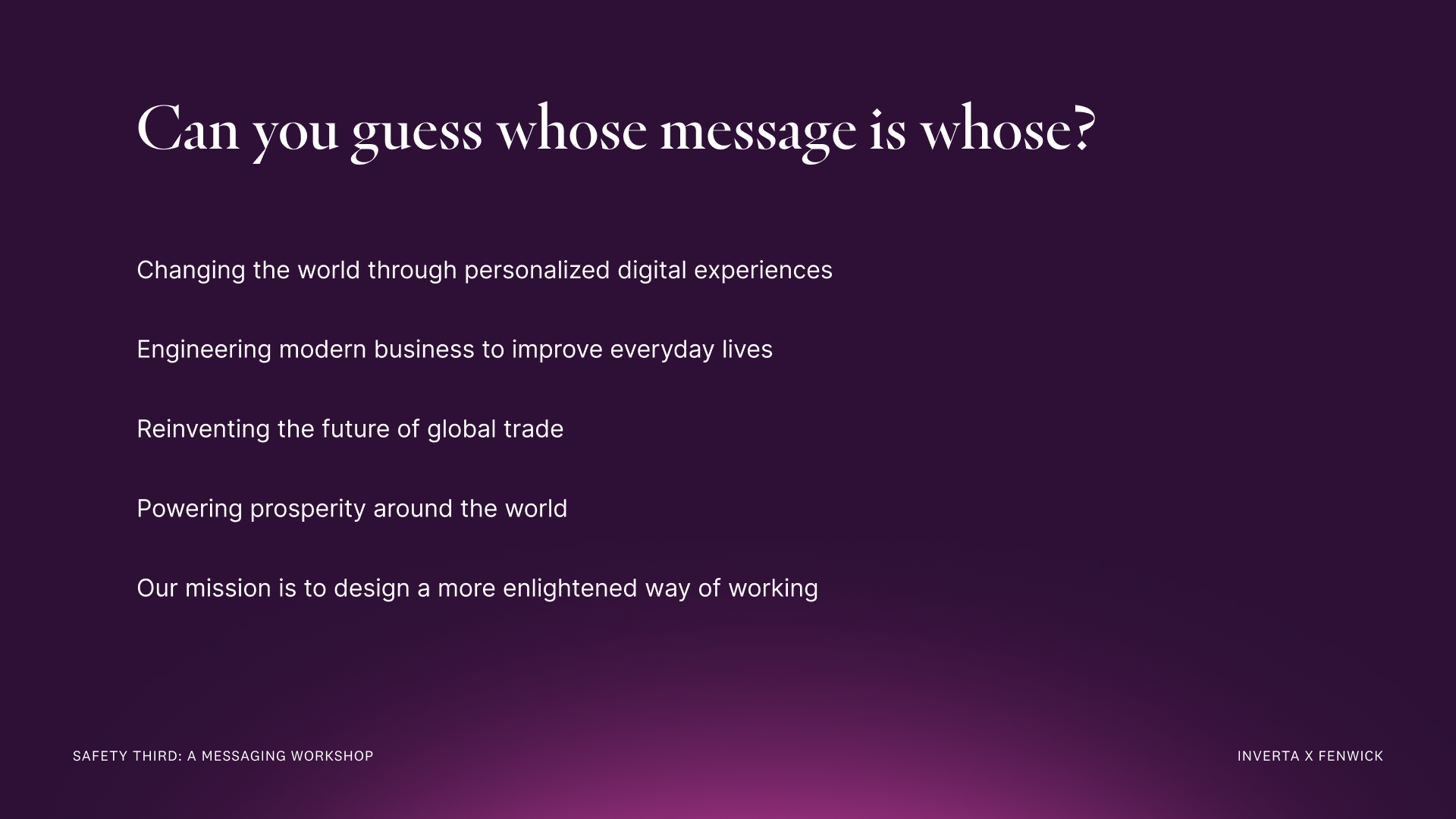
I’ll explain why that happens. The way a company is organized dictates how it communicates. If your company has a lot of products, I’ll bet it uses lots of acronyms and Trademarked Names™. If your company thrives on longwinded internal memos, it probably sends longwinded external emails. This is why big companies make worse campaigns—and mission statements like you see above.
This naturally hurts their conversions. In fact, they tend to kill their best campaign ideas before they even get made. I've written for and advised major technology enterprises like Salesforce, Shopify, and Google where I’ve seen this over and over. But not always. Some of these teams still produce clear campaigns—and I’ll explain step by step.
This is based on a talk Fenwick gave with Inverta, Why Creative Risk-Takers Win.
How smart marketers accidentally kill their own best campaign ideas
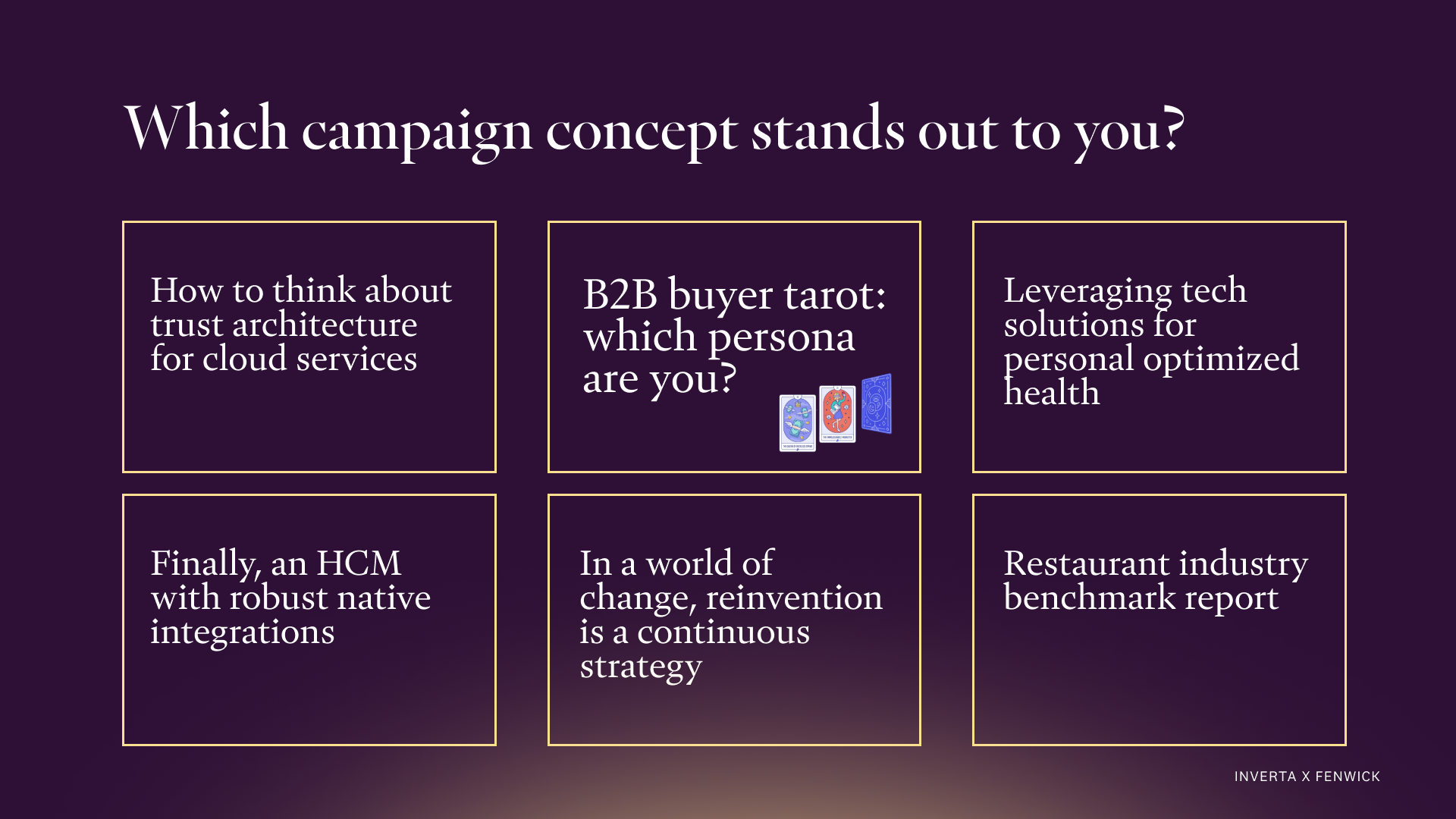
Which of these campaign concepts stands out to you? Yes it’s a bit reductive, but obviously, one does, no? That’s precisely what your team is trying to do. Stand out in an achingly boring sea of sameness.
So what is between you and that goal?

Probably, a whole heck of a lot.
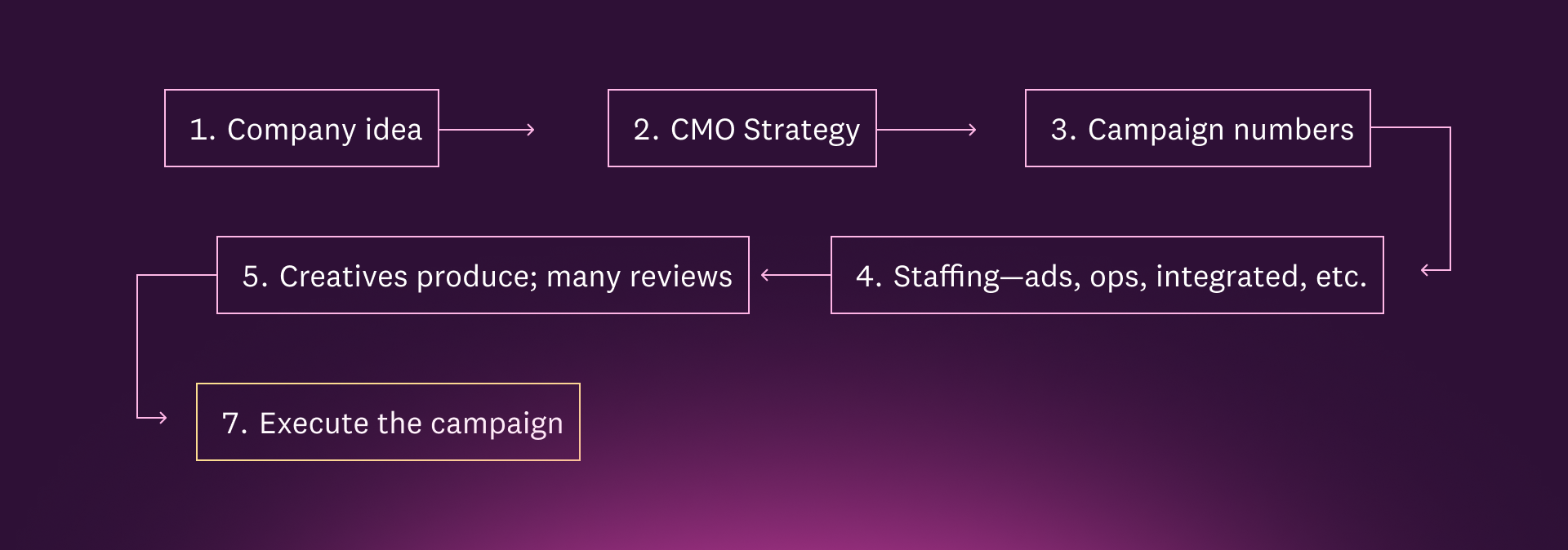
The steps in your workflow are a direct reflection of how your company is organized. If it isn't meticulously organized, probably, this process is a mess. Probably, too many people weigh in, there isn't clear ownership, teams pile on unrelated goals and requirements, and nobody realizes all this input is just leading the campaign astray. And—listen up—the greater a company’s focus on “shareholder value,” the less focus on buyer experience. And also the less likely the creative team is involved in key decisions.
This is bad because the creative team is the only one with any incentive to care deeply about what resonates with buyers. They are the only ones who can know, before it launches, if your campaign will stand out.
If your company does not correct for this, the committee will over-critique the creative team's “different” ideas until they are exactly the same.
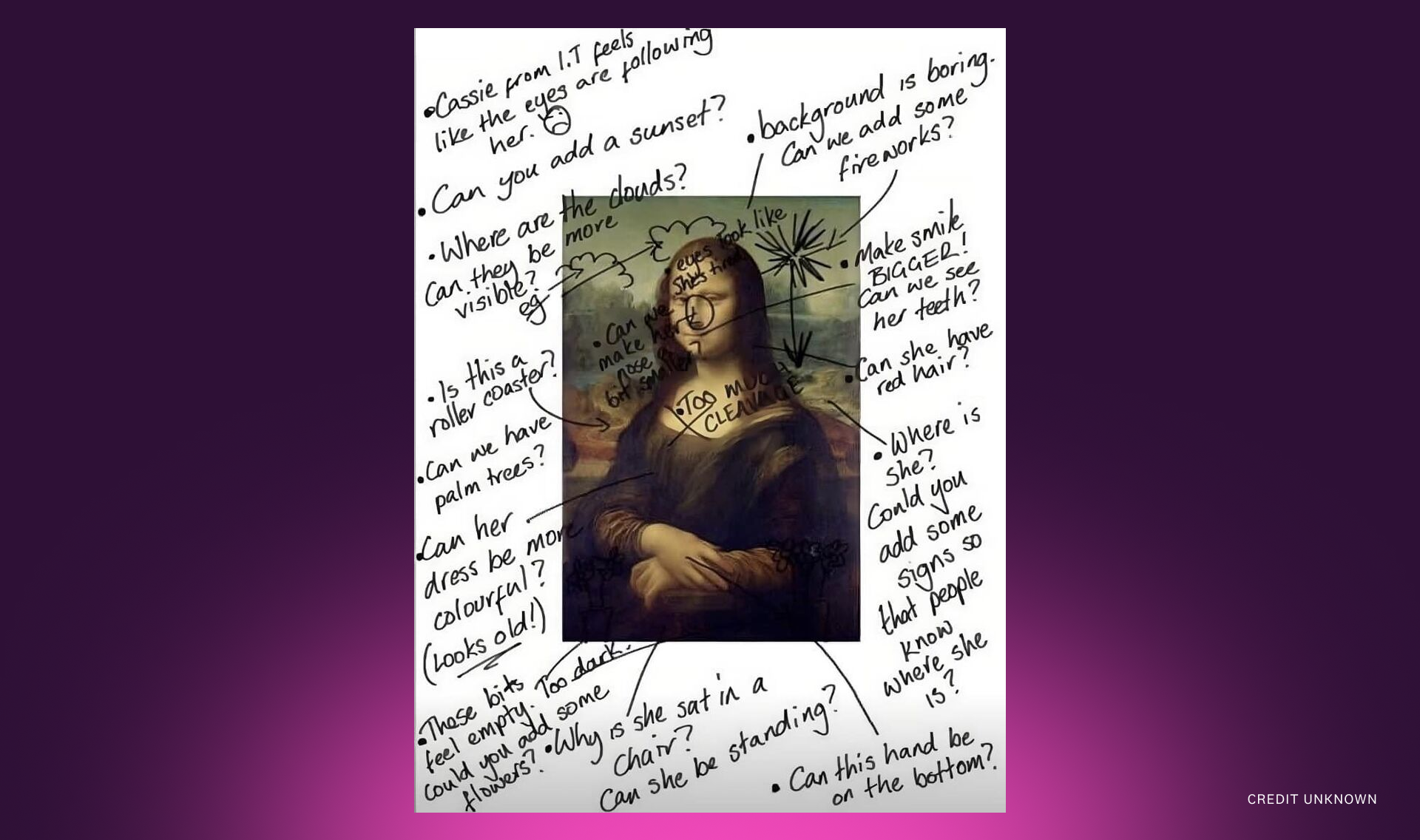
You can think of your review process as a machine. Machines do what they’re built to do. What is yours built for? Is it designed to help with your marketing goal of differentiation? Or is it a "let's please everybody equally, especially higher ups who don't have context" consensus machine?
Consensus is at odds with quality. Consensus is how you appease the legal team’s impossible desire for zero risk and churn out Yet Another Whitepaper Nobody Sees (YAWNS for short). It produces derivative, safe campaigns that blend in entirely.
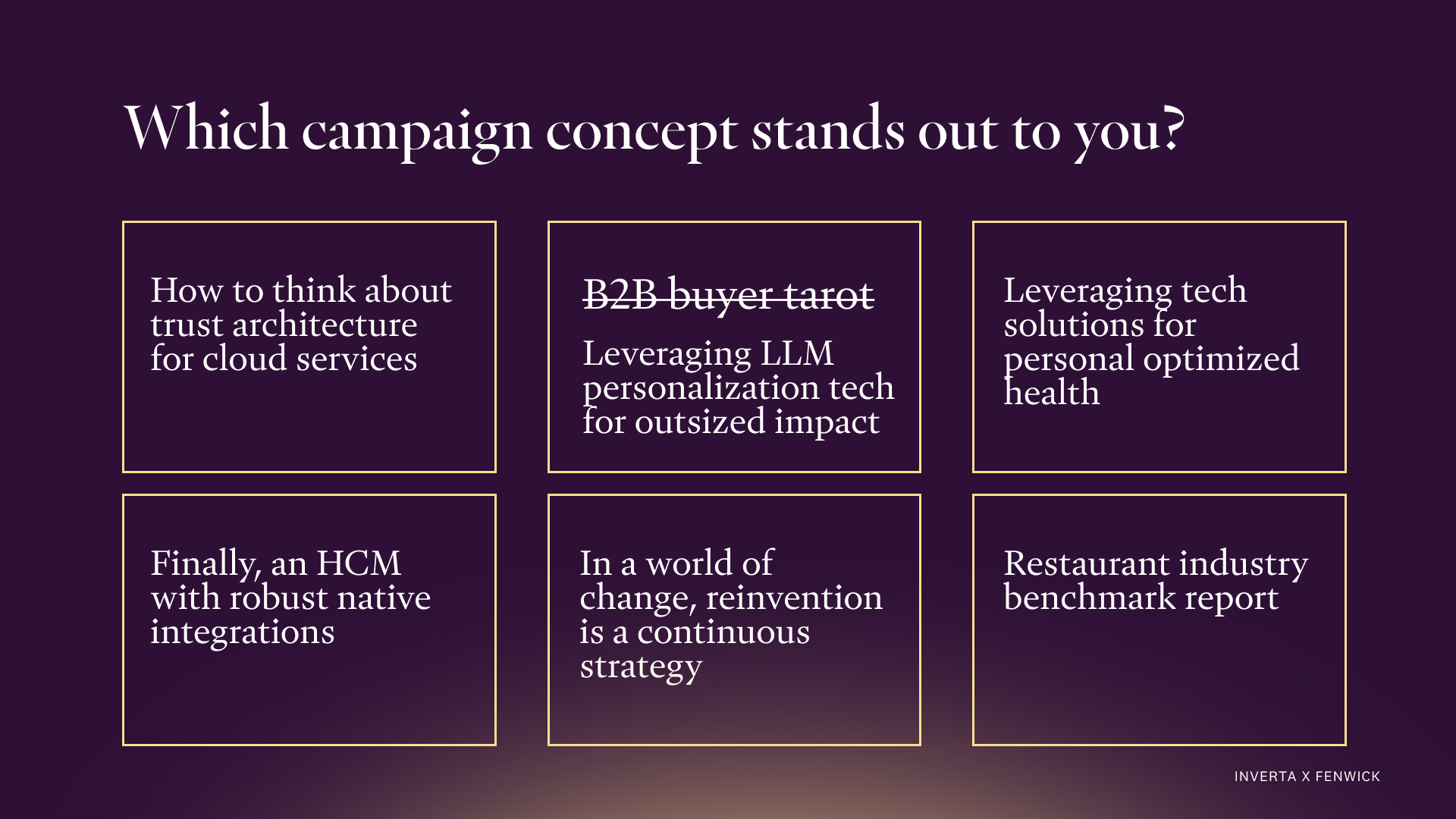
But of course, it's fixable. With a strong campaign process, you can create that clarity, define those roles, and while it may add steps, the net result is you arrive at differentiation—not consensus.
How some teams protect their creative concepts
Most big companies eventually just outsource creative work to an agency. Outside teams aren’t beholden to all the same goals, performance reviews, meetings, and measures, and can have the audacity to say and do things that don’t satisfy every internal stakeholder. But you don't need a partner. You need conviction.
Here are principles for preserving your differentiated campaign ideas:
1. Put a creative in charge of the campaign
They can solicit input from everyone, but they have the ultimate say. Without this person weighing all input against your goal—differentiation, awareness, and interest—the pile-on only produces slop. They can ask:
- What’s happening in our buyer’s world right now?
- How does this fit in?
- Why is this useful to them, before it’s useful to us?
- Creatively, does this stand out?
- Is it memorable?
- Is it effective?
Rewrite your campaign workflow to put their part upfront. Strive to generate something genuinely valuable to your buyers, then worry about internal stakeholders.
2. Run a creative pitch processes
Creatives don't always get it right on the first try—that is part of the creative process, trying many things out and feeling into what works. That's why you should ask them for three campaign concepts: deck slides with a few bullet points and visual examples.
Let them run the process of walking everyone involved through those concepts then taking an "open" vote, where people share their thoughts live so others can hear. Let the creatives develop the winning concept.
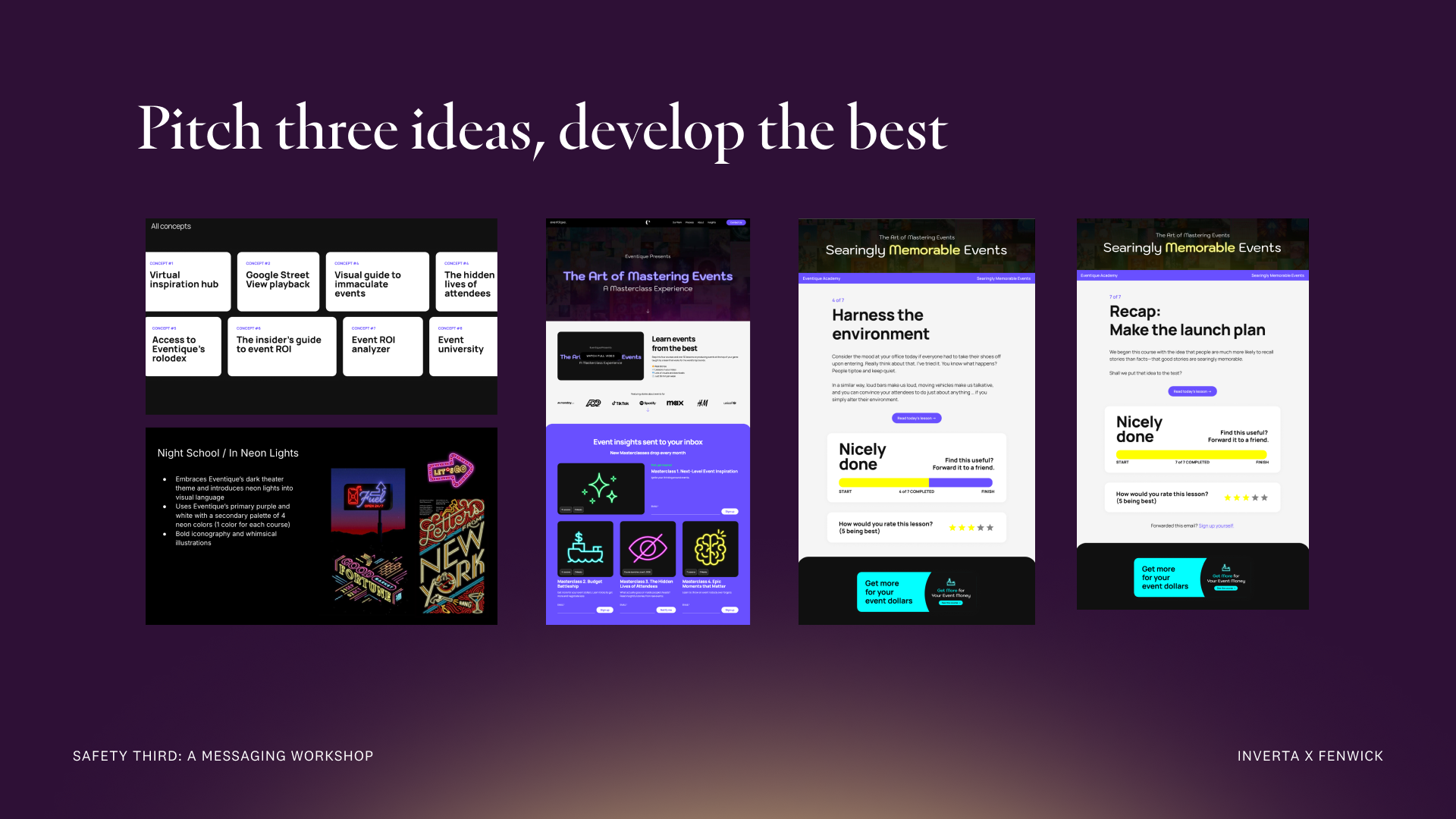
Now, sometimes the resulting ideas will be scarily differentiated. It may feel to everyone like a hair-raising risk. This is good! If you are having an emotional reaction to a concept, it has power. That means it will have power to your audience.
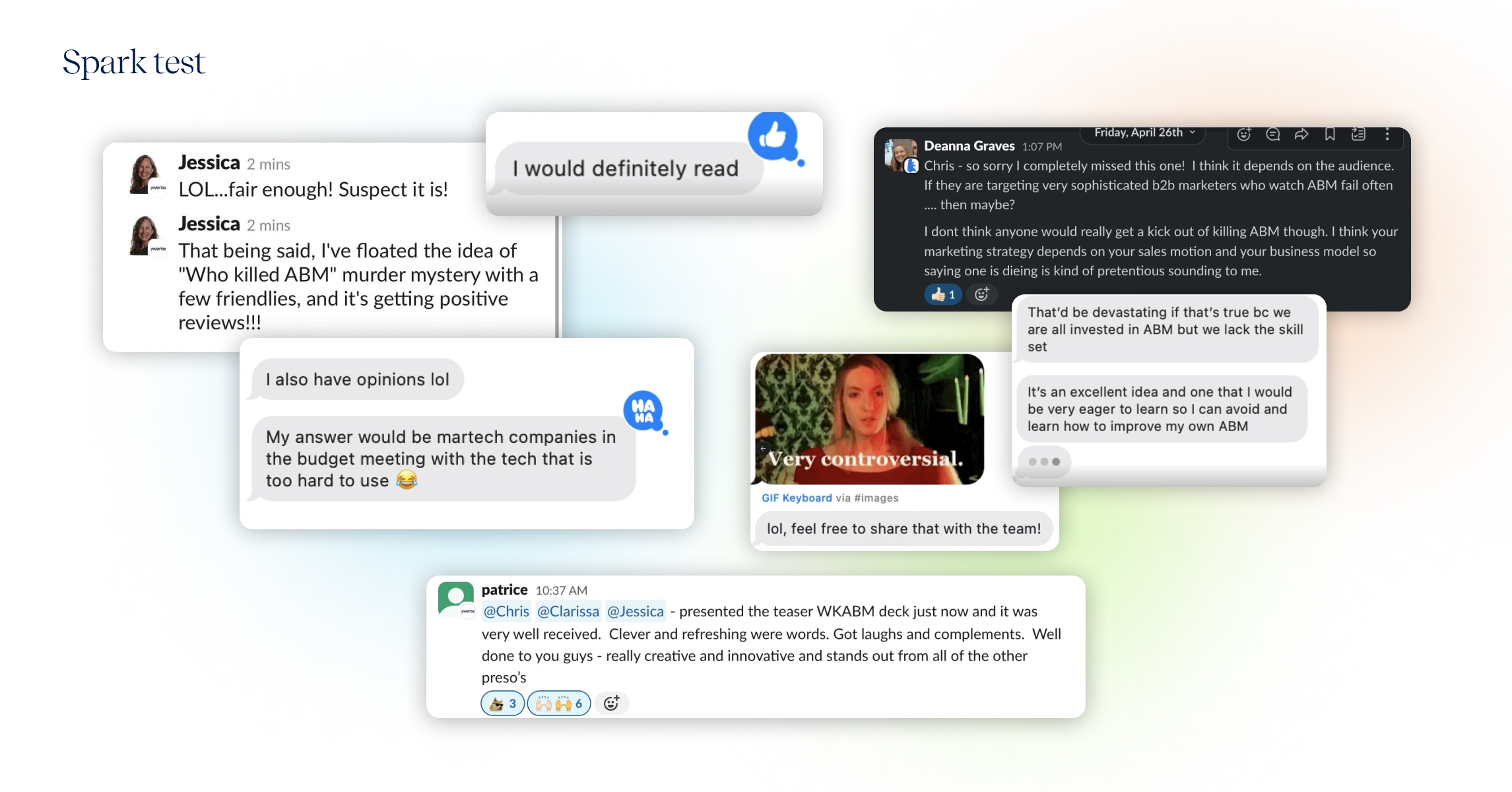
If you are worried you've gone to far (you almost never can in B2B), run what we at Fenwick call "spark tests." Show those early concepts to customers or buyer lookalikes. Ask them, does this make sense? Which of these do you prefer, if any? What’s unclear, and what would be more useful or interesting?
3. Limit creative reviews to 3 credible parties only
Select a campaign committee of just three people. This probably sounds insane. But if you are asking me, "How do we have a breakout campaign like such and such competitor?" this is how. The more opinions, the worse the campaign. Consensus kills quality. And while everyone will want to be helpful and have opinions, they aren't all equally credible to know what buyers will react to.
In fact, most of them have conflicts of interest. They need to hit their own numbers and don't realize their input is making the campaign less clear in service of that—by adding Trademarked Names™ and calls to action and lists of benefits.
Do not suffer it. Violate this principle at your own risk. (This is an area where it's actually helpful to have an agency. You can blame those nattily-dressed eccentrics.)
4. Market your best marketing
If the process starts to fall apart and descend into boring mediocrity, ask everyone to go collect examples of their favorite marketing your company has done, and that they’ve simply seen out in the world. Bring everyone together to share what they found and discuss. It is guaranteed that whatever they resonated with did not get ground down by committee. When everyone asks, “Let’s do more of what so and so is doing,” remind them that the above process is how you do that.
Save your best ideas—stop the committee before it starts
If you don’t change how your campaign workflow occurs, it’s going to keep quashing creative ideas. When too many people enter with too many conflicting ideas, reviews reliably produce rubbish. Consensus is at odds with quality. And even if you can’t stop it happening at the organization level, you can stop it on your team.
Invite your creatives into the conversation with your campaign team, and set a goal: Redo an existing campaign to be creative. It’s a cheap test to run, allowing the creatives to go off and pull in outside inspiration, for a potentially large payoff. Instead of boring audiences to death with a minimally-offensive, legally-approved scarecrow, show them something that dares to be a lion.
Oh and by the way, here’s who those taglines are from.

About the author
Service page feature

Content


Consider the following taglines. Consider that millions of dollars of thinking went into writing them. Do any leave you inspired? Do any stand out as truly differentiated?
I’ll explain why that happens. The way a company is organized dictates how it communicates. If your company has a lot of products, I’ll bet it uses lots of acronyms and Trademarked Names™. If your company thrives on longwinded internal memos, it probably sends longwinded external emails. This is why big companies make worse campaigns—and mission statements like you see above.
This naturally hurts their conversions. In fact, they tend to kill their best campaign ideas before they even get made. I've written for and advised major technology enterprises like Salesforce, Shopify, and Google where I’ve seen this over and over. But not always. Some of these teams still produce clear campaigns—and I’ll explain step by step.
This is based on a talk Fenwick gave with Inverta, Why Creative Risk-Takers Win.
How smart marketers accidentally kill their own best campaign ideas
Which of these campaign concepts stands out to you? Yes it’s a bit reductive, but obviously, one does, no? That’s precisely what your team is trying to do. Stand out in an achingly boring sea of sameness.
So what is between you and that goal?
Probably, a whole heck of a lot.
The steps in your workflow are a direct reflection of how your company is organized. If it isn't meticulously organized, probably, this process is a mess. Probably, too many people weigh in, there isn't clear ownership, teams pile on unrelated goals and requirements, and nobody realizes all this input is just leading the campaign astray. And—listen up—the greater a company’s focus on “shareholder value,” the less focus on buyer experience. And also the less likely the creative team is involved in key decisions.
This is bad because the creative team is the only one with any incentive to care deeply about what resonates with buyers. They are the only ones who can know, before it launches, if your campaign will stand out.
If your company does not correct for this, the committee will over-critique the creative team's “different” ideas until they are exactly the same.
You can think of your review process as a machine. Machines do what they’re built to do. What is yours built for? Is it designed to help with your marketing goal of differentiation? Or is it a "let's please everybody equally, especially higher ups who don't have context" consensus machine?
Consensus is at odds with quality. Consensus is how you appease the legal team’s impossible desire for zero risk and churn out Yet Another Whitepaper Nobody Sees (YAWNS for short). It produces derivative, safe campaigns that blend in entirely.
But of course, it's fixable. With a strong campaign process, you can create that clarity, define those roles, and while it may add steps, the net result is you arrive at differentiation—not consensus.
How some teams protect their creative concepts
Most big companies eventually just outsource creative work to an agency. Outside teams aren’t beholden to all the same goals, performance reviews, meetings, and measures, and can have the audacity to say and do things that don’t satisfy every internal stakeholder. But you don't need a partner. You need conviction.
Here are principles for preserving your differentiated campaign ideas:
1. Put a creative in charge of the campaign
They can solicit input from everyone, but they have the ultimate say. Without this person weighing all input against your goal—differentiation, awareness, and interest—the pile-on only produces slop. They can ask:
- What’s happening in our buyer’s world right now?
- How does this fit in?
- Why is this useful to them, before it’s useful to us?
- Creatively, does this stand out?
- Is it memorable?
- Is it effective?
Rewrite your campaign workflow to put their part upfront. Strive to generate something genuinely valuable to your buyers, then worry about internal stakeholders.
2. Run a creative pitch processes
Creatives don't always get it right on the first try—that is part of the creative process, trying many things out and feeling into what works. That's why you should ask them for three campaign concepts: deck slides with a few bullet points and visual examples.
Let them run the process of walking everyone involved through those concepts then taking an "open" vote, where people share their thoughts live so others can hear. Let the creatives develop the winning concept.
Now, sometimes the resulting ideas will be scarily differentiated. It may feel to everyone like a hair-raising risk. This is good! If you are having an emotional reaction to a concept, it has power. That means it will have power to your audience.
If you are worried you've gone to far (you almost never can in B2B), run what we at Fenwick call "spark tests." Show those early concepts to customers or buyer lookalikes. Ask them, does this make sense? Which of these do you prefer, if any? What’s unclear, and what would be more useful or interesting?
3. Limit creative reviews to 3 credible parties only
Select a campaign committee of just three people. This probably sounds insane. But if you are asking me, "How do we have a breakout campaign like such and such competitor?" this is how. The more opinions, the worse the campaign. Consensus kills quality. And while everyone will want to be helpful and have opinions, they aren't all equally credible to know what buyers will react to.
In fact, most of them have conflicts of interest. They need to hit their own numbers and don't realize their input is making the campaign less clear in service of that—by adding Trademarked Names™ and calls to action and lists of benefits.
Do not suffer it. Violate this principle at your own risk. (This is an area where it's actually helpful to have an agency. You can blame those nattily-dressed eccentrics.)
4. Market your best marketing
If the process starts to fall apart and descend into boring mediocrity, ask everyone to go collect examples of their favorite marketing your company has done, and that they’ve simply seen out in the world. Bring everyone together to share what they found and discuss. It is guaranteed that whatever they resonated with did not get ground down by committee. When everyone asks, “Let’s do more of what so and so is doing,” remind them that the above process is how you do that.
Save your best ideas—stop the committee before it starts
If you don’t change how your campaign workflow occurs, it’s going to keep quashing creative ideas. When too many people enter with too many conflicting ideas, reviews reliably produce rubbish. Consensus is at odds with quality. And even if you can’t stop it happening at the organization level, you can stop it on your team.
Invite your creatives into the conversation with your campaign team, and set a goal: Redo an existing campaign to be creative. It’s a cheap test to run, allowing the creatives to go off and pull in outside inspiration, for a potentially large payoff. Instead of boring audiences to death with a minimally-offensive, legally-approved scarecrow, show them something that dares to be a lion.
Oh and by the way, here’s who those taglines are from.
Resources
About the author
Service page feature
Content
How smart marketers KILL their best campaigns

Speakers
Other helpful resources
Consider the following taglines. Consider that millions of dollars of thinking went into writing them. Do any leave you inspired? Do any stand out as truly differentiated?
I’ll explain why that happens. The way a company is organized dictates how it communicates. If your company has a lot of products, I’ll bet it uses lots of acronyms and Trademarked Names™. If your company thrives on longwinded internal memos, it probably sends longwinded external emails. This is why big companies make worse campaigns—and mission statements like you see above.
This naturally hurts their conversions. In fact, they tend to kill their best campaign ideas before they even get made. I've written for and advised major technology enterprises like Salesforce, Shopify, and Google where I’ve seen this over and over. But not always. Some of these teams still produce clear campaigns—and I’ll explain step by step.
This is based on a talk Fenwick gave with Inverta, Why Creative Risk-Takers Win.
How smart marketers accidentally kill their own best campaign ideas
Which of these campaign concepts stands out to you? Yes it’s a bit reductive, but obviously, one does, no? That’s precisely what your team is trying to do. Stand out in an achingly boring sea of sameness.
So what is between you and that goal?
Probably, a whole heck of a lot.
The steps in your workflow are a direct reflection of how your company is organized. If it isn't meticulously organized, probably, this process is a mess. Probably, too many people weigh in, there isn't clear ownership, teams pile on unrelated goals and requirements, and nobody realizes all this input is just leading the campaign astray. And—listen up—the greater a company’s focus on “shareholder value,” the less focus on buyer experience. And also the less likely the creative team is involved in key decisions.
This is bad because the creative team is the only one with any incentive to care deeply about what resonates with buyers. They are the only ones who can know, before it launches, if your campaign will stand out.
If your company does not correct for this, the committee will over-critique the creative team's “different” ideas until they are exactly the same.
You can think of your review process as a machine. Machines do what they’re built to do. What is yours built for? Is it designed to help with your marketing goal of differentiation? Or is it a "let's please everybody equally, especially higher ups who don't have context" consensus machine?
Consensus is at odds with quality. Consensus is how you appease the legal team’s impossible desire for zero risk and churn out Yet Another Whitepaper Nobody Sees (YAWNS for short). It produces derivative, safe campaigns that blend in entirely.
But of course, it's fixable. With a strong campaign process, you can create that clarity, define those roles, and while it may add steps, the net result is you arrive at differentiation—not consensus.
How some teams protect their creative concepts
Most big companies eventually just outsource creative work to an agency. Outside teams aren’t beholden to all the same goals, performance reviews, meetings, and measures, and can have the audacity to say and do things that don’t satisfy every internal stakeholder. But you don't need a partner. You need conviction.
Here are principles for preserving your differentiated campaign ideas:
1. Put a creative in charge of the campaign
They can solicit input from everyone, but they have the ultimate say. Without this person weighing all input against your goal—differentiation, awareness, and interest—the pile-on only produces slop. They can ask:
- What’s happening in our buyer’s world right now?
- How does this fit in?
- Why is this useful to them, before it’s useful to us?
- Creatively, does this stand out?
- Is it memorable?
- Is it effective?
Rewrite your campaign workflow to put their part upfront. Strive to generate something genuinely valuable to your buyers, then worry about internal stakeholders.
2. Run a creative pitch processes
Creatives don't always get it right on the first try—that is part of the creative process, trying many things out and feeling into what works. That's why you should ask them for three campaign concepts: deck slides with a few bullet points and visual examples.
Let them run the process of walking everyone involved through those concepts then taking an "open" vote, where people share their thoughts live so others can hear. Let the creatives develop the winning concept.
Now, sometimes the resulting ideas will be scarily differentiated. It may feel to everyone like a hair-raising risk. This is good! If you are having an emotional reaction to a concept, it has power. That means it will have power to your audience.
If you are worried you've gone to far (you almost never can in B2B), run what we at Fenwick call "spark tests." Show those early concepts to customers or buyer lookalikes. Ask them, does this make sense? Which of these do you prefer, if any? What’s unclear, and what would be more useful or interesting?
3. Limit creative reviews to 3 credible parties only
Select a campaign committee of just three people. This probably sounds insane. But if you are asking me, "How do we have a breakout campaign like such and such competitor?" this is how. The more opinions, the worse the campaign. Consensus kills quality. And while everyone will want to be helpful and have opinions, they aren't all equally credible to know what buyers will react to.
In fact, most of them have conflicts of interest. They need to hit their own numbers and don't realize their input is making the campaign less clear in service of that—by adding Trademarked Names™ and calls to action and lists of benefits.
Do not suffer it. Violate this principle at your own risk. (This is an area where it's actually helpful to have an agency. You can blame those nattily-dressed eccentrics.)
4. Market your best marketing
If the process starts to fall apart and descend into boring mediocrity, ask everyone to go collect examples of their favorite marketing your company has done, and that they’ve simply seen out in the world. Bring everyone together to share what they found and discuss. It is guaranteed that whatever they resonated with did not get ground down by committee. When everyone asks, “Let’s do more of what so and so is doing,” remind them that the above process is how you do that.
Save your best ideas—stop the committee before it starts
If you don’t change how your campaign workflow occurs, it’s going to keep quashing creative ideas. When too many people enter with too many conflicting ideas, reviews reliably produce rubbish. Consensus is at odds with quality. And even if you can’t stop it happening at the organization level, you can stop it on your team.
Invite your creatives into the conversation with your campaign team, and set a goal: Redo an existing campaign to be creative. It’s a cheap test to run, allowing the creatives to go off and pull in outside inspiration, for a potentially large payoff. Instead of boring audiences to death with a minimally-offensive, legally-approved scarecrow, show them something that dares to be a lion.
Oh and by the way, here’s who those taglines are from.
About the author
Service page feature