Want 117% more conversions? Practice writing

In partnership with:
Featuring
Featuring
How are you going to stand out in 2026?
Buyers are in control of the buying process. Over 70% of it is happening online. And they are putting companies on their short list of vendors that provide value and establish trust with their content.
How are you accounting for this in your 2026 strategy?
You need to stand out. To make sure your buyers notice you. Let us help you build that into your strategy for next year -->


The Revenue Marketer

Want 117% more conversions? Practice writing
Still chasing 10% efficiency gains?
2023-2025 were the years of experimentation with AI. 2026 is the year to make it transformative. If you're still trying to figure out the strategic advantage AI will bring to your team, we're here to help!

My Brazilian Jiu Jitsu coach has become something of a meme in our community for always giving the same advice.
Someone will get tied into a pretzel by their opponent and shout, “Coach! How do I get out of this?” and Kurt will reply, “You messed up a long time ago.” Meaning, if that person had only practiced the fundamentals Kurt had taught them, they wouldn’t be in that position.
I think about that a lot with B2B campaigns. By the time you’re changing button colors trying to eke another 2-3% performance from something that’s already not performing, you lost a long time ago. The thing to practice was the fundamentals. And there is no greater fundamental than writing.
Writing isn’t depositing words on a page, as a thousand ChatGPTers have learned. Writing is thinking. Writing is applied intelligence. It is the hard-won skill of wondering, why would readers care? And then choosing words that make them feel seen.
Marketers have gotten away from this skill and if you are wondering how to untie all your campaign pretzels, consider—instead of more tools—puting your team through a writing course. Here is my argument for why, with links to good courses.
This essay is based on a talk Fenwick gave with Inverta, Why Creative Risk-Takers Win. At the end, I share a marketing writing rubric.
Your buyers aren’t thinking about you
Companies create their content inside out. Literally, they start with what matters to them, then convey that to the world. Which is a little narcissistic, when you think about it, and the reason so many companies are busily trying to eke 2-3% more conversions out of campaigns that are already not working.
Take an enterprise I consulted with recently. One business unit had done $30 million in revenue the prior year and now management wanted them to do $150 million. So when they asked us for a campaign, it’s because they needed a miracle. They needed that campaign to achieve what none had before—to 5x their total billings. Which is even crazier when you consider their deal cycles are nine months. To do that much more revenue, they needed all those opportunities to open in the first quarter.
This company called Fenwick because they had actually tried to create the campaign on their own, but universally agreed: It was unexciting. They wanted a new, more powerful concept. By the time we came in, they’d put in a great deal of work: They had set top-down goals linked to OKRs, had several kickoff calls uniting the campaigns team with the tech team, built out the programs in the CRM and marketing software, defined the target lists, written messaging, designed assets, requested ad coverage, and so on.
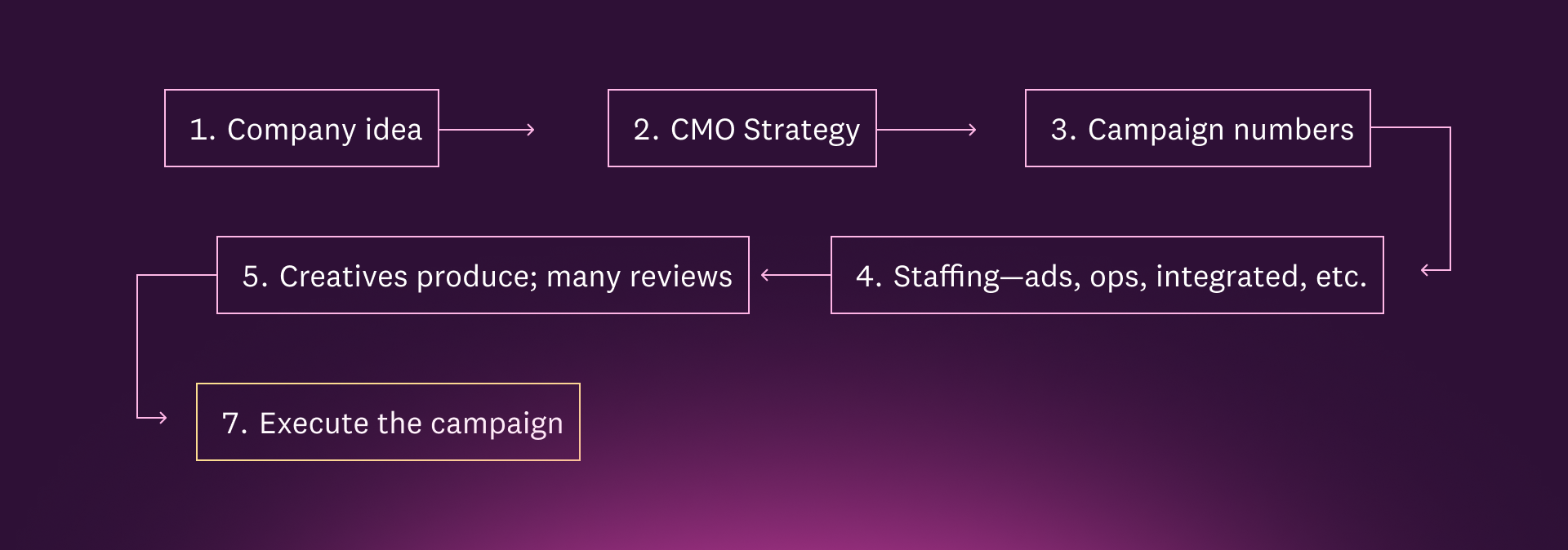
Our first question was, “What’s happening in your customer’s world that would warrant them spending more with you?”
To which there were no answers.
Really consider that. Because I can tell you what’s happening in their buyers’ worlds:
- Political panic
- Wealth inequality
- Job scarcity and fears of AI job armageddon
- Screaming kids or ailing parents
- Trying to have a life outside work
- Hobbies like tennis or cooking
- Review season
- Trying to get ahead in their job
- Responding to the big new company pivot
- Signing up for an ad blocker
- Ignoring all calls from unknown numbers
Notably absent from that list is “helping that one vendor we don’t think about much grow their billings from $30 million to $150 million.” Buyers aren’t interested in helping you increase engagement (whatever that means to them), binge your content (whatever that means to them), or drive marketing efficiencies (whatever that means to anyone).
They are less interested and more jaded than you give them credit, and the responsibility for bridging that interest gap—of being clear and obviously useful—lies with your team. Writing white papers is no longer enough. Your content must do a heckuva lot more than simply exist these days.

As Ogilvy said, “Nobody reads advertising. People read what interests them; and sometimes it’s an ad.” All these project management tools and attribution data and analytics and dashboards have gotten marketing teams away from those core fundamentals. In some ways, marketing was actually easier during the “dumber” golden age of advertising:
- Set a sales goal
- Hire an ad agency
- That agency’s sociologists study actual buyers, visiting their workplaces
- The agency runs that copy and concept through a focus group
- If people use the coupon / sales rise, keep running it
But now? Marketers are running too many campaigns at once, many of them conflicting. They almost never get quality time talking to actual buyers about their actual life. And by the way, all those ad agencies were doing was applying basic writing fundamentals:
- Who’s our subject?
- What do they believe?
- How do we hope to shift that belief?
- What evidence are we working with?
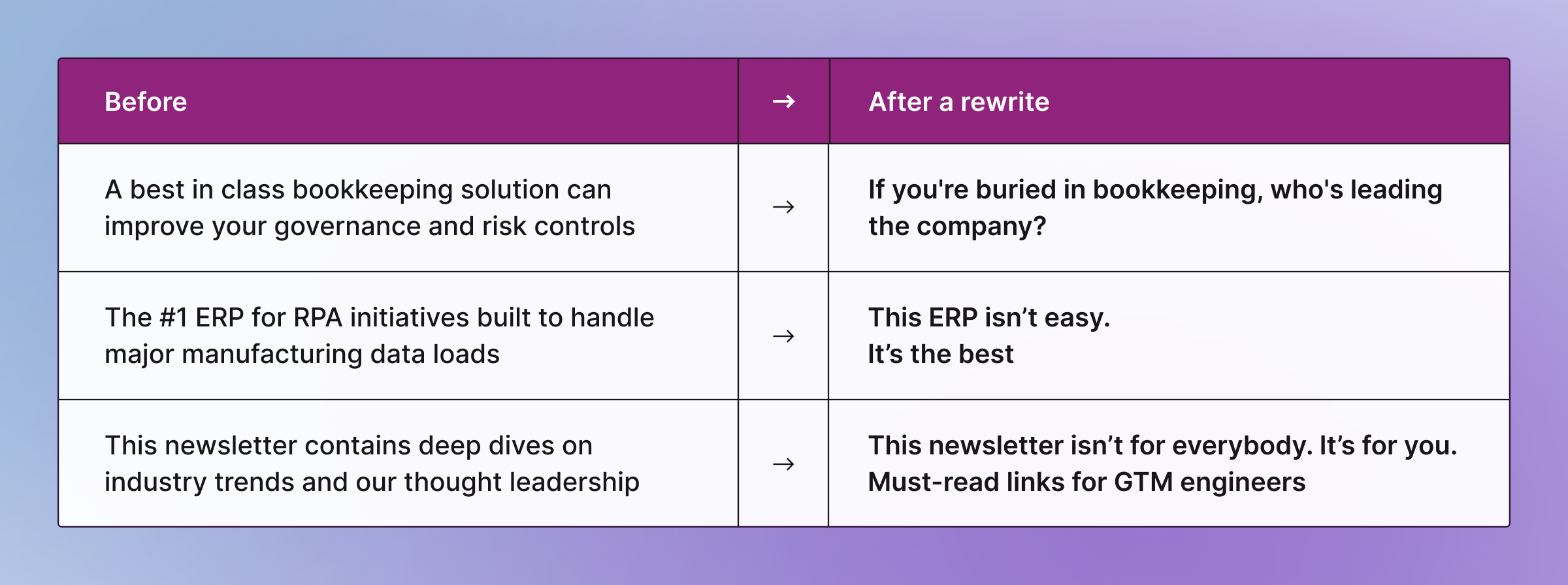
I know firsthand that with the same writing fundamentals, your team can achieve a lot more in your digital campaigns. A writer we trained on basic clarity went back and rewrote their company’s top 20 landing pages and increased conversions 117%. Another conducted interviews to write a guide and email series about “AI slop” that generated 264 meetings.
I’ll bet yours can too. Simple tweaks can change everything. See how the “after” versions spark? Can you guess which one compels your busy buyer?
Your team can learn this the way people have always learned it—through reading books. This skill can cost basically nothing and deliver everything.
How to improve your team’s marketing writing
I recommend two simultaneous motions:
1. A company reading club
2. Formal writing training
As your team reads, they’ll generate questions and ideas. And as they go through training, they’ll fit all those tools into slots on a mental shelf. Fenwick’s isn’t the only writing course—there are many good ones. (But also many bad ones.)
Books to read
On Writing Well by William Zinsser
Though it looks drab this is the best book on business writing ever, in my opinion. It’s brief, witty, and easy to apply.
Confessions of an Advertising Man by David Ogilvy
Maybe the most famous book to make it out of the golden age of advertising. Fun and will leave your team feeling clever.
Everybody Writes by Ann Handley
Ann has one of the most distinctive voices in marketing copy. Her newsletter is good too.
Dreyer’s English by Benjamin Dreyer
An acquired taste, but hilarious for literary-inclined teams. Your team will think sharper as a result.
Courses to consider
Uncommonly Clear Writing by Fenwick
Our flagship writing course teaches teams to memorize three questions over three weeks that make everything they write more precise, concise, and evocative. We sometimes teach this in partnership with Inverta.
Business Writing and Storytelling by The Economist
Six-weeks long, rich with anecdotes and stories, and taught by journalists who know how to write a fun headline. (Their puns are famous.)
Digital Marketing by Growclass
While not writing-specific, Growclass is known for clear writing and thinking and your marketers will learn a bit of it while gathering a range of valuable skills.
What’s one thing you can do today?
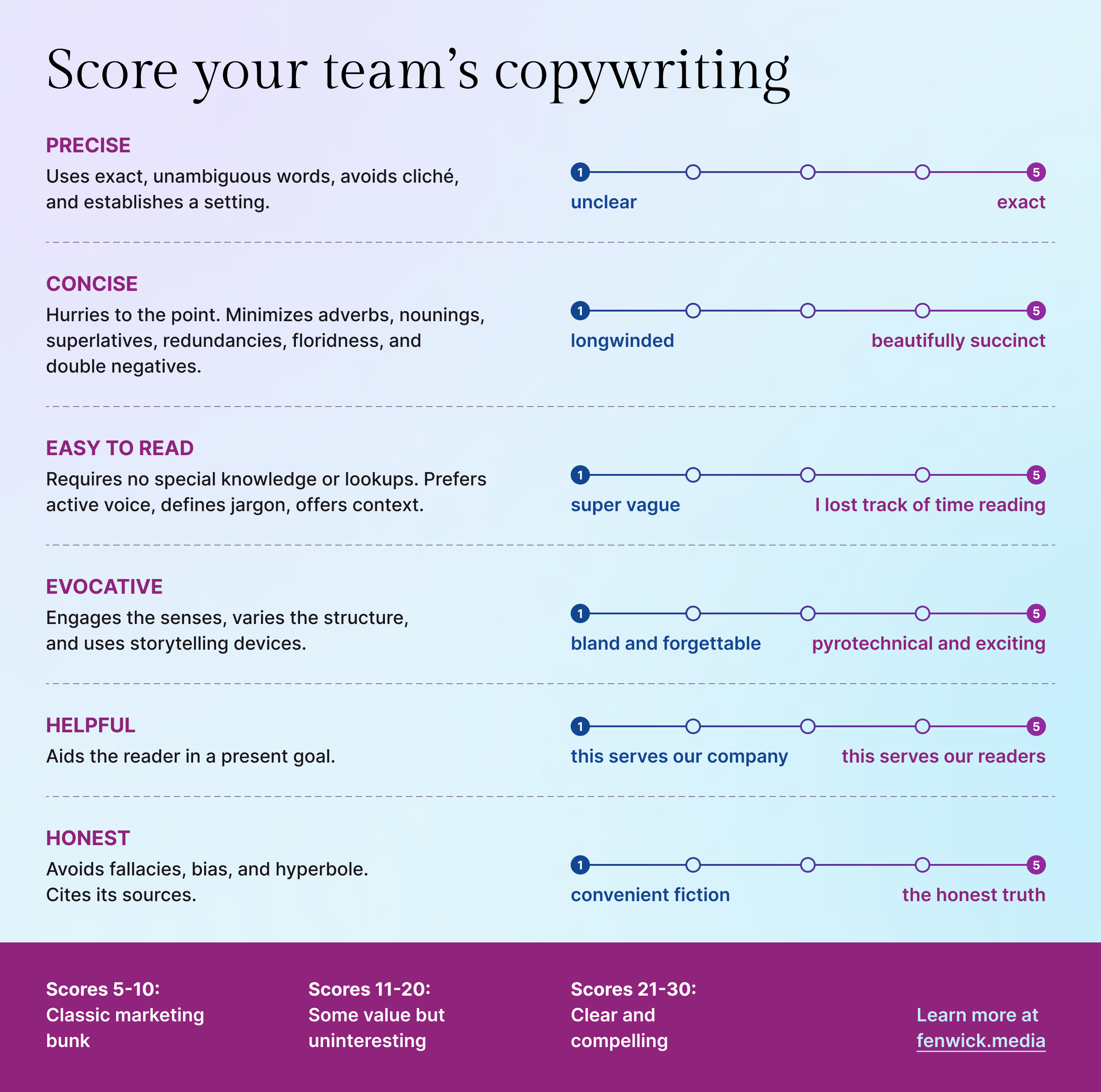
Test your own team’s writing. Take a recent campaign—emails, ads, landing pages, articles—and rate them on this rubric. This may tell you how much you have to gain from investing in training your team to write:
Coach! Help!
If your team is bereft of ideas and miserably trying to eke 2-3% more performance out of a listless campaign, you already know what I—like Kurt—am going to say. You messed up a long time ago. Focus on your writing fundamentals.
About the author
Service page feature

Content


My Brazilian Jiu Jitsu coach has become something of a meme in our community for always giving the same advice.
Someone will get tied into a pretzel by their opponent and shout, “Coach! How do I get out of this?” and Kurt will reply, “You messed up a long time ago.” Meaning, if that person had only practiced the fundamentals Kurt had taught them, they wouldn’t be in that position.
I think about that a lot with B2B campaigns. By the time you’re changing button colors trying to eke another 2-3% performance from something that’s already not performing, you lost a long time ago. The thing to practice was the fundamentals. And there is no greater fundamental than writing.
Writing isn’t depositing words on a page, as a thousand ChatGPTers have learned. Writing is thinking. Writing is applied intelligence. It is the hard-won skill of wondering, why would readers care? And then choosing words that make them feel seen.
Marketers have gotten away from this skill and if you are wondering how to untie all your campaign pretzels, consider—instead of more tools—puting your team through a writing course. Here is my argument for why, with links to good courses.
This essay is based on a talk Fenwick gave with Inverta, Why Creative Risk-Takers Win. At the end, I share a marketing writing rubric.
Your buyers aren’t thinking about you
Companies create their content inside out. Literally, they start with what matters to them, then convey that to the world. Which is a little narcissistic, when you think about it, and the reason so many companies are busily trying to eke 2-3% more conversions out of campaigns that are already not working.
Take an enterprise I consulted with recently. One business unit had done $30 million in revenue the prior year and now management wanted them to do $150 million. So when they asked us for a campaign, it’s because they needed a miracle. They needed that campaign to achieve what none had before—to 5x their total billings. Which is even crazier when you consider their deal cycles are nine months. To do that much more revenue, they needed all those opportunities to open in the first quarter.
This company called Fenwick because they had actually tried to create the campaign on their own, but universally agreed: It was unexciting. They wanted a new, more powerful concept. By the time we came in, they’d put in a great deal of work: They had set top-down goals linked to OKRs, had several kickoff calls uniting the campaigns team with the tech team, built out the programs in the CRM and marketing software, defined the target lists, written messaging, designed assets, requested ad coverage, and so on.
Our first question was, “What’s happening in your customer’s world that would warrant them spending more with you?”
To which there were no answers.
Really consider that. Because I can tell you what’s happening in their buyers’ worlds:
- Political panic
- Wealth inequality
- Job scarcity and fears of AI job armageddon
- Screaming kids or ailing parents
- Trying to have a life outside work
- Hobbies like tennis or cooking
- Review season
- Trying to get ahead in their job
- Responding to the big new company pivot
- Signing up for an ad blocker
- Ignoring all calls from unknown numbers
Notably absent from that list is “helping that one vendor we don’t think about much grow their billings from $30 million to $150 million.” Buyers aren’t interested in helping you increase engagement (whatever that means to them), binge your content (whatever that means to them), or drive marketing efficiencies (whatever that means to anyone).
They are less interested and more jaded than you give them credit, and the responsibility for bridging that interest gap—of being clear and obviously useful—lies with your team. Writing white papers is no longer enough. Your content must do a heckuva lot more than simply exist these days.
As Ogilvy said, “Nobody reads advertising. People read what interests them; and sometimes it’s an ad.” All these project management tools and attribution data and analytics and dashboards have gotten marketing teams away from those core fundamentals. In some ways, marketing was actually easier during the “dumber” golden age of advertising:
- Set a sales goal
- Hire an ad agency
- That agency’s sociologists study actual buyers, visiting their workplaces
- The agency runs that copy and concept through a focus group
- If people use the coupon / sales rise, keep running it
But now? Marketers are running too many campaigns at once, many of them conflicting. They almost never get quality time talking to actual buyers about their actual life. And by the way, all those ad agencies were doing was applying basic writing fundamentals:
- Who’s our subject?
- What do they believe?
- How do we hope to shift that belief?
- What evidence are we working with?
I know firsthand that with the same writing fundamentals, your team can achieve a lot more in your digital campaigns. A writer we trained on basic clarity went back and rewrote their company’s top 20 landing pages and increased conversions 117%. Another conducted interviews to write a guide and email series about “AI slop” that generated 264 meetings.
I’ll bet yours can too. Simple tweaks can change everything. See how the “after” versions spark? Can you guess which one compels your busy buyer?
Your team can learn this the way people have always learned it—through reading books. This skill can cost basically nothing and deliver everything.
How to improve your team’s marketing writing
I recommend two simultaneous motions:
1. A company reading club
2. Formal writing training
As your team reads, they’ll generate questions and ideas. And as they go through training, they’ll fit all those tools into slots on a mental shelf. Fenwick’s isn’t the only writing course—there are many good ones. (But also many bad ones.)
Books to read
On Writing Well by William Zinsser
Though it looks drab this is the best book on business writing ever, in my opinion. It’s brief, witty, and easy to apply.
Confessions of an Advertising Man by David Ogilvy
Maybe the most famous book to make it out of the golden age of advertising. Fun and will leave your team feeling clever.
Everybody Writes by Ann Handley
Ann has one of the most distinctive voices in marketing copy. Her newsletter is good too.
Dreyer’s English by Benjamin Dreyer
An acquired taste, but hilarious for literary-inclined teams. Your team will think sharper as a result.
Courses to consider
Uncommonly Clear Writing by Fenwick
Our flagship writing course teaches teams to memorize three questions over three weeks that make everything they write more precise, concise, and evocative. We sometimes teach this in partnership with Inverta.
Business Writing and Storytelling by The Economist
Six-weeks long, rich with anecdotes and stories, and taught by journalists who know how to write a fun headline. (Their puns are famous.)
Digital Marketing by Growclass
While not writing-specific, Growclass is known for clear writing and thinking and your marketers will learn a bit of it while gathering a range of valuable skills.
What’s one thing you can do today?
Test your own team’s writing. Take a recent campaign—emails, ads, landing pages, articles—and rate them on this rubric. This may tell you how much you have to gain from investing in training your team to write:
Coach! Help!
If your team is bereft of ideas and miserably trying to eke 2-3% more performance out of a listless campaign, you already know what I—like Kurt—am going to say. You messed up a long time ago. Focus on your writing fundamentals.
Resources
About the author
Service page feature
Content
Want 117% more conversions? Practice writing

Speakers
Other helpful resources
My Brazilian Jiu Jitsu coach has become something of a meme in our community for always giving the same advice.
Someone will get tied into a pretzel by their opponent and shout, “Coach! How do I get out of this?” and Kurt will reply, “You messed up a long time ago.” Meaning, if that person had only practiced the fundamentals Kurt had taught them, they wouldn’t be in that position.
I think about that a lot with B2B campaigns. By the time you’re changing button colors trying to eke another 2-3% performance from something that’s already not performing, you lost a long time ago. The thing to practice was the fundamentals. And there is no greater fundamental than writing.
Writing isn’t depositing words on a page, as a thousand ChatGPTers have learned. Writing is thinking. Writing is applied intelligence. It is the hard-won skill of wondering, why would readers care? And then choosing words that make them feel seen.
Marketers have gotten away from this skill and if you are wondering how to untie all your campaign pretzels, consider—instead of more tools—puting your team through a writing course. Here is my argument for why, with links to good courses.
This essay is based on a talk Fenwick gave with Inverta, Why Creative Risk-Takers Win. At the end, I share a marketing writing rubric.
Your buyers aren’t thinking about you
Companies create their content inside out. Literally, they start with what matters to them, then convey that to the world. Which is a little narcissistic, when you think about it, and the reason so many companies are busily trying to eke 2-3% more conversions out of campaigns that are already not working.
Take an enterprise I consulted with recently. One business unit had done $30 million in revenue the prior year and now management wanted them to do $150 million. So when they asked us for a campaign, it’s because they needed a miracle. They needed that campaign to achieve what none had before—to 5x their total billings. Which is even crazier when you consider their deal cycles are nine months. To do that much more revenue, they needed all those opportunities to open in the first quarter.
This company called Fenwick because they had actually tried to create the campaign on their own, but universally agreed: It was unexciting. They wanted a new, more powerful concept. By the time we came in, they’d put in a great deal of work: They had set top-down goals linked to OKRs, had several kickoff calls uniting the campaigns team with the tech team, built out the programs in the CRM and marketing software, defined the target lists, written messaging, designed assets, requested ad coverage, and so on.
Our first question was, “What’s happening in your customer’s world that would warrant them spending more with you?”
To which there were no answers.
Really consider that. Because I can tell you what’s happening in their buyers’ worlds:
- Political panic
- Wealth inequality
- Job scarcity and fears of AI job armageddon
- Screaming kids or ailing parents
- Trying to have a life outside work
- Hobbies like tennis or cooking
- Review season
- Trying to get ahead in their job
- Responding to the big new company pivot
- Signing up for an ad blocker
- Ignoring all calls from unknown numbers
Notably absent from that list is “helping that one vendor we don’t think about much grow their billings from $30 million to $150 million.” Buyers aren’t interested in helping you increase engagement (whatever that means to them), binge your content (whatever that means to them), or drive marketing efficiencies (whatever that means to anyone).
They are less interested and more jaded than you give them credit, and the responsibility for bridging that interest gap—of being clear and obviously useful—lies with your team. Writing white papers is no longer enough. Your content must do a heckuva lot more than simply exist these days.
As Ogilvy said, “Nobody reads advertising. People read what interests them; and sometimes it’s an ad.” All these project management tools and attribution data and analytics and dashboards have gotten marketing teams away from those core fundamentals. In some ways, marketing was actually easier during the “dumber” golden age of advertising:
- Set a sales goal
- Hire an ad agency
- That agency’s sociologists study actual buyers, visiting their workplaces
- The agency runs that copy and concept through a focus group
- If people use the coupon / sales rise, keep running it
But now? Marketers are running too many campaigns at once, many of them conflicting. They almost never get quality time talking to actual buyers about their actual life. And by the way, all those ad agencies were doing was applying basic writing fundamentals:
- Who’s our subject?
- What do they believe?
- How do we hope to shift that belief?
- What evidence are we working with?
I know firsthand that with the same writing fundamentals, your team can achieve a lot more in your digital campaigns. A writer we trained on basic clarity went back and rewrote their company’s top 20 landing pages and increased conversions 117%. Another conducted interviews to write a guide and email series about “AI slop” that generated 264 meetings.
I’ll bet yours can too. Simple tweaks can change everything. See how the “after” versions spark? Can you guess which one compels your busy buyer?
Your team can learn this the way people have always learned it—through reading books. This skill can cost basically nothing and deliver everything.
How to improve your team’s marketing writing
I recommend two simultaneous motions:
1. A company reading club
2. Formal writing training
As your team reads, they’ll generate questions and ideas. And as they go through training, they’ll fit all those tools into slots on a mental shelf. Fenwick’s isn’t the only writing course—there are many good ones. (But also many bad ones.)
Books to read
On Writing Well by William Zinsser
Though it looks drab this is the best book on business writing ever, in my opinion. It’s brief, witty, and easy to apply.
Confessions of an Advertising Man by David Ogilvy
Maybe the most famous book to make it out of the golden age of advertising. Fun and will leave your team feeling clever.
Everybody Writes by Ann Handley
Ann has one of the most distinctive voices in marketing copy. Her newsletter is good too.
Dreyer’s English by Benjamin Dreyer
An acquired taste, but hilarious for literary-inclined teams. Your team will think sharper as a result.
Courses to consider
Uncommonly Clear Writing by Fenwick
Our flagship writing course teaches teams to memorize three questions over three weeks that make everything they write more precise, concise, and evocative. We sometimes teach this in partnership with Inverta.
Business Writing and Storytelling by The Economist
Six-weeks long, rich with anecdotes and stories, and taught by journalists who know how to write a fun headline. (Their puns are famous.)
Digital Marketing by Growclass
While not writing-specific, Growclass is known for clear writing and thinking and your marketers will learn a bit of it while gathering a range of valuable skills.
What’s one thing you can do today?
Test your own team’s writing. Take a recent campaign—emails, ads, landing pages, articles—and rate them on this rubric. This may tell you how much you have to gain from investing in training your team to write:
Coach! Help!
If your team is bereft of ideas and miserably trying to eke 2-3% more performance out of a listless campaign, you already know what I—like Kurt—am going to say. You messed up a long time ago. Focus on your writing fundamentals.
About the author
Service page feature