Pipeline pressure? More activity isn't the answer.
.svg)

In partnership with:
Featuring
Featuring
How are you going to stand out in 2026?
Buyers are in control of the buying process. Over 70% of it is happening online. And they are putting companies on their short list of vendors that provide value and establish trust with their content.
How are you accounting for this in your 2026 strategy?
You need to stand out. To make sure your buyers notice you. Let us help you build that into your strategy for next year -->

%20(1).webp)

The Revenue Marketer


Pipeline pressure? More activity isn't the answer.
Still chasing 10% efficiency gains?
2023-2025 were the years of experimentation with AI. 2026 is the year to make it transformative. If you're still trying to figure out the strategic advantage AI will bring to your team, we're here to help!

Marketing Leadership Under Pressure
A Perspective Series from Inverta · Volume 01
For all resources on how to overcome today's pipeline pressure, check out our complete guide
The most expensive thing a marketing team can do is get very productive at the wrong things. That's exactly what pipeline pressure produces.
When pipeline comes under pressure, the default response is more activity: more campaigns, more content, more advertising, more events. None of that is inherently wrong. The trouble starts when activity becomes the strategy, and marketing starts optimizing output instead of outcomes.
The marketing teams winning in today’s buying environment ask a different question: where are buyers losing momentum, and what's stopping them from moving forward? That question changes how teams prioritize investment, design campaigns, align with sales, and build pipeline.
Pipeline is the business outcome. Buying momentum is how marketing leaders influence it.
How pipeline pressure is changing the marketing leader's role
Every marketing leader knows the conversation at the start of a new quarter. Revenue targets get reaffirmed. Pipeline gaps get surfaced. And marketing gets the question it always gets: how are we going to create more pipeline?
It's a fair question. But the conditions for generating pipeline have changed dramatically, while most organizations are still running the planning models they used five years ago. Buyers complete most of their evaluation before they ever talk to sales. Enterprise decisions routinely involve six to ten stakeholders, each judging the investment through a different lens. And buyers expect credible proof that the disruption of change is worth it.
Meanwhile, marketing leaders own far more than pipeline. Product launches, sales enablement, customer expansion, partner programs, AI initiatives, events, and brand all sit on their plate now, usually with smaller teams, sometimes with less budget, and always with higher expectations than the year before.
The result is predictable. Teams build a thoughtful strategy. Then execution begins, additional pressures are introduced, and attention shifts back to activity. Sales needs support for a strategic account. A webinar needs promotion. A product launch moves up the calendar. None of those requests are unimportant. The problem is that under pressure, they start replacing the strategic conversations that determine whether any of that activity moves a deal forward.
Observation from the field:
This is one of the most common patterns we see. Organizations increase marketing activity before they understand where buyers are actually losing momentum. It's not unusual to find a team running a dozen concurrent campaigns while fewer than one in five of their open opportunities has more than a single engaged stakeholder.
Pipeline problems aren't solved with more marketing activity
Pressure tends to collapse thinking. And when thinking collapses, activity replaces strategy.
The teams that stay stuck aren't stuck because they aren't working hard enough. They're stuck because nobody stopped to ask how the business actually grows, how buyers actually buy, and what's preventing them from moving forward. The answer is usually sitting in the data already: the deals that stalled, the buying groups that are incomplete, the accounts that went quiet after the second outreach from sales.
Marketing leaders don't need more activity. They need perspective. With perspective, "what else can we launch?" becomes "what do buyers need next?" Once you make this shift, everything else becomes more clear.
Campaigns create and influence buyer momentum.
A campaign launching or an email going out doesn't create pipeline by itself. Buyers continuing to move toward a decision does.
Every interaction a buyer has with your organization either builds confidence or introduces friction. Every piece of content, every conversation, every campaign either helps buyers understand the problem, evaluate their options, build internal consensus, and justify the investment, or it slows them down. Those moments accumulate and surface as a buyer moving closer to yes, or drifting further away.
Thinking in terms of buying momentum gives leaders a useful lens. It shows where confidence is building, where friction is increasing, and where investment will have the greatest impact. It uses the data you already track, asked through a different question: is this buyer closer to yes?
When buying momentum increases, opportunities progress more consistently, buying groups engage more broadly, and pipeline gets healthier. When it stalls, marketing activity often increases while pipeline performance stays flat.
The goal is more moments that help buyers move forward, not more activity.
How buying momentum builds
Buying momentum builds as a sequence. Business goals determine which revenue motions matter. Revenue motions define distinct buying journeys. Buying journeys shape the experiences marketing designs. Those experiences either build buyer confidence or introduce friction. Pipeline is the result.
Start with business goals, not campaign calendars
Revenue growth, customer expansion, market penetration, product adoption, and retention all require different marketing motions. Skip that context, and it's easy to build a campaign plan that looks ambitious and produces nothing the business cares about.
Not all pipeline is created the same way
New logo acquisition, enterprise expansion, cross-sell, renewals, and partner growth might all show up as pipeline on the same dashboard. But they don't move through the same buying journey. Each has different stakeholders, different objections, and a different definition of done. Most organizations segment markets well and segment buying journeys almost never. Every account gets a similar experience whether it's still building awareness, working through procurement, expanding an existing relationship, or three weeks from signature. Treat every buying journey the same, and you're solving the wrong problem for most of your accounts, most of the time.
Understand how buyers actually buy, not just who they are
What problem are they trying to solve? Who influences the decision, and who can quietly kill it? What concerns slow progress? What evidence builds confidence? Where do opportunities typically stall between first conversation and close? These aren't persona questions. They're questions about the practical and emotional barriers that shape every buying decision. In B2B, nobody makes an impulse purchase. Buyers make decisions that affect budgets, teams, careers, and the organizational change that follows the signature.
Design experiences around buying journeys, not just markets
This is where campaigns come to life, and where most marketing programs lose momentum. Every campaign, offer, event, piece of content, customer story, or executive briefing should answer one question: what does this buyer need to take the next step? Sometimes that's creating awareness. Sometimes it's helping an internal champion make the case to finance. Sometimes it's reducing the perceived risk of change for a skeptical technical team. The marketing leaders who consistently create pipeline stopped asking "what campaign should we launch?" They ask "what experience does this buyer need next?"
Stop asking "what campaign should we launch?" Ask "what experience does this buyer need next?"
Momentum builds when confidence builds
Buyers understand the problem more clearly. They see why the status quo costs more than change. Additional stakeholders engage. Questions get easier to answer. Risk gets easier to justify. Consensus starts to form. Marketing can't control every buying decision, but it can meaningfully influence whether momentum keeps building or quietly erodes.
Healthy pipeline comes from consistently helping buyers progress from curiosity to commitment, not from simply running more campaigns.
Where marketing leaders create buying momentum
Understanding where buyers lose momentum only matters if it changes what marketing does next.
One champion isn't a buying group. It's a liability.
Pipeline rarely stalls because one person loses interest. It stalls because organizations mistake account engagement for buying group engagement.
Enterprise decisions involve multiple stakeholders, each evaluating the investment through a different lens. The Decider considers business outcomes. The Financier evaluates cost and return. The Technologist assesses implementation risk. The Beneficiaries want to know how change will affect their day-to-day work. The Procurer wants to know why this vendor, and why now.
If only one of those people is engaged, momentum is fragile. One re-org, one competing priority, one skeptical colleague the champion forgot to brief, and the deal stops moving.
Marketing leaders should regularly ask whether the right people are actually participating in the buying process. Executive briefings, industry research, implementation guides, customer proof, business case models, and role-specific content help different stakeholders answer different questions while building confidence across the group, not just at the top.
For a closer look at these roles and how to engage each one, see our complete guide to buying groups. Momentum grows when confidence isn't concentrated in a single person.
Stop generating interest. Start reducing buying risk.
Many organizations respond to pipeline pressure by creating more content. The organizations making the greatest progress create more opportunities for buyers to experience value before they commit.
Every significant purchase introduces real uncertainty. Buyers wonder whether implementation will succeed, whether their teams will actually use what they're buying, whether the investment will produce measurable results, and whether they're making a decision they'll be held accountable for.
Marketing can reduce that uncertainty long before contracts are signed. Instead of defaulting to another downloadable asset, consider experiences that move buyers closer to a decision:
- Executive working sessions
- Readiness assessments
- Return on investment and business case workshops
- Customer roundtables
- Industry benchmark reviews
- Pilot programs
- Implementation planning sessions
The goal is a buyer who's less afraid to move forward, not another lead.
Surround the opportunities that matter most
Not every account deserves the same investment. When pipeline is under pressure, one of the fastest ways to improve results is focusing marketing and sales on the accounts with the greatest potential to affect revenue, and coordinating around them deliberately.
Identify the must-win accounts together. Review where momentum is already slowing. Evaluate buying group coverage. Then build marketing around those accounts: digital advertising, executive outreach, customer advocacy, personalized content, account-specific experiences, and sales enablement that helps the seller have better conversations.
Marketing shouldn't go quiet once an opportunity enters the pipeline. That's precisely when it should be most intentional.
Measure buyer progression, not just marketing production
Most marketing dashboards answer questions about activity: how many campaigns, how many MQLs, how many downloads. Those metrics matter. They just don't tell you whether buyers are getting closer to a decision.
Complement activity metrics with questions that reveal momentum:
- Where are opportunities stalling?
- Which buying groups are still incomplete?
- Which accounts are progressing, and which experiences consistently accelerate that?
- Where are buyers losing confidence?
The answers will tell you more about future pipeline than any activity report.
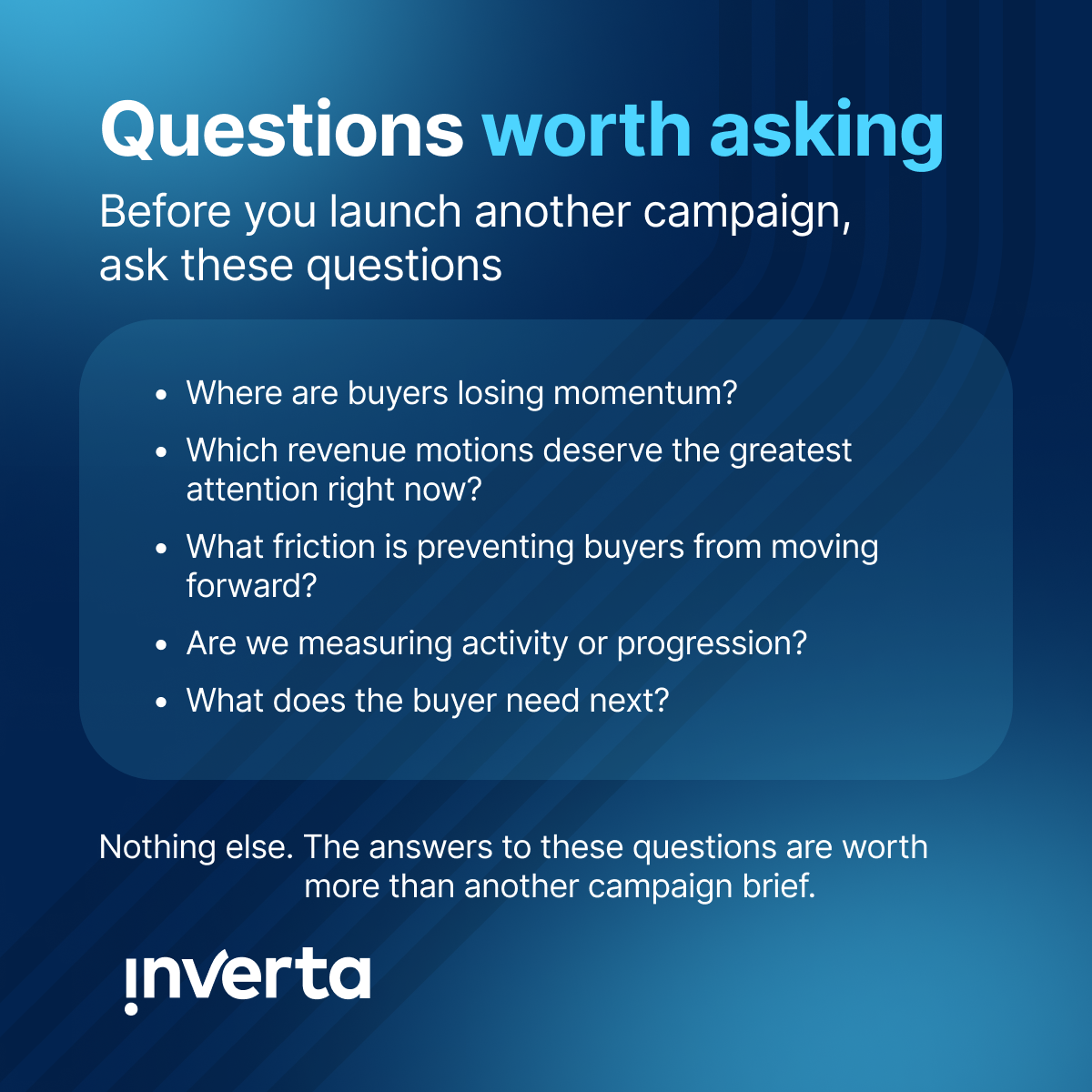
Before you launch another campaign
Pressure collapses thinking. That's when activity replaces strategy, and the questions worth asking get pushed aside for the work that feels urgent. Before the next campaign brief gets written, ask these instead:
- Where are buyers losing momentum?
- Which revenue motions deserve the greatest attention right now?
- What friction is preventing buyers from moving forward?
- Are we measuring activity or progression?
- What does the buyer need next?
The answers to these questions are worth more than another campaign brief.
Closing perspective
Pipeline pressure isn't going away. Marketing leaders should expect greater complexity, higher expectations, and continued pressure to prove business impact, often with less time and fewer resources than the year before.
The response to that pressure is a choice. You can increase activity and hope more campaigns produce more opportunities. Or you can slow down long enough to ask where buyers are losing momentum, and build your next move around that answer.
The marketing leaders who consistently create pipeline aren't working harder than everyone else. They're asking better questions before they launch anything. They understand how buyers make decisions, where confidence breaks down, and how every investment either builds momentum or squanders it.
Pipeline is the business outcome. Buying momentum is how marketing leaders influence it. When marketing stops asking "what else can we launch?" and starts asking "what do buyers need next?" it stops being a support function and starts being the reason the business grows.
Start here: pull your ten most recent closed-lost or stalled opportunities and count how many buying group roles were actually engaged before the deal went quiet. If most show one or two, you've found where to focus, not simply defaulting to more campaigns to make up for the shortfall.
Helping marketing leaders think more clearly under pressure
Marketing strategy rarely fails on knowledge. It fails under pressure, when thinking collapses and collapsed thinking produces campaigns instead of strategy. Inverta partners with B2B marketing organizations to simplify complexity, strengthen strategy, improve buying experiences, and build durable paths to revenue growth.
This is Volume 01 of Marketing Leadership Under Pressure, our ongoing perspective series for marketing leaders navigating high expectations and limited resources.
Because when marketing leaders think more clearly under pressure, they make better decisions. And better decisions create better outcomes.
About the author
Service page feature

Demand gen


Marketing Leadership Under Pressure
A Perspective Series from Inverta · Volume 01
For all resources on how to overcome today's pipeline pressure, check out our complete guide
The most expensive thing a marketing team can do is get very productive at the wrong things. That's exactly what pipeline pressure produces.
When pipeline comes under pressure, the default response is more activity: more campaigns, more content, more advertising, more events. None of that is inherently wrong. The trouble starts when activity becomes the strategy, and marketing starts optimizing output instead of outcomes.
The marketing teams winning in today’s buying environment ask a different question: where are buyers losing momentum, and what's stopping them from moving forward? That question changes how teams prioritize investment, design campaigns, align with sales, and build pipeline.
Pipeline is the business outcome. Buying momentum is how marketing leaders influence it.
How pipeline pressure is changing the marketing leader's role
Every marketing leader knows the conversation at the start of a new quarter. Revenue targets get reaffirmed. Pipeline gaps get surfaced. And marketing gets the question it always gets: how are we going to create more pipeline?
It's a fair question. But the conditions for generating pipeline have changed dramatically, while most organizations are still running the planning models they used five years ago. Buyers complete most of their evaluation before they ever talk to sales. Enterprise decisions routinely involve six to ten stakeholders, each judging the investment through a different lens. And buyers expect credible proof that the disruption of change is worth it.
Meanwhile, marketing leaders own far more than pipeline. Product launches, sales enablement, customer expansion, partner programs, AI initiatives, events, and brand all sit on their plate now, usually with smaller teams, sometimes with less budget, and always with higher expectations than the year before.
The result is predictable. Teams build a thoughtful strategy. Then execution begins, additional pressures are introduced, and attention shifts back to activity. Sales needs support for a strategic account. A webinar needs promotion. A product launch moves up the calendar. None of those requests are unimportant. The problem is that under pressure, they start replacing the strategic conversations that determine whether any of that activity moves a deal forward.
Observation from the field:
This is one of the most common patterns we see. Organizations increase marketing activity before they understand where buyers are actually losing momentum. It's not unusual to find a team running a dozen concurrent campaigns while fewer than one in five of their open opportunities has more than a single engaged stakeholder.
Pipeline problems aren't solved with more marketing activity
Pressure tends to collapse thinking. And when thinking collapses, activity replaces strategy.
The teams that stay stuck aren't stuck because they aren't working hard enough. They're stuck because nobody stopped to ask how the business actually grows, how buyers actually buy, and what's preventing them from moving forward. The answer is usually sitting in the data already: the deals that stalled, the buying groups that are incomplete, the accounts that went quiet after the second outreach from sales.
Marketing leaders don't need more activity. They need perspective. With perspective, "what else can we launch?" becomes "what do buyers need next?" Once you make this shift, everything else becomes more clear.
Campaigns create and influence buyer momentum.
A campaign launching or an email going out doesn't create pipeline by itself. Buyers continuing to move toward a decision does.
Every interaction a buyer has with your organization either builds confidence or introduces friction. Every piece of content, every conversation, every campaign either helps buyers understand the problem, evaluate their options, build internal consensus, and justify the investment, or it slows them down. Those moments accumulate and surface as a buyer moving closer to yes, or drifting further away.
Thinking in terms of buying momentum gives leaders a useful lens. It shows where confidence is building, where friction is increasing, and where investment will have the greatest impact. It uses the data you already track, asked through a different question: is this buyer closer to yes?
When buying momentum increases, opportunities progress more consistently, buying groups engage more broadly, and pipeline gets healthier. When it stalls, marketing activity often increases while pipeline performance stays flat.
The goal is more moments that help buyers move forward, not more activity.
How buying momentum builds
Buying momentum builds as a sequence. Business goals determine which revenue motions matter. Revenue motions define distinct buying journeys. Buying journeys shape the experiences marketing designs. Those experiences either build buyer confidence or introduce friction. Pipeline is the result.
Start with business goals, not campaign calendars
Revenue growth, customer expansion, market penetration, product adoption, and retention all require different marketing motions. Skip that context, and it's easy to build a campaign plan that looks ambitious and produces nothing the business cares about.
Not all pipeline is created the same way
New logo acquisition, enterprise expansion, cross-sell, renewals, and partner growth might all show up as pipeline on the same dashboard. But they don't move through the same buying journey. Each has different stakeholders, different objections, and a different definition of done. Most organizations segment markets well and segment buying journeys almost never. Every account gets a similar experience whether it's still building awareness, working through procurement, expanding an existing relationship, or three weeks from signature. Treat every buying journey the same, and you're solving the wrong problem for most of your accounts, most of the time.
Understand how buyers actually buy, not just who they are
What problem are they trying to solve? Who influences the decision, and who can quietly kill it? What concerns slow progress? What evidence builds confidence? Where do opportunities typically stall between first conversation and close? These aren't persona questions. They're questions about the practical and emotional barriers that shape every buying decision. In B2B, nobody makes an impulse purchase. Buyers make decisions that affect budgets, teams, careers, and the organizational change that follows the signature.
Design experiences around buying journeys, not just markets
This is where campaigns come to life, and where most marketing programs lose momentum. Every campaign, offer, event, piece of content, customer story, or executive briefing should answer one question: what does this buyer need to take the next step? Sometimes that's creating awareness. Sometimes it's helping an internal champion make the case to finance. Sometimes it's reducing the perceived risk of change for a skeptical technical team. The marketing leaders who consistently create pipeline stopped asking "what campaign should we launch?" They ask "what experience does this buyer need next?"
Stop asking "what campaign should we launch?" Ask "what experience does this buyer need next?"
Momentum builds when confidence builds
Buyers understand the problem more clearly. They see why the status quo costs more than change. Additional stakeholders engage. Questions get easier to answer. Risk gets easier to justify. Consensus starts to form. Marketing can't control every buying decision, but it can meaningfully influence whether momentum keeps building or quietly erodes.
Healthy pipeline comes from consistently helping buyers progress from curiosity to commitment, not from simply running more campaigns.
Where marketing leaders create buying momentum
Understanding where buyers lose momentum only matters if it changes what marketing does next.
One champion isn't a buying group. It's a liability.
Pipeline rarely stalls because one person loses interest. It stalls because organizations mistake account engagement for buying group engagement.
Enterprise decisions involve multiple stakeholders, each evaluating the investment through a different lens. The Decider considers business outcomes. The Financier evaluates cost and return. The Technologist assesses implementation risk. The Beneficiaries want to know how change will affect their day-to-day work. The Procurer wants to know why this vendor, and why now.
If only one of those people is engaged, momentum is fragile. One re-org, one competing priority, one skeptical colleague the champion forgot to brief, and the deal stops moving.
Marketing leaders should regularly ask whether the right people are actually participating in the buying process. Executive briefings, industry research, implementation guides, customer proof, business case models, and role-specific content help different stakeholders answer different questions while building confidence across the group, not just at the top.
For a closer look at these roles and how to engage each one, see our complete guide to buying groups. Momentum grows when confidence isn't concentrated in a single person.
Stop generating interest. Start reducing buying risk.
Many organizations respond to pipeline pressure by creating more content. The organizations making the greatest progress create more opportunities for buyers to experience value before they commit.
Every significant purchase introduces real uncertainty. Buyers wonder whether implementation will succeed, whether their teams will actually use what they're buying, whether the investment will produce measurable results, and whether they're making a decision they'll be held accountable for.
Marketing can reduce that uncertainty long before contracts are signed. Instead of defaulting to another downloadable asset, consider experiences that move buyers closer to a decision:
- Executive working sessions
- Readiness assessments
- Return on investment and business case workshops
- Customer roundtables
- Industry benchmark reviews
- Pilot programs
- Implementation planning sessions
The goal is a buyer who's less afraid to move forward, not another lead.
Surround the opportunities that matter most
Not every account deserves the same investment. When pipeline is under pressure, one of the fastest ways to improve results is focusing marketing and sales on the accounts with the greatest potential to affect revenue, and coordinating around them deliberately.
Identify the must-win accounts together. Review where momentum is already slowing. Evaluate buying group coverage. Then build marketing around those accounts: digital advertising, executive outreach, customer advocacy, personalized content, account-specific experiences, and sales enablement that helps the seller have better conversations.
Marketing shouldn't go quiet once an opportunity enters the pipeline. That's precisely when it should be most intentional.
Measure buyer progression, not just marketing production
Most marketing dashboards answer questions about activity: how many campaigns, how many MQLs, how many downloads. Those metrics matter. They just don't tell you whether buyers are getting closer to a decision.
Complement activity metrics with questions that reveal momentum:
- Where are opportunities stalling?
- Which buying groups are still incomplete?
- Which accounts are progressing, and which experiences consistently accelerate that?
- Where are buyers losing confidence?
The answers will tell you more about future pipeline than any activity report.
Before you launch another campaign
Pressure collapses thinking. That's when activity replaces strategy, and the questions worth asking get pushed aside for the work that feels urgent. Before the next campaign brief gets written, ask these instead:
- Where are buyers losing momentum?
- Which revenue motions deserve the greatest attention right now?
- What friction is preventing buyers from moving forward?
- Are we measuring activity or progression?
- What does the buyer need next?
The answers to these questions are worth more than another campaign brief.
Closing perspective
Pipeline pressure isn't going away. Marketing leaders should expect greater complexity, higher expectations, and continued pressure to prove business impact, often with less time and fewer resources than the year before.
The response to that pressure is a choice. You can increase activity and hope more campaigns produce more opportunities. Or you can slow down long enough to ask where buyers are losing momentum, and build your next move around that answer.
The marketing leaders who consistently create pipeline aren't working harder than everyone else. They're asking better questions before they launch anything. They understand how buyers make decisions, where confidence breaks down, and how every investment either builds momentum or squanders it.
Pipeline is the business outcome. Buying momentum is how marketing leaders influence it. When marketing stops asking "what else can we launch?" and starts asking "what do buyers need next?" it stops being a support function and starts being the reason the business grows.
Start here: pull your ten most recent closed-lost or stalled opportunities and count how many buying group roles were actually engaged before the deal went quiet. If most show one or two, you've found where to focus, not simply defaulting to more campaigns to make up for the shortfall.
Helping marketing leaders think more clearly under pressure
Marketing strategy rarely fails on knowledge. It fails under pressure, when thinking collapses and collapsed thinking produces campaigns instead of strategy. Inverta partners with B2B marketing organizations to simplify complexity, strengthen strategy, improve buying experiences, and build durable paths to revenue growth.
This is Volume 01 of Marketing Leadership Under Pressure, our ongoing perspective series for marketing leaders navigating high expectations and limited resources.
Because when marketing leaders think more clearly under pressure, they make better decisions. And better decisions create better outcomes.
Resources
About the author
Service page feature
Demand gen
Pipeline pressure? More activity isn't the answer.


Speakers
Other helpful resources
Marketing Leadership Under Pressure
A Perspective Series from Inverta · Volume 01
For all resources on how to overcome today's pipeline pressure, check out our complete guide
The most expensive thing a marketing team can do is get very productive at the wrong things. That's exactly what pipeline pressure produces.
When pipeline comes under pressure, the default response is more activity: more campaigns, more content, more advertising, more events. None of that is inherently wrong. The trouble starts when activity becomes the strategy, and marketing starts optimizing output instead of outcomes.
The marketing teams winning in today’s buying environment ask a different question: where are buyers losing momentum, and what's stopping them from moving forward? That question changes how teams prioritize investment, design campaigns, align with sales, and build pipeline.
Pipeline is the business outcome. Buying momentum is how marketing leaders influence it.
How pipeline pressure is changing the marketing leader's role
Every marketing leader knows the conversation at the start of a new quarter. Revenue targets get reaffirmed. Pipeline gaps get surfaced. And marketing gets the question it always gets: how are we going to create more pipeline?
It's a fair question. But the conditions for generating pipeline have changed dramatically, while most organizations are still running the planning models they used five years ago. Buyers complete most of their evaluation before they ever talk to sales. Enterprise decisions routinely involve six to ten stakeholders, each judging the investment through a different lens. And buyers expect credible proof that the disruption of change is worth it.
Meanwhile, marketing leaders own far more than pipeline. Product launches, sales enablement, customer expansion, partner programs, AI initiatives, events, and brand all sit on their plate now, usually with smaller teams, sometimes with less budget, and always with higher expectations than the year before.
The result is predictable. Teams build a thoughtful strategy. Then execution begins, additional pressures are introduced, and attention shifts back to activity. Sales needs support for a strategic account. A webinar needs promotion. A product launch moves up the calendar. None of those requests are unimportant. The problem is that under pressure, they start replacing the strategic conversations that determine whether any of that activity moves a deal forward.
Observation from the field:
This is one of the most common patterns we see. Organizations increase marketing activity before they understand where buyers are actually losing momentum. It's not unusual to find a team running a dozen concurrent campaigns while fewer than one in five of their open opportunities has more than a single engaged stakeholder.
Pipeline problems aren't solved with more marketing activity
Pressure tends to collapse thinking. And when thinking collapses, activity replaces strategy.
The teams that stay stuck aren't stuck because they aren't working hard enough. They're stuck because nobody stopped to ask how the business actually grows, how buyers actually buy, and what's preventing them from moving forward. The answer is usually sitting in the data already: the deals that stalled, the buying groups that are incomplete, the accounts that went quiet after the second outreach from sales.
Marketing leaders don't need more activity. They need perspective. With perspective, "what else can we launch?" becomes "what do buyers need next?" Once you make this shift, everything else becomes more clear.
Campaigns create and influence buyer momentum.
A campaign launching or an email going out doesn't create pipeline by itself. Buyers continuing to move toward a decision does.
Every interaction a buyer has with your organization either builds confidence or introduces friction. Every piece of content, every conversation, every campaign either helps buyers understand the problem, evaluate their options, build internal consensus, and justify the investment, or it slows them down. Those moments accumulate and surface as a buyer moving closer to yes, or drifting further away.
Thinking in terms of buying momentum gives leaders a useful lens. It shows where confidence is building, where friction is increasing, and where investment will have the greatest impact. It uses the data you already track, asked through a different question: is this buyer closer to yes?
When buying momentum increases, opportunities progress more consistently, buying groups engage more broadly, and pipeline gets healthier. When it stalls, marketing activity often increases while pipeline performance stays flat.
The goal is more moments that help buyers move forward, not more activity.
How buying momentum builds
Buying momentum builds as a sequence. Business goals determine which revenue motions matter. Revenue motions define distinct buying journeys. Buying journeys shape the experiences marketing designs. Those experiences either build buyer confidence or introduce friction. Pipeline is the result.
Start with business goals, not campaign calendars
Revenue growth, customer expansion, market penetration, product adoption, and retention all require different marketing motions. Skip that context, and it's easy to build a campaign plan that looks ambitious and produces nothing the business cares about.
Not all pipeline is created the same way
New logo acquisition, enterprise expansion, cross-sell, renewals, and partner growth might all show up as pipeline on the same dashboard. But they don't move through the same buying journey. Each has different stakeholders, different objections, and a different definition of done. Most organizations segment markets well and segment buying journeys almost never. Every account gets a similar experience whether it's still building awareness, working through procurement, expanding an existing relationship, or three weeks from signature. Treat every buying journey the same, and you're solving the wrong problem for most of your accounts, most of the time.
Understand how buyers actually buy, not just who they are
What problem are they trying to solve? Who influences the decision, and who can quietly kill it? What concerns slow progress? What evidence builds confidence? Where do opportunities typically stall between first conversation and close? These aren't persona questions. They're questions about the practical and emotional barriers that shape every buying decision. In B2B, nobody makes an impulse purchase. Buyers make decisions that affect budgets, teams, careers, and the organizational change that follows the signature.
Design experiences around buying journeys, not just markets
This is where campaigns come to life, and where most marketing programs lose momentum. Every campaign, offer, event, piece of content, customer story, or executive briefing should answer one question: what does this buyer need to take the next step? Sometimes that's creating awareness. Sometimes it's helping an internal champion make the case to finance. Sometimes it's reducing the perceived risk of change for a skeptical technical team. The marketing leaders who consistently create pipeline stopped asking "what campaign should we launch?" They ask "what experience does this buyer need next?"
Stop asking "what campaign should we launch?" Ask "what experience does this buyer need next?"
Momentum builds when confidence builds
Buyers understand the problem more clearly. They see why the status quo costs more than change. Additional stakeholders engage. Questions get easier to answer. Risk gets easier to justify. Consensus starts to form. Marketing can't control every buying decision, but it can meaningfully influence whether momentum keeps building or quietly erodes.
Healthy pipeline comes from consistently helping buyers progress from curiosity to commitment, not from simply running more campaigns.
Where marketing leaders create buying momentum
Understanding where buyers lose momentum only matters if it changes what marketing does next.
One champion isn't a buying group. It's a liability.
Pipeline rarely stalls because one person loses interest. It stalls because organizations mistake account engagement for buying group engagement.
Enterprise decisions involve multiple stakeholders, each evaluating the investment through a different lens. The Decider considers business outcomes. The Financier evaluates cost and return. The Technologist assesses implementation risk. The Beneficiaries want to know how change will affect their day-to-day work. The Procurer wants to know why this vendor, and why now.
If only one of those people is engaged, momentum is fragile. One re-org, one competing priority, one skeptical colleague the champion forgot to brief, and the deal stops moving.
Marketing leaders should regularly ask whether the right people are actually participating in the buying process. Executive briefings, industry research, implementation guides, customer proof, business case models, and role-specific content help different stakeholders answer different questions while building confidence across the group, not just at the top.
For a closer look at these roles and how to engage each one, see our complete guide to buying groups. Momentum grows when confidence isn't concentrated in a single person.
Stop generating interest. Start reducing buying risk.
Many organizations respond to pipeline pressure by creating more content. The organizations making the greatest progress create more opportunities for buyers to experience value before they commit.
Every significant purchase introduces real uncertainty. Buyers wonder whether implementation will succeed, whether their teams will actually use what they're buying, whether the investment will produce measurable results, and whether they're making a decision they'll be held accountable for.
Marketing can reduce that uncertainty long before contracts are signed. Instead of defaulting to another downloadable asset, consider experiences that move buyers closer to a decision:
- Executive working sessions
- Readiness assessments
- Return on investment and business case workshops
- Customer roundtables
- Industry benchmark reviews
- Pilot programs
- Implementation planning sessions
The goal is a buyer who's less afraid to move forward, not another lead.
Surround the opportunities that matter most
Not every account deserves the same investment. When pipeline is under pressure, one of the fastest ways to improve results is focusing marketing and sales on the accounts with the greatest potential to affect revenue, and coordinating around them deliberately.
Identify the must-win accounts together. Review where momentum is already slowing. Evaluate buying group coverage. Then build marketing around those accounts: digital advertising, executive outreach, customer advocacy, personalized content, account-specific experiences, and sales enablement that helps the seller have better conversations.
Marketing shouldn't go quiet once an opportunity enters the pipeline. That's precisely when it should be most intentional.
Measure buyer progression, not just marketing production
Most marketing dashboards answer questions about activity: how many campaigns, how many MQLs, how many downloads. Those metrics matter. They just don't tell you whether buyers are getting closer to a decision.
Complement activity metrics with questions that reveal momentum:
- Where are opportunities stalling?
- Which buying groups are still incomplete?
- Which accounts are progressing, and which experiences consistently accelerate that?
- Where are buyers losing confidence?
The answers will tell you more about future pipeline than any activity report.
Before you launch another campaign
Pressure collapses thinking. That's when activity replaces strategy, and the questions worth asking get pushed aside for the work that feels urgent. Before the next campaign brief gets written, ask these instead:
- Where are buyers losing momentum?
- Which revenue motions deserve the greatest attention right now?
- What friction is preventing buyers from moving forward?
- Are we measuring activity or progression?
- What does the buyer need next?
The answers to these questions are worth more than another campaign brief.
Closing perspective
Pipeline pressure isn't going away. Marketing leaders should expect greater complexity, higher expectations, and continued pressure to prove business impact, often with less time and fewer resources than the year before.
The response to that pressure is a choice. You can increase activity and hope more campaigns produce more opportunities. Or you can slow down long enough to ask where buyers are losing momentum, and build your next move around that answer.
The marketing leaders who consistently create pipeline aren't working harder than everyone else. They're asking better questions before they launch anything. They understand how buyers make decisions, where confidence breaks down, and how every investment either builds momentum or squanders it.
Pipeline is the business outcome. Buying momentum is how marketing leaders influence it. When marketing stops asking "what else can we launch?" and starts asking "what do buyers need next?" it stops being a support function and starts being the reason the business grows.
Start here: pull your ten most recent closed-lost or stalled opportunities and count how many buying group roles were actually engaged before the deal went quiet. If most show one or two, you've found where to focus, not simply defaulting to more campaigns to make up for the shortfall.
Helping marketing leaders think more clearly under pressure
Marketing strategy rarely fails on knowledge. It fails under pressure, when thinking collapses and collapsed thinking produces campaigns instead of strategy. Inverta partners with B2B marketing organizations to simplify complexity, strengthen strategy, improve buying experiences, and build durable paths to revenue growth.
This is Volume 01 of Marketing Leadership Under Pressure, our ongoing perspective series for marketing leaders navigating high expectations and limited resources.
Because when marketing leaders think more clearly under pressure, they make better decisions. And better decisions create better outcomes.
About the author
Service page feature