The #1 buying group marketing checklist—make your switch

In partnership with:
Featuring
Featuring
How are you going to stand out in 2026?
Buyers are in control of the buying process. Over 70% of it is happening online. And they are putting companies on their short list of vendors that provide value and establish trust with their content.
How are you accounting for this in your 2026 strategy?
You need to stand out. To make sure your buyers notice you. Let us help you build that into your strategy for next year -->


The Revenue Marketer

The #1 buying group marketing checklist—make your switch
Still chasing 10% efficiency gains?
2023-2025 were the years of experimentation with AI. 2026 is the year to make it transformative. If you're still trying to figure out the strategic advantage AI will bring to your team, we're here to help!

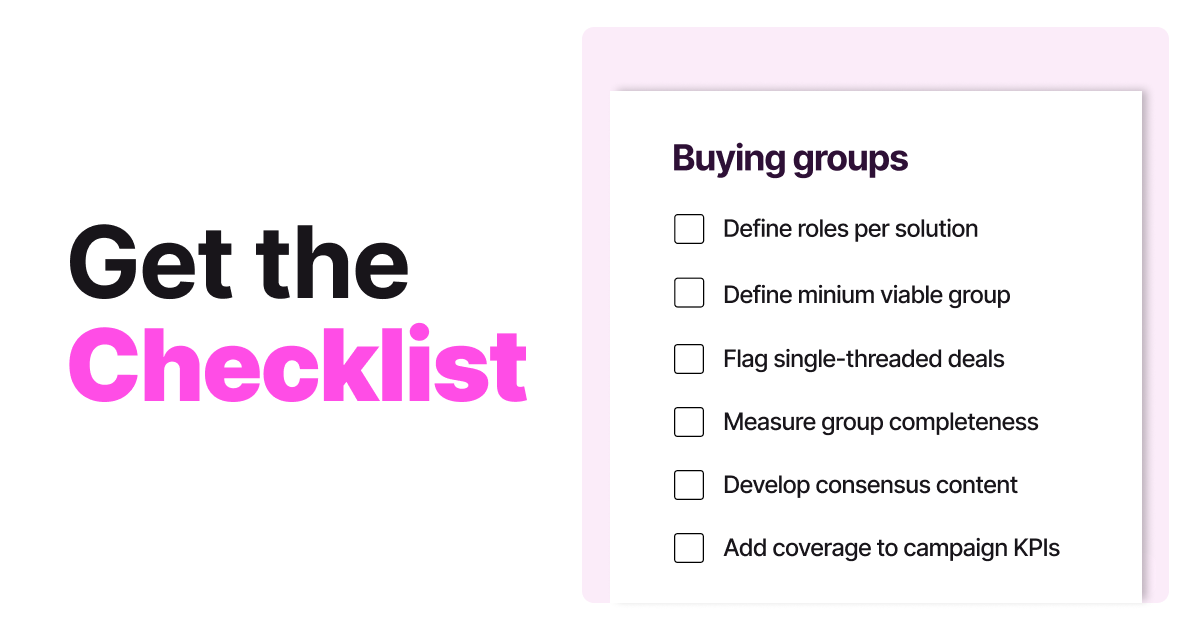
Most of the marketers we hear from with questions regarding buying groups say they’re stuck in analysis paralysis: “Yes, I get it, but how do I do it at an organization like ours?” So our very own Kathy Macchi created this step-by-step checklist to walk you through it.
If it looks long, it is, because it’s thorough. You also don’t have to complete it all to succeed—teams that get even halfway through it will start to see the benefits. Think of it as a long-term roadmap where you prioritize the pieces that are most palatable to your organization today.
Download the buying group checklist here, and read on for Kathy’s full instructions. One overarching piece of advice: Complete these sections sequentially, but skip around to whatever points you want within each.
Step 1: Stop the revenue leakage
Lead-gen is causing you to lose out on revenue, whether you know it or not. Single-threaded sales opportunities are less likely to close and tend to be smaller than multi-threaded opportunities.
That’s because only working through your champion is nice and probably respects their wishes, but it makes things really hard on them. “Why are you putting all that on your champion?” asks Hannah Swanson, VP of marketing at the intent data provider Intentsify. “They’re busy too. They have a job.” So while sales may not want to push the champion to introduce other teams, it’s your job to help those champions realize why, if they want this to happen, it’s in their best interest.
That’s why we say, “Stop the revenue leakage.” Marketers are almost always surprised by how much higher win rates are when they target buying groups. When you make the switch, you can expect to see fewer 11th-hour objections and surprise procurement questions. Win rates improve and you can forecast better, which your CRO will love to see.

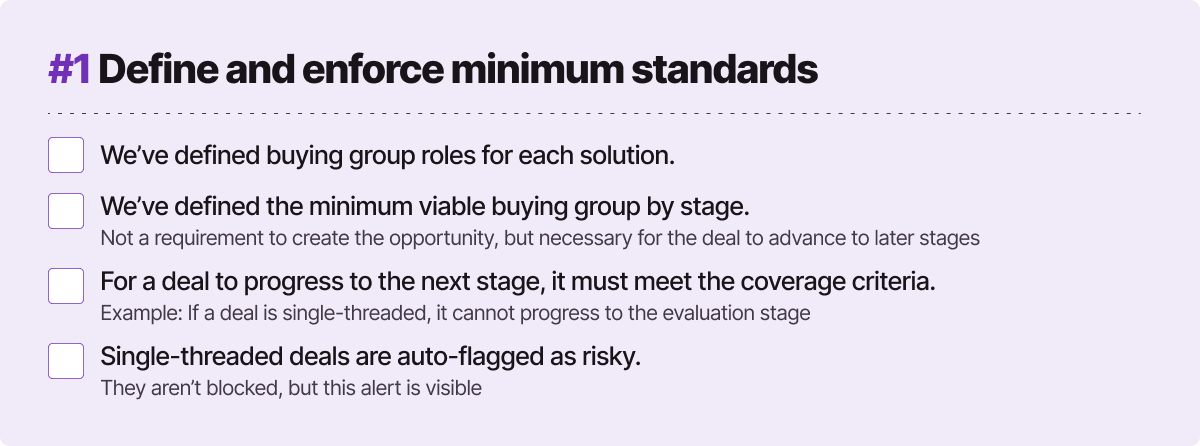
Okay, sub-step one: Define what “buying groups” means to your organization, and enforce minimum standards around them. This might start out as simple as saying, “An account cannot progress to sales qualified until it has four buying roles attached to the account.”
Do the math in your own organization to confirm that exact number. Shanti Kohli, CMO at Sysdig, an analytics platform, found that their number is five.
Next, configure your current martech systems, as far as you are able, to track and capture buying group roles. Note: Roles are not the same as titles. If two IT people show up, that’s still just one technical evaluator “role.” In which case, for Sysdig, that would be 1 out of 5 roles completed, so just 20% completion.
Then the hard part. You have to get other teams to change. Buying groups is not a marketing initiative—and we should be careful about calling it “buying group marketing” too much, lest it get treated like ABM sometimes did: as just added care that marketing gives to sales’ accounts.
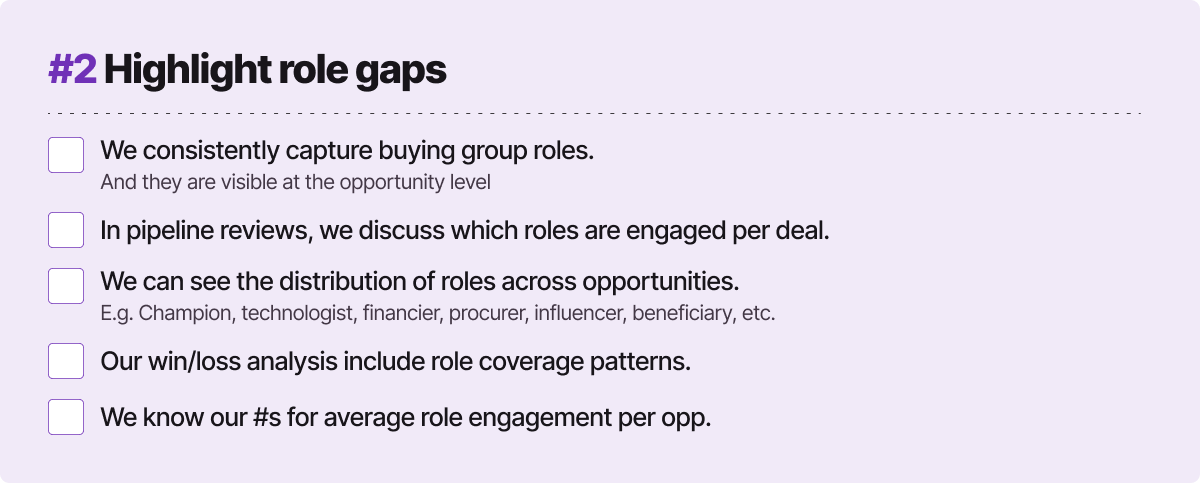
This takes some time, but really sit with this question: If we went all in on buying group theory, what all would we have to update? It should lead you to think about campaign briefs: Add a dimension about not just reaching accounts, but expanding coverage of roles within the account. And think about your signals and data. How can you tell which titles map to which roles? Literally, in Salesforce, how do you track roles at the opportunity level?
And here’s a tricky one: What is an MQL anymore? (The answer for most will be, still drive MQLs—but they matter less, because they’re just to help development reps complete the account.)
One of the biggest and most controversial changes you will likely make is adjusting how sales is compensated. Reward "completing accounts,” which means 1) identifying and 2) engaging buying group members. If you want to be data-driven about this, you can run a regression analysis on closed won and lost accounts over the trailing twelve months to ask that question: How much more valuable is a complete account versus an incomplete account? Tweak compensation accordingly.
Step 2: Systematically expand to reach more roles
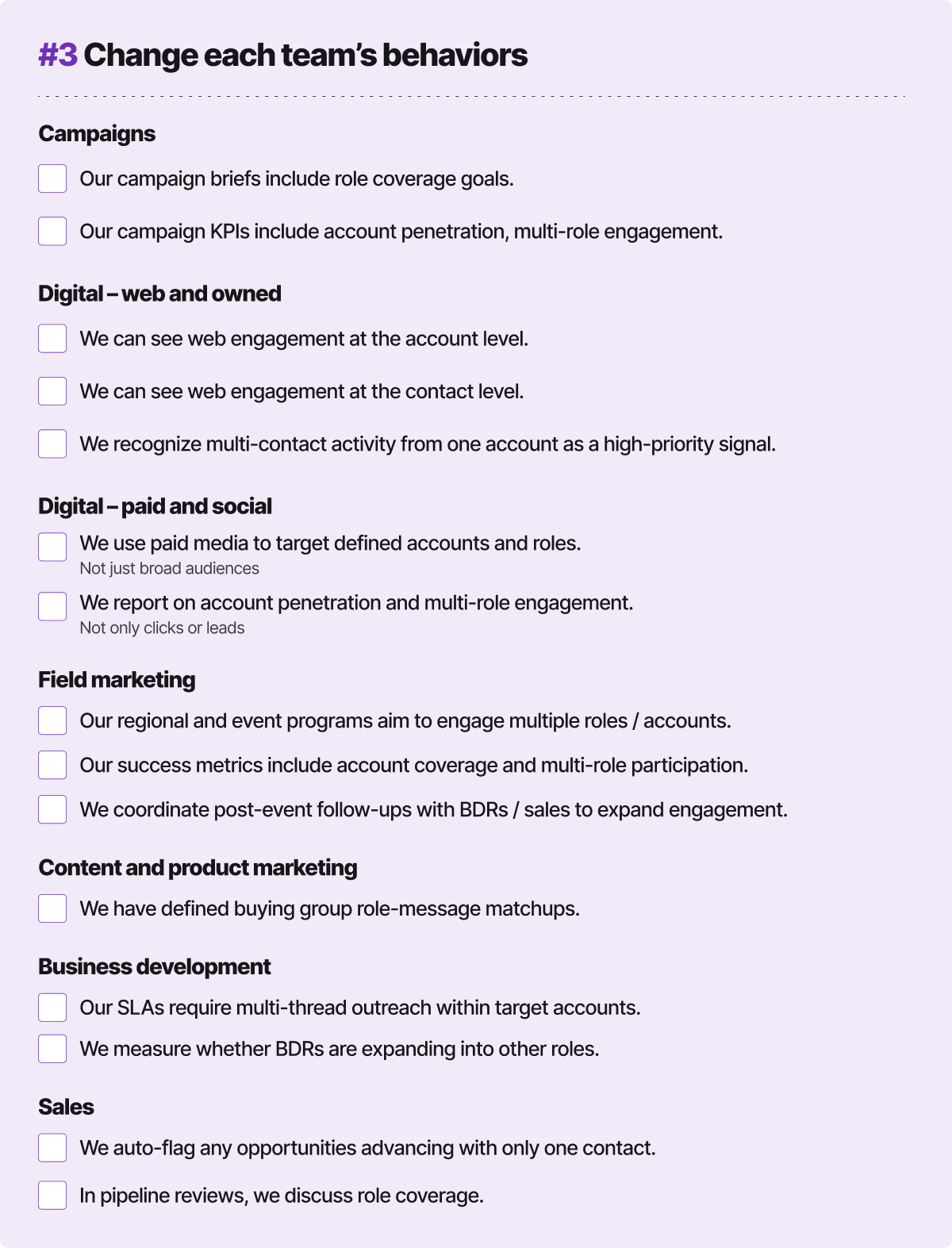
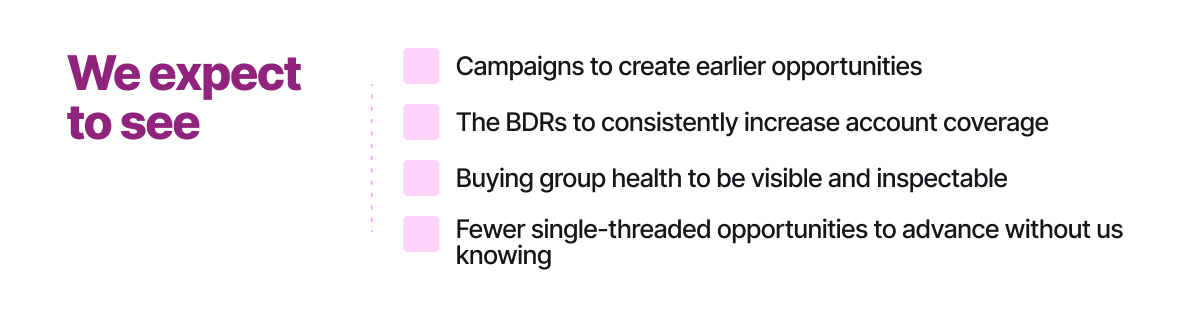
Now that you have the basic tracking and awareness implemented, it’s time to enforce it. This means changing your whole go-to-market motion in many small ways, so it drives toward completing accounts and messaging those buying groups in the proper way.
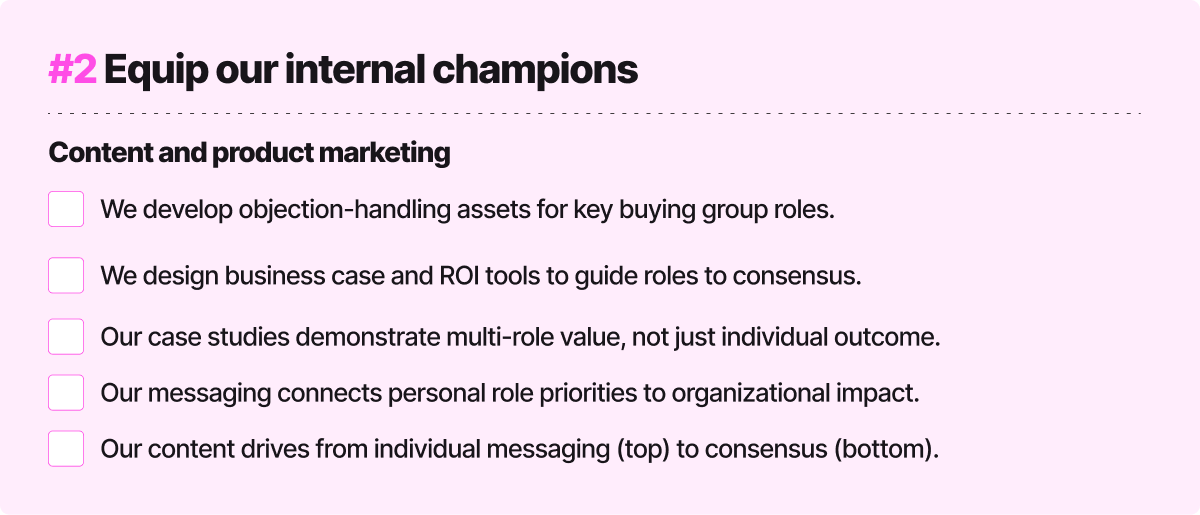
The “proper” way, if you are curious, is to start with individualized messaging to get each person’s attention, then switch to consensus messaging and content to draw that group together. Or as I put it in our recent webinar on this topic, you go from “vibes to value.”
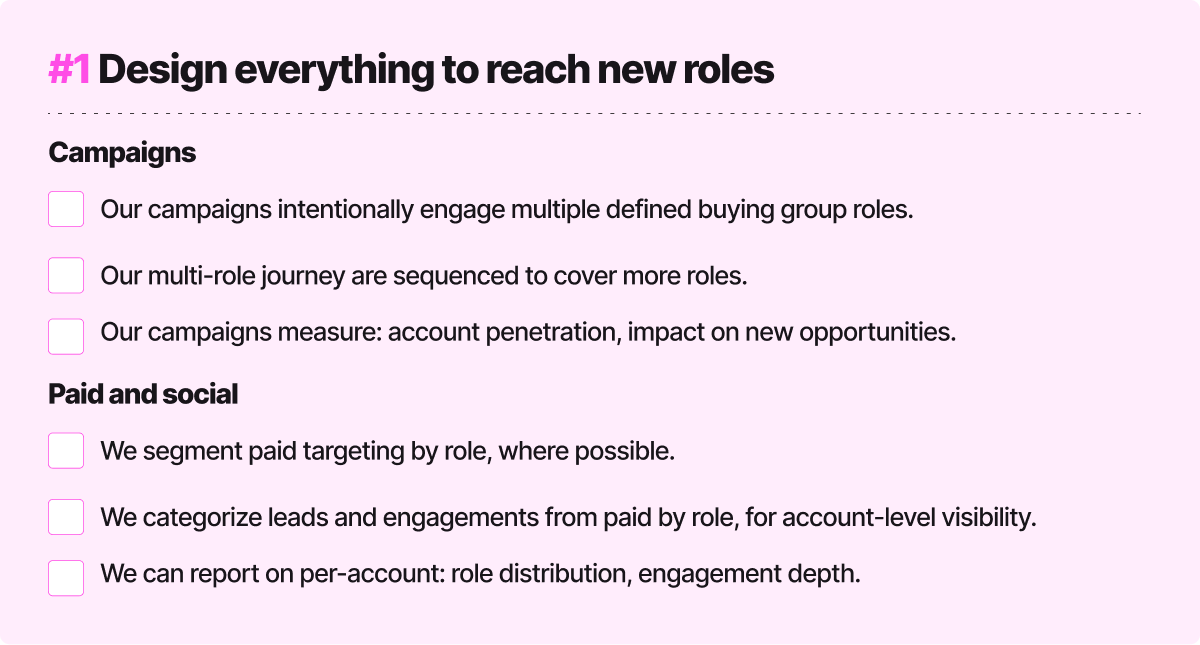
Revisit your buying journey map, if you have one, or create a rough sketch of one for the purposes of this checklist. Is it a primary goal of your next few campaigns to define and expand role coverage in each account? How could they do that? What about your nurtures and always-on campaigns? Do they consider all those separate roles and draw them toward consensus messaging as you go down the funnel?
Ask the same questions of your paid advertising programs. Are you segmenting by role and moving people from vibes to value? Same of reporting. Can you report on per-account role distribution?
Ask for content and product marketing support, and involve them early. Your goal here is relevant, not personalization, actually: It doesn’t matter if any given ebook contains someone’s first name. It matters that the people who receive it say, “Oh, this was written for me!” You can achieve that by having one generic piece of content full of role-based takeaways: “IT managers, that means … finance people, that means …” In fact, it’s actually good for everyone to see the same piece of content, and for teams to know what other teams need to know. That’s a key part of consensus messaging.
Normalize role-based everything across all teams. This’ll probably take a series of recurring meetings that go on for as many months after as needed—maybe as a sort of office hours where people can pop in to ask questions. One upfront training won’t suffice. People need to try—and struggle— to apply this to their own work to figure out what’s actually blocking them.
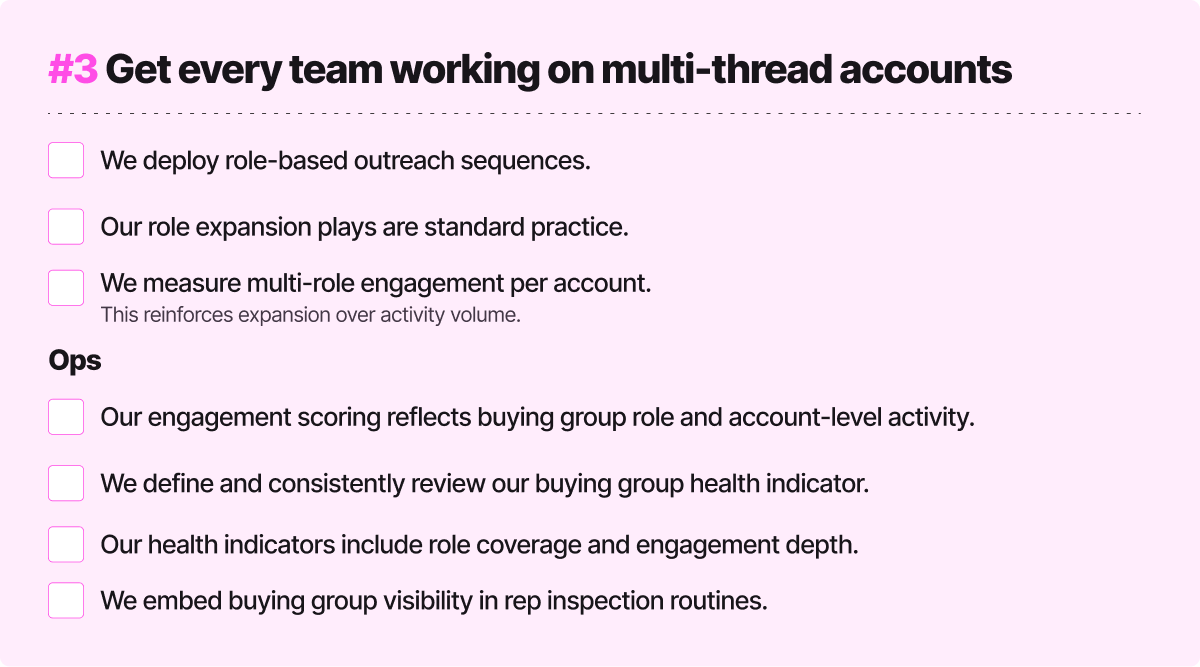
Step 3: Implement buying group governance
If you have reached this step, you are doing buying group go-to-marketing, so congratulations on that. This section focuses on the advanced stuff that’ll turn standardized tactics into a sustainable revenue engine.

Are buying groups the default way of doing this? How deeply are you able to report on group engagement? Are those insights proactive, so sales leaders and account teams can have coaching sessions on what to do differently to drive the deal to close? In a buying-group led organization, salespeople discuss in their 1:1s how they will reach greater coverage within their accounts, not just how they progress them with their champion. And managers and marketers get flags and alerts when accounts have low coverage.
If you have proven it all, you’ll want to start to enforce gates: Deals cannot progress between different stages if they have insufficient account coverage and/or engagement. If the team can’t get more engagement from that account, that tells you a lot about where the deal is headed.
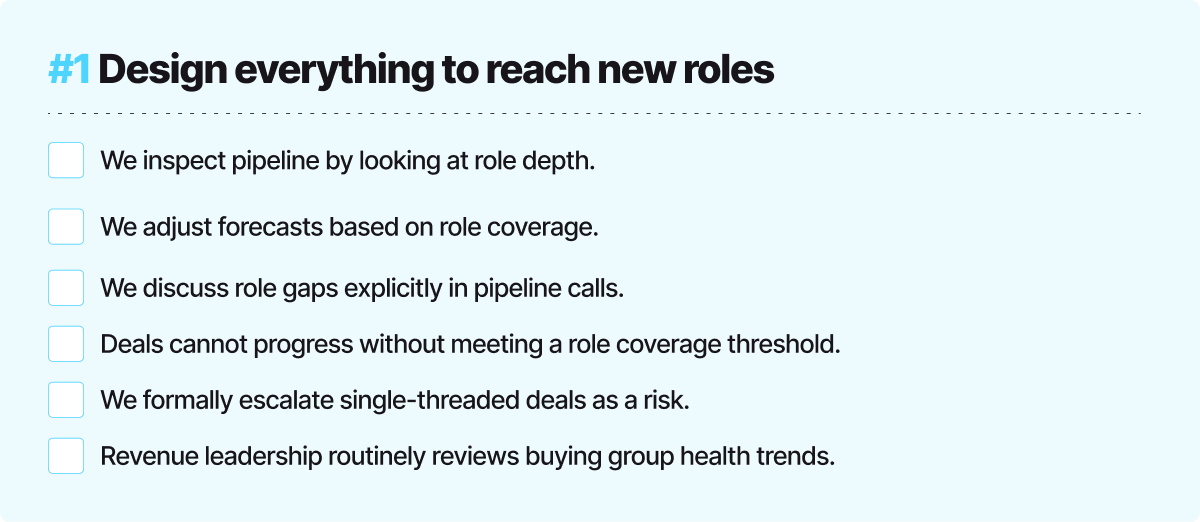
With sales, compensation is the destination. If business development reps and salespeople are not compensated on role coverage, that’s a problem. Same with marketers, to a lesser degree. Everyone should have it in their objectives and key results (OKRs) to increase coverage and engagement along with deal size and wins.
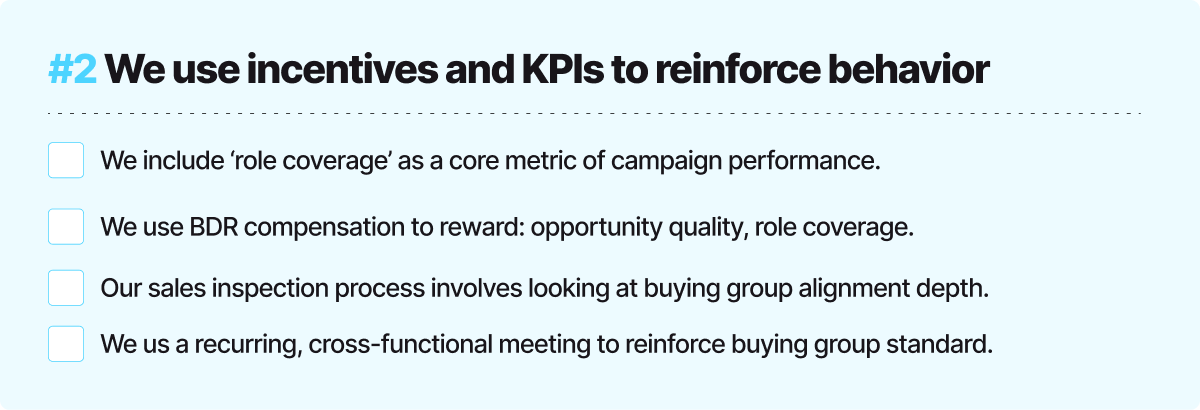
You didn’t think we’d stop at pre-sale, did you? Buying group marketing is just as important, if not more important, in earning renewals, upsells, and the like. The pre-sales process might take nine months, but the customer lifetime will be years. Economic buyers and procurement people on that account will swap out, and you have to be constantly re-assessing and completing the account. Account teams know this intuitively, but too rarely have the time and space to ensure they’re getting multi-threaded within their accounts. All the above advice with pre-sales teams applies here. Customer success managers should be discussing account coverage right alongside NPS.
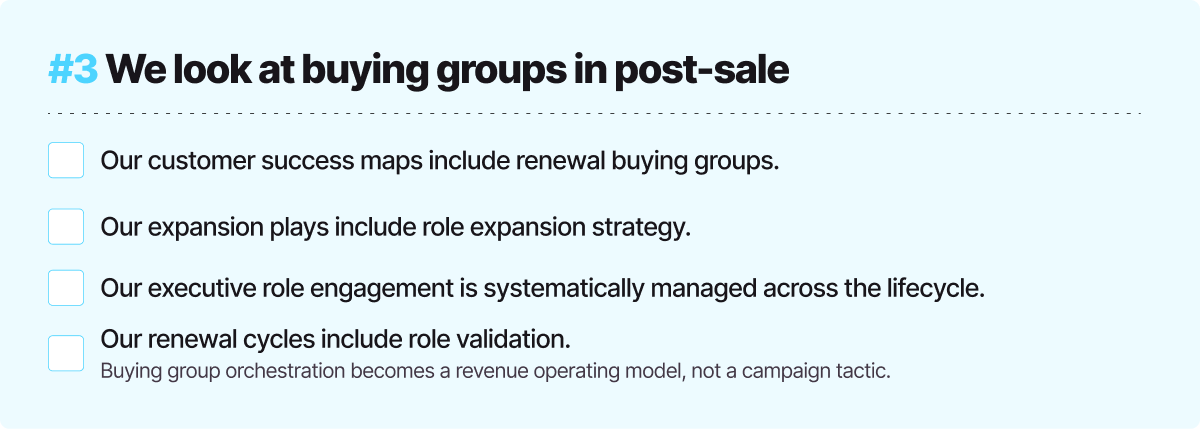
Buying group marketing and sales does pay for itself
Buying groups are work. This demands time from your RevOps team that they most certainly cannot spare. This requires your CMO to spend political capital on this bet, and your CRO to alter the revenue machine and risk it underperforming for a bit. So what’s going to get this deal across the line?
The fact that buying group-focused companies win bigger deals with overall less effort. It’s a “choose your hard” type of situation. To salespeople, not pushing their champion to reach out to procurement or legal feels easy in the short term. But it’s so much harder later on, when those people swoop in with 11th-hour objections that tank the deal.
For help making your case for buying groups, watch the webinar →

About the author
Service page feature

Demand gen


Most of the marketers we hear from with questions regarding buying groups say they’re stuck in analysis paralysis: “Yes, I get it, but how do I do it at an organization like ours?” So our very own Kathy Macchi created this step-by-step checklist to walk you through it.
If it looks long, it is, because it’s thorough. You also don’t have to complete it all to succeed—teams that get even halfway through it will start to see the benefits. Think of it as a long-term roadmap where you prioritize the pieces that are most palatable to your organization today.
Download the buying group checklist here, and read on for Kathy’s full instructions. One overarching piece of advice: Complete these sections sequentially, but skip around to whatever points you want within each.
Step 1: Stop the revenue leakage
Lead-gen is causing you to lose out on revenue, whether you know it or not. Single-threaded sales opportunities are less likely to close and tend to be smaller than multi-threaded opportunities.
That’s because only working through your champion is nice and probably respects their wishes, but it makes things really hard on them. “Why are you putting all that on your champion?” asks Hannah Swanson, VP of marketing at the intent data provider Intentsify. “They’re busy too. They have a job.” So while sales may not want to push the champion to introduce other teams, it’s your job to help those champions realize why, if they want this to happen, it’s in their best interest.
That’s why we say, “Stop the revenue leakage.” Marketers are almost always surprised by how much higher win rates are when they target buying groups. When you make the switch, you can expect to see fewer 11th-hour objections and surprise procurement questions. Win rates improve and you can forecast better, which your CRO will love to see.
Okay, sub-step one: Define what “buying groups” means to your organization, and enforce minimum standards around them. This might start out as simple as saying, “An account cannot progress to sales qualified until it has four buying roles attached to the account.”
Do the math in your own organization to confirm that exact number. Shanti Kohli, CMO at Sysdig, an analytics platform, found that their number is five.
Next, configure your current martech systems, as far as you are able, to track and capture buying group roles. Note: Roles are not the same as titles. If two IT people show up, that’s still just one technical evaluator “role.” In which case, for Sysdig, that would be 1 out of 5 roles completed, so just 20% completion.
Then the hard part. You have to get other teams to change. Buying groups is not a marketing initiative—and we should be careful about calling it “buying group marketing” too much, lest it get treated like ABM sometimes did: as just added care that marketing gives to sales’ accounts.
This takes some time, but really sit with this question: If we went all in on buying group theory, what all would we have to update? It should lead you to think about campaign briefs: Add a dimension about not just reaching accounts, but expanding coverage of roles within the account. And think about your signals and data. How can you tell which titles map to which roles? Literally, in Salesforce, how do you track roles at the opportunity level?
And here’s a tricky one: What is an MQL anymore? (The answer for most will be, still drive MQLs—but they matter less, because they’re just to help development reps complete the account.)
One of the biggest and most controversial changes you will likely make is adjusting how sales is compensated. Reward "completing accounts,” which means 1) identifying and 2) engaging buying group members. If you want to be data-driven about this, you can run a regression analysis on closed won and lost accounts over the trailing twelve months to ask that question: How much more valuable is a complete account versus an incomplete account? Tweak compensation accordingly.
Step 2: Systematically expand to reach more roles
Now that you have the basic tracking and awareness implemented, it’s time to enforce it. This means changing your whole go-to-market motion in many small ways, so it drives toward completing accounts and messaging those buying groups in the proper way.
The “proper” way, if you are curious, is to start with individualized messaging to get each person’s attention, then switch to consensus messaging and content to draw that group together. Or as I put it in our recent webinar on this topic, you go from “vibes to value.”
Revisit your buying journey map, if you have one, or create a rough sketch of one for the purposes of this checklist. Is it a primary goal of your next few campaigns to define and expand role coverage in each account? How could they do that? What about your nurtures and always-on campaigns? Do they consider all those separate roles and draw them toward consensus messaging as you go down the funnel?
Ask the same questions of your paid advertising programs. Are you segmenting by role and moving people from vibes to value? Same of reporting. Can you report on per-account role distribution?
Ask for content and product marketing support, and involve them early. Your goal here is relevant, not personalization, actually: It doesn’t matter if any given ebook contains someone’s first name. It matters that the people who receive it say, “Oh, this was written for me!” You can achieve that by having one generic piece of content full of role-based takeaways: “IT managers, that means … finance people, that means …” In fact, it’s actually good for everyone to see the same piece of content, and for teams to know what other teams need to know. That’s a key part of consensus messaging.
Normalize role-based everything across all teams. This’ll probably take a series of recurring meetings that go on for as many months after as needed—maybe as a sort of office hours where people can pop in to ask questions. One upfront training won’t suffice. People need to try—and struggle— to apply this to their own work to figure out what’s actually blocking them.
Step 3: Implement buying group governance
If you have reached this step, you are doing buying group go-to-marketing, so congratulations on that. This section focuses on the advanced stuff that’ll turn standardized tactics into a sustainable revenue engine.
Are buying groups the default way of doing this? How deeply are you able to report on group engagement? Are those insights proactive, so sales leaders and account teams can have coaching sessions on what to do differently to drive the deal to close? In a buying-group led organization, salespeople discuss in their 1:1s how they will reach greater coverage within their accounts, not just how they progress them with their champion. And managers and marketers get flags and alerts when accounts have low coverage.
If you have proven it all, you’ll want to start to enforce gates: Deals cannot progress between different stages if they have insufficient account coverage and/or engagement. If the team can’t get more engagement from that account, that tells you a lot about where the deal is headed.
With sales, compensation is the destination. If business development reps and salespeople are not compensated on role coverage, that’s a problem. Same with marketers, to a lesser degree. Everyone should have it in their objectives and key results (OKRs) to increase coverage and engagement along with deal size and wins.
You didn’t think we’d stop at pre-sale, did you? Buying group marketing is just as important, if not more important, in earning renewals, upsells, and the like. The pre-sales process might take nine months, but the customer lifetime will be years. Economic buyers and procurement people on that account will swap out, and you have to be constantly re-assessing and completing the account. Account teams know this intuitively, but too rarely have the time and space to ensure they’re getting multi-threaded within their accounts. All the above advice with pre-sales teams applies here. Customer success managers should be discussing account coverage right alongside NPS.
Buying group marketing and sales does pay for itself
Buying groups are work. This demands time from your RevOps team that they most certainly cannot spare. This requires your CMO to spend political capital on this bet, and your CRO to alter the revenue machine and risk it underperforming for a bit. So what’s going to get this deal across the line?
The fact that buying group-focused companies win bigger deals with overall less effort. It’s a “choose your hard” type of situation. To salespeople, not pushing their champion to reach out to procurement or legal feels easy in the short term. But it’s so much harder later on, when those people swoop in with 11th-hour objections that tank the deal.
For help making your case for buying groups, watch the webinar →
Resources
About the author
Service page feature
Demand gen
The #1 buying group marketing checklist—make your switch

Speakers
Other helpful resources
Most of the marketers we hear from with questions regarding buying groups say they’re stuck in analysis paralysis: “Yes, I get it, but how do I do it at an organization like ours?” So our very own Kathy Macchi created this step-by-step checklist to walk you through it.
If it looks long, it is, because it’s thorough. You also don’t have to complete it all to succeed—teams that get even halfway through it will start to see the benefits. Think of it as a long-term roadmap where you prioritize the pieces that are most palatable to your organization today.
Download the buying group checklist here, and read on for Kathy’s full instructions. One overarching piece of advice: Complete these sections sequentially, but skip around to whatever points you want within each.
Step 1: Stop the revenue leakage
Lead-gen is causing you to lose out on revenue, whether you know it or not. Single-threaded sales opportunities are less likely to close and tend to be smaller than multi-threaded opportunities.
That’s because only working through your champion is nice and probably respects their wishes, but it makes things really hard on them. “Why are you putting all that on your champion?” asks Hannah Swanson, VP of marketing at the intent data provider Intentsify. “They’re busy too. They have a job.” So while sales may not want to push the champion to introduce other teams, it’s your job to help those champions realize why, if they want this to happen, it’s in their best interest.
That’s why we say, “Stop the revenue leakage.” Marketers are almost always surprised by how much higher win rates are when they target buying groups. When you make the switch, you can expect to see fewer 11th-hour objections and surprise procurement questions. Win rates improve and you can forecast better, which your CRO will love to see.
Okay, sub-step one: Define what “buying groups” means to your organization, and enforce minimum standards around them. This might start out as simple as saying, “An account cannot progress to sales qualified until it has four buying roles attached to the account.”
Do the math in your own organization to confirm that exact number. Shanti Kohli, CMO at Sysdig, an analytics platform, found that their number is five.
Next, configure your current martech systems, as far as you are able, to track and capture buying group roles. Note: Roles are not the same as titles. If two IT people show up, that’s still just one technical evaluator “role.” In which case, for Sysdig, that would be 1 out of 5 roles completed, so just 20% completion.
Then the hard part. You have to get other teams to change. Buying groups is not a marketing initiative—and we should be careful about calling it “buying group marketing” too much, lest it get treated like ABM sometimes did: as just added care that marketing gives to sales’ accounts.
This takes some time, but really sit with this question: If we went all in on buying group theory, what all would we have to update? It should lead you to think about campaign briefs: Add a dimension about not just reaching accounts, but expanding coverage of roles within the account. And think about your signals and data. How can you tell which titles map to which roles? Literally, in Salesforce, how do you track roles at the opportunity level?
And here’s a tricky one: What is an MQL anymore? (The answer for most will be, still drive MQLs—but they matter less, because they’re just to help development reps complete the account.)
One of the biggest and most controversial changes you will likely make is adjusting how sales is compensated. Reward "completing accounts,” which means 1) identifying and 2) engaging buying group members. If you want to be data-driven about this, you can run a regression analysis on closed won and lost accounts over the trailing twelve months to ask that question: How much more valuable is a complete account versus an incomplete account? Tweak compensation accordingly.
Step 2: Systematically expand to reach more roles
Now that you have the basic tracking and awareness implemented, it’s time to enforce it. This means changing your whole go-to-market motion in many small ways, so it drives toward completing accounts and messaging those buying groups in the proper way.
The “proper” way, if you are curious, is to start with individualized messaging to get each person’s attention, then switch to consensus messaging and content to draw that group together. Or as I put it in our recent webinar on this topic, you go from “vibes to value.”
Revisit your buying journey map, if you have one, or create a rough sketch of one for the purposes of this checklist. Is it a primary goal of your next few campaigns to define and expand role coverage in each account? How could they do that? What about your nurtures and always-on campaigns? Do they consider all those separate roles and draw them toward consensus messaging as you go down the funnel?
Ask the same questions of your paid advertising programs. Are you segmenting by role and moving people from vibes to value? Same of reporting. Can you report on per-account role distribution?
Ask for content and product marketing support, and involve them early. Your goal here is relevant, not personalization, actually: It doesn’t matter if any given ebook contains someone’s first name. It matters that the people who receive it say, “Oh, this was written for me!” You can achieve that by having one generic piece of content full of role-based takeaways: “IT managers, that means … finance people, that means …” In fact, it’s actually good for everyone to see the same piece of content, and for teams to know what other teams need to know. That’s a key part of consensus messaging.
Normalize role-based everything across all teams. This’ll probably take a series of recurring meetings that go on for as many months after as needed—maybe as a sort of office hours where people can pop in to ask questions. One upfront training won’t suffice. People need to try—and struggle— to apply this to their own work to figure out what’s actually blocking them.
Step 3: Implement buying group governance
If you have reached this step, you are doing buying group go-to-marketing, so congratulations on that. This section focuses on the advanced stuff that’ll turn standardized tactics into a sustainable revenue engine.
Are buying groups the default way of doing this? How deeply are you able to report on group engagement? Are those insights proactive, so sales leaders and account teams can have coaching sessions on what to do differently to drive the deal to close? In a buying-group led organization, salespeople discuss in their 1:1s how they will reach greater coverage within their accounts, not just how they progress them with their champion. And managers and marketers get flags and alerts when accounts have low coverage.
If you have proven it all, you’ll want to start to enforce gates: Deals cannot progress between different stages if they have insufficient account coverage and/or engagement. If the team can’t get more engagement from that account, that tells you a lot about where the deal is headed.
With sales, compensation is the destination. If business development reps and salespeople are not compensated on role coverage, that’s a problem. Same with marketers, to a lesser degree. Everyone should have it in their objectives and key results (OKRs) to increase coverage and engagement along with deal size and wins.
You didn’t think we’d stop at pre-sale, did you? Buying group marketing is just as important, if not more important, in earning renewals, upsells, and the like. The pre-sales process might take nine months, but the customer lifetime will be years. Economic buyers and procurement people on that account will swap out, and you have to be constantly re-assessing and completing the account. Account teams know this intuitively, but too rarely have the time and space to ensure they’re getting multi-threaded within their accounts. All the above advice with pre-sales teams applies here. Customer success managers should be discussing account coverage right alongside NPS.
Buying group marketing and sales does pay for itself
Buying groups are work. This demands time from your RevOps team that they most certainly cannot spare. This requires your CMO to spend political capital on this bet, and your CRO to alter the revenue machine and risk it underperforming for a bit. So what’s going to get this deal across the line?
The fact that buying group-focused companies win bigger deals with overall less effort. It’s a “choose your hard” type of situation. To salespeople, not pushing their champion to reach out to procurement or legal feels easy in the short term. But it’s so much harder later on, when those people swoop in with 11th-hour objections that tank the deal.
For help making your case for buying groups, watch the webinar →
About the author
Service page feature