Stuck in the Messy Middle of AI?


In partnership with:
Featuring
Featuring
How are you going to stand out in 2026?
Buyers are in control of the buying process. Over 70% of it is happening online. And they are putting companies on their short list of vendors that provide value and establish trust with their content.
How are you accounting for this in your 2026 strategy?
You need to stand out. To make sure your buyers notice you. Let us help you build that into your strategy for next year -->


The Revenue Marketer

Stuck in the Messy Middle of AI?
Still chasing 10% efficiency gains?
2023-2025 were the years of experimentation with AI. 2026 is the year to make it transformative. If you're still trying to figure out the strategic advantage AI will bring to your team, we're here to help!

About the author
Service page feature

Strategic Planning


Resources
About the author
Service page feature
Strategic Planning
Stuck in the Messy Middle of AI?
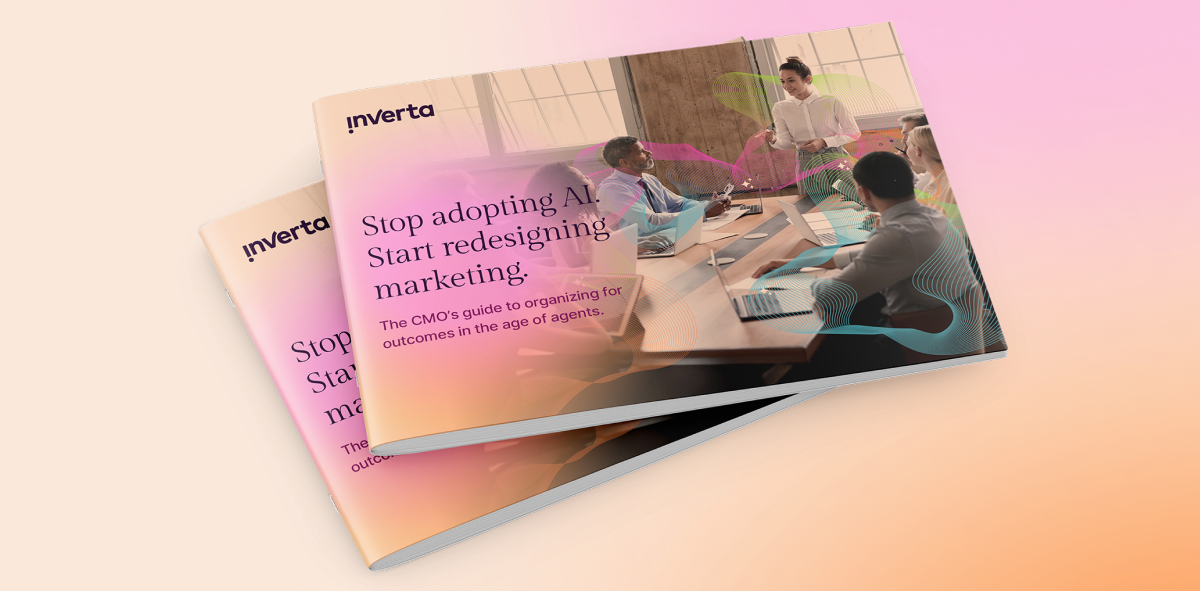
The marketing playbook we all grew up with, professionally speaking, is obsolete. You are likely facing a familiar, uncomfortable squeeze: budgets and headcount are down, but revenue targets are moving up and to the right - what we're affectionately calling "The Era of Less". The standard executive advice is to use AI to "make up the difference," but a simple reduction in headcount combined with a ChatGPT subscription is not a strategy.
The organization that got you here will not get you through 2026.
Kathy Macchi, Inverta's co-founder, recently sat down with Sydney Sloan, CMO of G2, and Craig Rosenberg, Chief Platform Officer at Scale Venture Partners, to discuss the hard truths of organizational design. They didn't offer incremental tweaks. They argued for a fundamental tear-down of the silos we have spent the last decade building.
Here is why your current org chart is failing you, and what you need to build instead.
Move beyond the "10% thinking"
Right now, most marketing teams are stuck in Phase 1 of AI adoption. This is the efficiency phase—using Large Language Models (LLMs) to do the same old work, just faster.
According to Scale Venture Partners’ recent research, marketing has the highest AI adoption of any function at 81%. The top use cases are exactly what you would expect: content creation (97%) and research (73%).
"Marketing teams are producing more assets in a single quarter than they used to in an entire year." - G2 2025 AI Agent Insights Report
This volume is impressive, but it is low-value. It is "10% thinking." The real unlock happens in Phase 2, where you shift focus from volume to outcomes. This is where you stop asking "How can I write this email faster?" and start asking "Do I need to send this email at all, or can an agent handle the entire booking process?"
When teams move to this outcome-based approach—using AI for campaign analysis and account scoring—they are three times more likely to increase pipeline and five times more likely to see increased conversion rates.
The "Rick Rubin Economy" of taste
If AI agents can handle research, segmentation, and drafting, what is left for the humans?
Sydney Sloan calls this the "Rick Rubin Economy". Rick Rubin doesn't play an instrument. He doesn't work the soundboard. Yet he is one of the most successful music producers in history because he has impeccable taste and judgment.
As we democratize creation, judgment becomes the premium skill. You no longer need a marketer who can just grind out copy; you need a "tastemaker" who knows how that copy makes a buyer feel.
This changes your hiring profile. You stop looking for the person with the thickest binder of writing samples. You look for the person who says, "Here is how I used AI to generate 50 variations, and here is why I selected this specific one to go to market". The human is the arbiter of quality. If your team lacks taste, your AI strategy will simply scale mediocrity at lightning speed.
Hire a "Go-to-Market Engineer"
Innovation is moving so fast that your roadmap is obsolete before you finish planning it. To keep up, you need a new role: the Go-to-Market Engineer (or what Craig Rosenberg affectionately calls a "Vibe Coder").
This is not a traditional IT role. This is a technical marketer who sits within the business unit—not in a siloed engineering department—and has their hands in the code. Their job is to build the connective tissue between your strategy and the exploding landscape of AI tools.
Scale Venture Partners found that organizations with a Go-to-Market Engineer were 20% more likely to report high impact from their AI initiatives. Why? because they bridge the gap between the CMO's vision and the technical reality of agentic workflows.
If you cannot hire a full-time engineer yet, look for the innovator with drive on your team. This is the person—often a digital native—who is already automating their own workflows with Zapier or other systems because they are annoyed by repetitive tasks. Find them, and give them the mandate to build.
Organizations with a Go-to-Market Engineer were 20% more likely to report high impact from their AI initiatives. - Scale Venture Partners State of GTM AI Report 2025
Blow up your silos
The most radical idea to come out of our conversation was a complete rejection of the standard "Product Marketing / Demand Gen / Brand" structure.
If you were building a marketing org from scratch today, completely unburdened by legacy titles, Sydney Sloan suggests you might create three outcome-based pods:
- Brand Building and Signal Capture: This merges brand and demand. Their job is not just "awareness" or "MQLs." It is to own the digital presence and execute all the way to the meeting booked.
- Relationship and Engagement: This team takes the signal and expands it across the buying committee. It is a mix of campaign managers, SDRs, and product marketers who understand the persona deeply. Their metric is relationship depth, not just email opens.
- Product Love: This team drives adoption, usage, and in-product education. They ensure the promise made by the first two teams is actually delivered.
This structure forces collaboration. You cannot hide behind "I delivered the lead" if your job description includes "Signal Capture."
Stop hiding behind the roadmap
The biggest mistake leaders make is over-planning. You do not need a six-month study to start rethinking your website or your outreach process.
When G2 wanted to consolidate five websites into one, they didn't issue an RFP to an agency for a $400,000 project. They locked themselves in a room for a hackathon. They used AI to analyze information architecture and propose user flows. They didn't finish the whole site in a day, but they accomplished weeks of work in an afternoon and saved hundreds of thousands of dollars.
The market is moving too fast for perfection. The "Vibe Coders" in Brooklyn are already building an app that competes with you. Speed is your only defense.
Focus on the outcome, not the agent
A word of caution: Do not go to your CFO with an org chart full of AI agents and promise to cut your staff in half. We have not proven that agents can fully replace the strategic nuance of a human marketer yet.
Instead, work backward from the outcome. If the goal is "speed to meeting booked," map that process. Identify where friction exists. Then, and only then, ask which parts can be automated by an agent and which parts require a human tastemaker.
The marketing organizations that win in 2026 will not be the ones with the most AI tools. They will be the ones that reorganized their humans to do the work that only humans can do—judgment, empathy, and taste—while letting the machines handle the rest.
Thank you to our excellent panelists:
- Sydney Sloan, CMO, G2
- Craig Rosenberg, Chief Platform Officer, Scale Venture Partners
- Kathy Macchi, EVP of Innovation & Co-founder, Inverta



About the author
Service page feature