Your AI prompts are only as good as what you feed them

In partnership with:
Featuring
Featuring
How are you going to stand out in 2026?
Buyers are in control of the buying process. Over 70% of it is happening online. And they are putting companies on their short list of vendors that provide value and establish trust with their content.
How are you accounting for this in your 2026 strategy?
You need to stand out. To make sure your buyers notice you. Let us help you build that into your strategy for next year -->


The Revenue Marketer

Your AI prompts are only as good as what you feed them
Still chasing 10% efficiency gains?
2023-2025 were the years of experimentation with AI. 2026 is the year to make it transformative. If you're still trying to figure out the strategic advantage AI will bring to your team, we're here to help!

Ask ChatGPT how to fix your pipeline problem and you'll get an answer. A confident one. It will mention alignment, attribution, and probably the word "synergy." It will also be almost entirely useless, because it has no idea what your pipeline coverage ratio actually is, what your sales team is ignoring, or what happened three months ago when the SDR compensation model changed.
Give the model context, and the answer changes completely. That's the gap Inverta solves for clients every day. An emerging company gets a different play than a company doing a billion in revenue, because the right move depends on actual conditions: growth stage, team structure, buyer complexity. A generic prompt skips all of that and hands you the AI equivalent of a stock playbook. Broadly true. Useful to no one in particular.
We built the Inverta Prompt Library to fix that. It's a set of structured prompts for the moments that keep marketing leaders up at night, starting with the one we hear about most: pipeline pressure.
Why most AI prompts give you nothing you can use
Marketing leaders are already using AI. Most are getting shallow output back because they're asking a reasoning model to reason without giving it anything to reason about.
A prompt with no context about your business can't tell you whether your pipeline gap is a targeting problem, a messaging problem, or a sales process problem wearing a marketing costume. It can only guess, and it guesses toward the generic. Our prompts are built the opposite way. Each one requires specific inputs, applies a defined analytical lens, and asks for a specific output. That's what turns a chatbot into a thinking partner rather than a search engine.
A prompt with no context about your business gets you the AI equivalent of a stock playbook.
Diagnose pipeline pressure before you touch the campaigns
Pipeline pressure hits every B2B marketing leader eventually, and the instinct is to blame the campaigns. Sometimes that's right. More often, the real issue is sitting somewhere else entirely: a broken marketing-to-sales handoff, a targeting model built for a buyer who no longer exists, or a messaging gap nobody's tested since last year's positioning refresh.
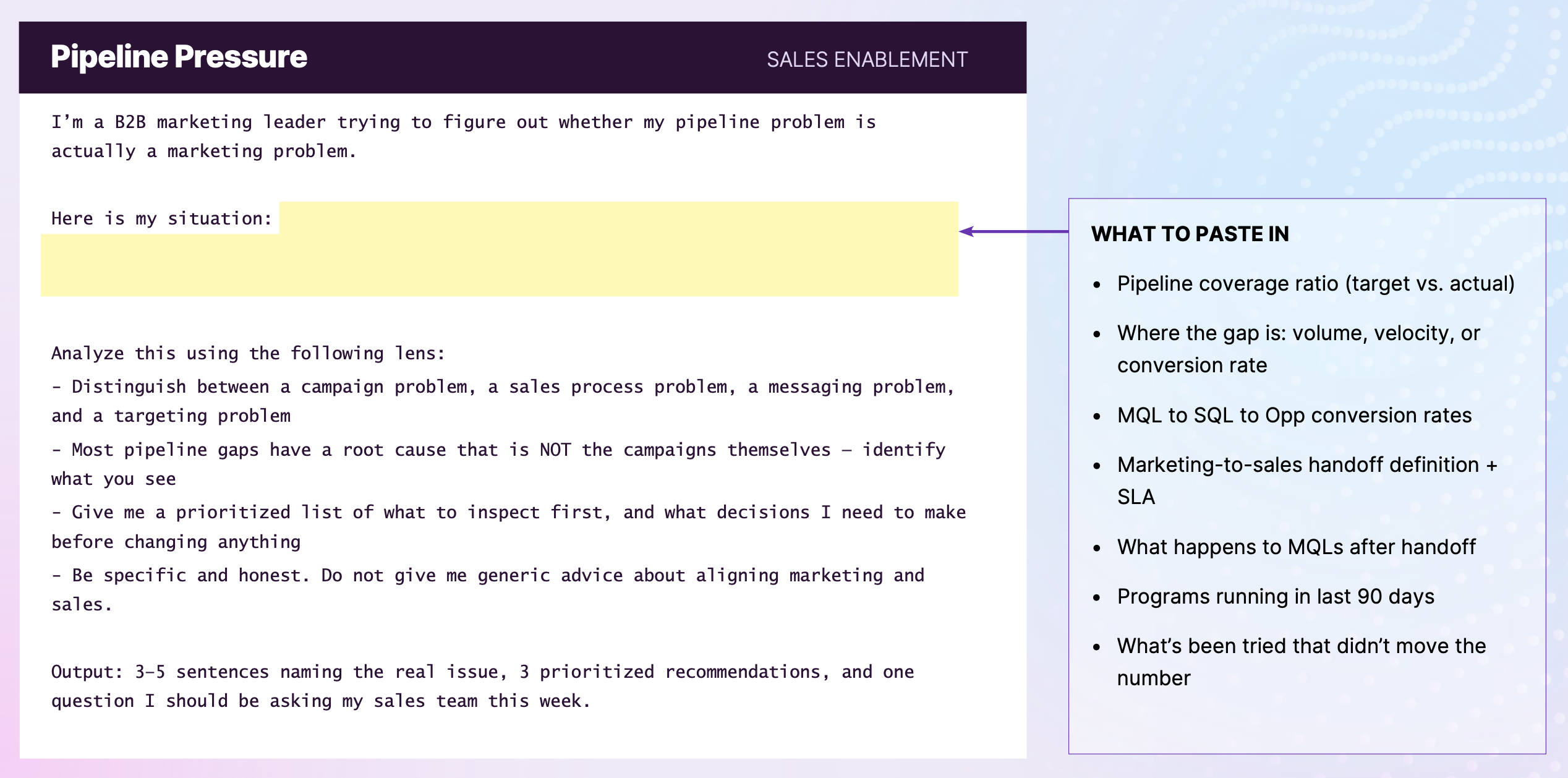
The Pipeline Pressure prompt forces that distinction. It asks you to bring your actual coverage ratio, your MQL to SQL to opportunity conversion rates, your handoff definition, and what you've already tried that didn't move the number. Then it applies a specific lens: separate the campaign problem from the sales process problem from the targeting problem, find the root cause that isn't the campaigns themselves, and prioritize what to inspect before you touch anything.
The output skips the platitudes about "aligning marketing and sales" and gives you 3 to 5 sentences naming the real issue, three prioritized recommendations, and one question to bring to your sales team this week.
Six inputs, one library, every scenario
Pipeline pressure is one prompt among several. The library also covers the moments leaders face on either side of it: stepping into a new role and needing to validate what you're seeing before you change it, prioritizing when every stakeholder thinks their request is the urgent one, deciding what to stop, simplify, or outsource when the team is overcommitted, figuring out where AI actually creates leverage versus more work, proving marketing's value when your attribution isn't perfect, helping buyers discover you before they ever want to talk to sales, and reading whether your account-based marketing program is really building buying group consensus or just generating engagement that goes nowhere.
Every prompt draws from the same six inputs: your team size and structure, your active programs and channels, leadership's expectations and timeline, what you've already tried, your target market, and your sales motion. Gather those once and you can run any prompt in the library with real precision instead of generic filler.
What a prompt can't do for you
We built this library to be an honest diagnostic tool, which means we're honest about its ceiling too.
An AI model can look at your messy spreadsheet and tell you pipeline conversion dropped 30 percent last quarter. It cannot sit in your cross-functional pipeline meeting and notice that your sales reps have quietly stopped working marketing leads because their compensation model changed. It cannot build executive consensus, defend a budget shift to a skeptical CFO, or map the database dependencies your marketing ops team needs to make a new workflow actually stick.
Most strategic pivots die from internal friction the AI never saw. A prompt starts the thinking. Turning that thinking into execution that survives contact with your real organization takes an operational partner who knows the terrain.
We know what it's like to just need a calm, confident senior person beside you who has done it before. - Patrice, cofounder and CEO, Inverta
Start with the questions, then bring us the answers
Download the full prompt library, run the Pipeline Pressure prompt against your own numbers, and see what it surfaces. If what comes back points to a fix your team can make this week, make it. If it points to something bigger, that's usually where the real conversation starts. For more about pressures facing today's b2b marketing teams, check out our full resources center.
Book 30 minutes with Patrice, our CEO and co-founder, and bring what the prompt told you. We'll tell you what it missed.
About the author
Service page feature

Artificial intelligence


Ask ChatGPT how to fix your pipeline problem and you'll get an answer. A confident one. It will mention alignment, attribution, and probably the word "synergy." It will also be almost entirely useless, because it has no idea what your pipeline coverage ratio actually is, what your sales team is ignoring, or what happened three months ago when the SDR compensation model changed.
Give the model context, and the answer changes completely. That's the gap Inverta solves for clients every day. An emerging company gets a different play than a company doing a billion in revenue, because the right move depends on actual conditions: growth stage, team structure, buyer complexity. A generic prompt skips all of that and hands you the AI equivalent of a stock playbook. Broadly true. Useful to no one in particular.
We built the Inverta Prompt Library to fix that. It's a set of structured prompts for the moments that keep marketing leaders up at night, starting with the one we hear about most: pipeline pressure.
Why most AI prompts give you nothing you can use
Marketing leaders are already using AI. Most are getting shallow output back because they're asking a reasoning model to reason without giving it anything to reason about.
A prompt with no context about your business can't tell you whether your pipeline gap is a targeting problem, a messaging problem, or a sales process problem wearing a marketing costume. It can only guess, and it guesses toward the generic. Our prompts are built the opposite way. Each one requires specific inputs, applies a defined analytical lens, and asks for a specific output. That's what turns a chatbot into a thinking partner rather than a search engine.
A prompt with no context about your business gets you the AI equivalent of a stock playbook.
Diagnose pipeline pressure before you touch the campaigns
Pipeline pressure hits every B2B marketing leader eventually, and the instinct is to blame the campaigns. Sometimes that's right. More often, the real issue is sitting somewhere else entirely: a broken marketing-to-sales handoff, a targeting model built for a buyer who no longer exists, or a messaging gap nobody's tested since last year's positioning refresh.
The Pipeline Pressure prompt forces that distinction. It asks you to bring your actual coverage ratio, your MQL to SQL to opportunity conversion rates, your handoff definition, and what you've already tried that didn't move the number. Then it applies a specific lens: separate the campaign problem from the sales process problem from the targeting problem, find the root cause that isn't the campaigns themselves, and prioritize what to inspect before you touch anything.
The output skips the platitudes about "aligning marketing and sales" and gives you 3 to 5 sentences naming the real issue, three prioritized recommendations, and one question to bring to your sales team this week.
Six inputs, one library, every scenario
Pipeline pressure is one prompt among several. The library also covers the moments leaders face on either side of it: stepping into a new role and needing to validate what you're seeing before you change it, prioritizing when every stakeholder thinks their request is the urgent one, deciding what to stop, simplify, or outsource when the team is overcommitted, figuring out where AI actually creates leverage versus more work, proving marketing's value when your attribution isn't perfect, helping buyers discover you before they ever want to talk to sales, and reading whether your account-based marketing program is really building buying group consensus or just generating engagement that goes nowhere.
Every prompt draws from the same six inputs: your team size and structure, your active programs and channels, leadership's expectations and timeline, what you've already tried, your target market, and your sales motion. Gather those once and you can run any prompt in the library with real precision instead of generic filler.
What a prompt can't do for you
We built this library to be an honest diagnostic tool, which means we're honest about its ceiling too.
An AI model can look at your messy spreadsheet and tell you pipeline conversion dropped 30 percent last quarter. It cannot sit in your cross-functional pipeline meeting and notice that your sales reps have quietly stopped working marketing leads because their compensation model changed. It cannot build executive consensus, defend a budget shift to a skeptical CFO, or map the database dependencies your marketing ops team needs to make a new workflow actually stick.
Most strategic pivots die from internal friction the AI never saw. A prompt starts the thinking. Turning that thinking into execution that survives contact with your real organization takes an operational partner who knows the terrain.
We know what it's like to just need a calm, confident senior person beside you who has done it before. - Patrice, cofounder and CEO, Inverta
Start with the questions, then bring us the answers
Download the full prompt library, run the Pipeline Pressure prompt against your own numbers, and see what it surfaces. If what comes back points to a fix your team can make this week, make it. If it points to something bigger, that's usually where the real conversation starts. For more about pressures facing today's b2b marketing teams, check out our full resources center.
Book 30 minutes with Patrice, our CEO and co-founder, and bring what the prompt told you. We'll tell you what it missed.
Resources
About the author
Service page feature
Artificial intelligence
Your AI prompts are only as good as what you feed them

Speakers
Other helpful resources
Ask ChatGPT how to fix your pipeline problem and you'll get an answer. A confident one. It will mention alignment, attribution, and probably the word "synergy." It will also be almost entirely useless, because it has no idea what your pipeline coverage ratio actually is, what your sales team is ignoring, or what happened three months ago when the SDR compensation model changed.
Give the model context, and the answer changes completely. That's the gap Inverta solves for clients every day. An emerging company gets a different play than a company doing a billion in revenue, because the right move depends on actual conditions: growth stage, team structure, buyer complexity. A generic prompt skips all of that and hands you the AI equivalent of a stock playbook. Broadly true. Useful to no one in particular.
We built the Inverta Prompt Library to fix that. It's a set of structured prompts for the moments that keep marketing leaders up at night, starting with the one we hear about most: pipeline pressure.
Why most AI prompts give you nothing you can use
Marketing leaders are already using AI. Most are getting shallow output back because they're asking a reasoning model to reason without giving it anything to reason about.
A prompt with no context about your business can't tell you whether your pipeline gap is a targeting problem, a messaging problem, or a sales process problem wearing a marketing costume. It can only guess, and it guesses toward the generic. Our prompts are built the opposite way. Each one requires specific inputs, applies a defined analytical lens, and asks for a specific output. That's what turns a chatbot into a thinking partner rather than a search engine.
A prompt with no context about your business gets you the AI equivalent of a stock playbook.
Diagnose pipeline pressure before you touch the campaigns
Pipeline pressure hits every B2B marketing leader eventually, and the instinct is to blame the campaigns. Sometimes that's right. More often, the real issue is sitting somewhere else entirely: a broken marketing-to-sales handoff, a targeting model built for a buyer who no longer exists, or a messaging gap nobody's tested since last year's positioning refresh.
The Pipeline Pressure prompt forces that distinction. It asks you to bring your actual coverage ratio, your MQL to SQL to opportunity conversion rates, your handoff definition, and what you've already tried that didn't move the number. Then it applies a specific lens: separate the campaign problem from the sales process problem from the targeting problem, find the root cause that isn't the campaigns themselves, and prioritize what to inspect before you touch anything.
The output skips the platitudes about "aligning marketing and sales" and gives you 3 to 5 sentences naming the real issue, three prioritized recommendations, and one question to bring to your sales team this week.
Six inputs, one library, every scenario
Pipeline pressure is one prompt among several. The library also covers the moments leaders face on either side of it: stepping into a new role and needing to validate what you're seeing before you change it, prioritizing when every stakeholder thinks their request is the urgent one, deciding what to stop, simplify, or outsource when the team is overcommitted, figuring out where AI actually creates leverage versus more work, proving marketing's value when your attribution isn't perfect, helping buyers discover you before they ever want to talk to sales, and reading whether your account-based marketing program is really building buying group consensus or just generating engagement that goes nowhere.
Every prompt draws from the same six inputs: your team size and structure, your active programs and channels, leadership's expectations and timeline, what you've already tried, your target market, and your sales motion. Gather those once and you can run any prompt in the library with real precision instead of generic filler.
What a prompt can't do for you
We built this library to be an honest diagnostic tool, which means we're honest about its ceiling too.
An AI model can look at your messy spreadsheet and tell you pipeline conversion dropped 30 percent last quarter. It cannot sit in your cross-functional pipeline meeting and notice that your sales reps have quietly stopped working marketing leads because their compensation model changed. It cannot build executive consensus, defend a budget shift to a skeptical CFO, or map the database dependencies your marketing ops team needs to make a new workflow actually stick.
Most strategic pivots die from internal friction the AI never saw. A prompt starts the thinking. Turning that thinking into execution that survives contact with your real organization takes an operational partner who knows the terrain.
We know what it's like to just need a calm, confident senior person beside you who has done it before. - Patrice, cofounder and CEO, Inverta
Start with the questions, then bring us the answers
Download the full prompt library, run the Pipeline Pressure prompt against your own numbers, and see what it surfaces. If what comes back points to a fix your team can make this week, make it. If it points to something bigger, that's usually where the real conversation starts. For more about pressures facing today's b2b marketing teams, check out our full resources center.
Book 30 minutes with Patrice, our CEO and co-founder, and bring what the prompt told you. We'll tell you what it missed.
About the author
Service page feature