11 things the best ABM agency would *never* do

In partnership with:
Featuring
Featuring
How are you going to stand out in 2026?
Buyers are in control of the buying process. Over 70% of it is happening online. And they are putting companies on their short list of vendors that provide value and establish trust with their content.
How are you accounting for this in your 2026 strategy?
You need to stand out. To make sure your buyers notice you. Let us help you build that into your strategy for next year -->


The Revenue Marketer

11 things the best ABM agency would *never* do
Still chasing 10% efficiency gains?
2023-2025 were the years of experimentation with AI. 2026 is the year to make it transformative. If you're still trying to figure out the strategic advantage AI will bring to your team, we're here to help!

It’s been 10 years since ABM swept B2B marketing, and haven’t we all learned the key lesson? Execution is everything.
No amount of guidelines or theory can make up for the fact that your teams need firsthand experience thinking about accounts. Decks can’t make salespeople cold call or use the dang message. “High value offers” may earn you a meeting but alone are not enough to compel someone to seriously evaluate. And no amount of saying, “This should be possible in Salesforce …” can ever make that a reality. (Signed, your martech team.)
Hence, over half of organizations that run an account-based marketing program use an agency. And hence you are here: Looking for a group who can execute, not just build a deck to woo the board.
You’ll find a lot of B2B agencies claim to offer account-based marketing and very few that have the case study receipts to show. I.e. Having driven 75% of a 2,000-person company’s inbound pipeline from ABM, or generated 8 opportunities in 3 months, or analyzed 4,444 accounts in 48 hours. Or have invented the ABM certification itself! But we digress.
Actually, we will digress. Schedule a no-pressure consultation, and we’ll answer anything.
However, if you want to know if your ABM agency knows what it’s doing, here are 11 red flags to look out for.
1. Run account-based marketing
Yes, it’s confusing, but insiders know the difference: Account-based is not, and can never be, just a marketing exercise. Jon Miller made a valiant push to rebrand ABM “ABX”—account-based everything, but alas it never stuck.
Real account-based marketing is a co-equal effort between the marketing, sales, success, and product teams to grow revenue from a target list of accounts that are a fit for your product. You need everyone’s buy-in. You need them to feel responsible enough that they do not resort to pointing fingers—none of this, “Marketing, give my accounts more coverage!” or “The accounts were weak!”—only bona fide, joint problem-solving.
Some ABM agencies will try to lure you into a project saying, “We’ll make this easy on the sales team and barely involve them,” and that’s a recipe for disaster later; it ensures virtual fist fights and finger-pointing.
2. Pitch you 1:many ABM
The internet is absolutely littered with diagrams of the ABM trifecta: 1:1, 1:few, and 1:many. Any agency you encounter who is still offering 1:many ABM as of this year has somehow missed out on the prior decade of discussion. Because there’s no such thing. It was one of those ideas that makes sense in theory but has basically never worked in practice because the tools just aren’t there for the level of reliable personalization at scale you need.
Issues with 1:many ABM:
- The real marketing currency today is handmade and in-person.
- Mechanical / AI personalization is never reliable enough at that scale.
- And if a human has to check the LLM’s work, does it save time?
You should read “1:many” as “just demand marketing, but we missed the message because we haven’t yet tried it.”

3. Propose you run ABM as a side pilot
“You can just pilot ABM on the down-low, and prove it out, before announcing it,” some agencies will tell you. And we’d tell you, good luck? Having cleaned up dozens of those experiments, there’s no way around the hardest part of ABM: executive buy-in. Get it now or get it later, you need it, and an ABM side project is just not going to generate the meaningful data you need to make a CRO-ready case. It’s just not. It’s going to generate ambiguous, limited data, and the CRO is still going to ask you to prove it out.
Best, we find, to just ask now and work through those issues because they only become arguments later.
4. Let your company cut the plan down to “just demand gen”
ABM is, by definition, a method for changing how your company works. If you were already coordinating on-target accounts with all go-to-market teams, there’d be no need for it. So if an agency tells you that they can implement ABM but they also say “yes” to the pushback from each of those other teams, they’ll let it get watered down to … just running ads.
How that typically goes:
- You propose full ABM.
- Sales doesn’t want to give up leads, so you agree to do both.
- The CFO won’t give up the MQL, and wants an MQL → MQA equation.
- Martech can’t devote hours to this so you’re tracking in spreadsheets.
- Success can’t afford to retrain right now, so they don’t adjust to buying groups.
- Product’s roadmap is too full, so they sit this one out.
- The agency says “No problem!” to all of it.
But, yes, problem. Big problem! Now you’re just running demand gen and when it doesn’t work like ABM is supposed to, they’ll say “ABM didn’t work.”
5. Buy lead lists and building upon bad data
The debate around “intent” and “signals” is all quite silly because it depends on your audience. I don’t presume to know that audience, but I can bet you a big data provider like ZoomInfo is not going to know them better than you do. So if your ABM agency’s entire plan for running account-specific personalized campaigns to your audience with mostly third-party data, freak out. Garbage in, garbage guaranteed.
That agency needs to have a plan that starts with working with the first-party data you already have, and continuously gathering and improving it as the foundation.
6. Mention “PDF” and “syndication” in the same sentence
When the internet was new, companies invented the email-capture form because there was no other way to measure contact requests. But some things have changed, and if your ABM agency is telling you their primary strategy is to create PDFs to promote via syndication, you’re buying a dinosaur plan. Just ask for those syndication sites and look at them yourself. Would you spend time there? Would you complete that monstrous form? A lot of that traffic isn’t real, many of the clicks aren’t intentional, and the branding options are so limited, most of the people you reach out to will say, “I didn’t download anything, I don’t know what you’re talking about.”
We have never in 10 years of doing this seen that work well enough to be the centerpiece. It is a supplementary motion, and you must be obsessive about greenlighting specific syndication sites.
7. Let the tech lead the conversation
Test your agency: Tell them your current tech stack and nothing else, and ask for a strategy. If their first response is, “No problem,” worry. Any ABM practitioner worth anything knows that strategy leads the technology, period. Real pros don’t bleed purple anymore, they are tech agnostic. They know it’s all in the plan and the execution, and that most systems can be jury-rigged to do most of what they need. And if there’s something missing, it is rarely the deciding factor.
Hard truths:
- Real ABM pros are tech agnostic.
- Real experts know more systems means more mess.
- Real experts will push you to make the strategy lead.
Any ABM agency you talk to that leads with technology is a martech reseller in disguise.
8. Promise shallow personalization
Can we all agree that "personalization" is the vaguest corporate term since synergy? And that creating one ebook and CTRL+F-ing “healthcare” and replacing all with "manufacturing" is not it?
Account-based personalization means tailoring content in a very structured fashion: You need individualized content for every relevant buyer persona, and consensus content that draws them together.
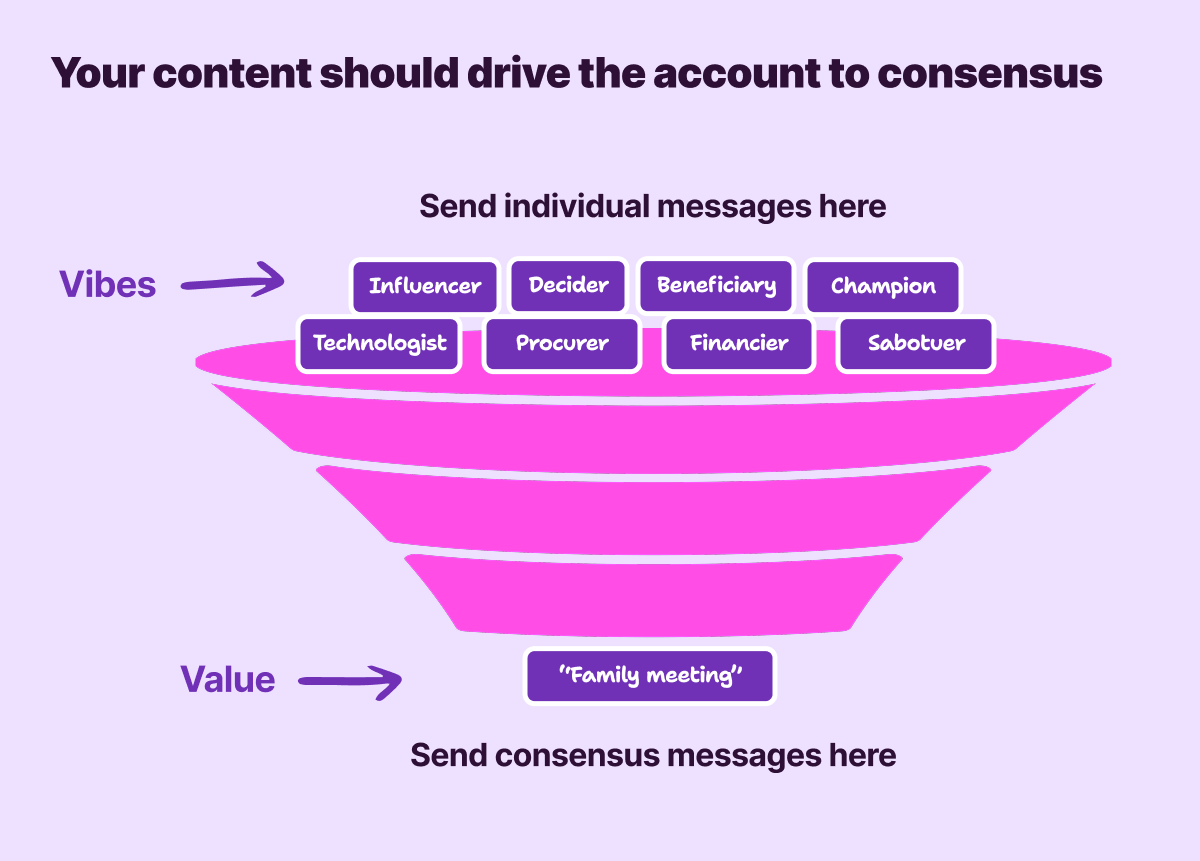
Further, ABM personalization is about layering in real relevance based on all the signals you’re taking in; so you can have your default content, and then you need to tailor the actual outreach. As Kathy Macchi, Inverta Co-Founder says, “There’s no better personalization engine than sales.”
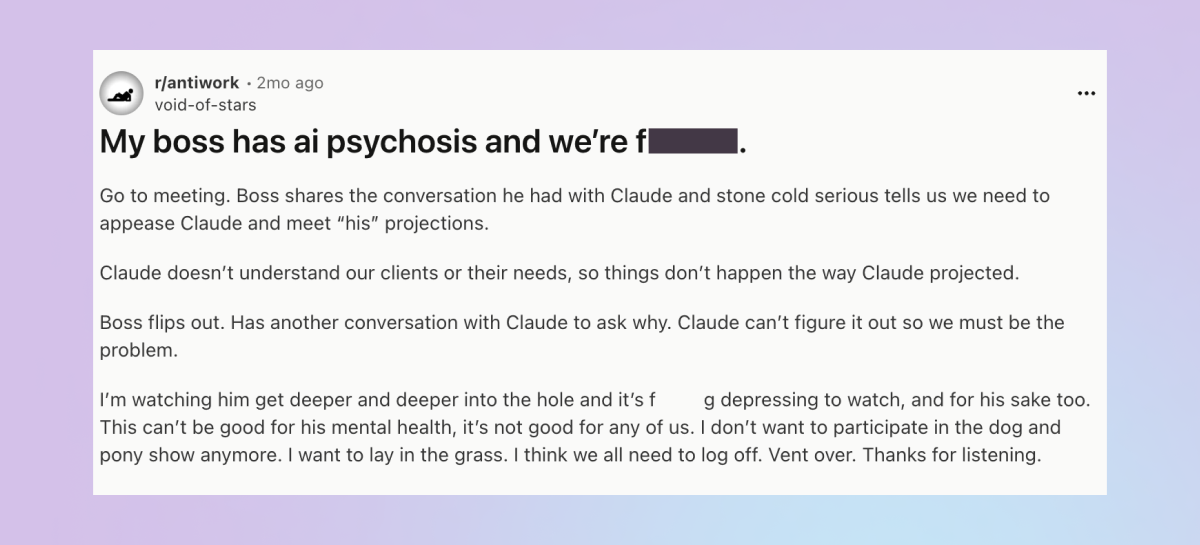
9. Let Claude aka “uncle AI psychosis” take the wheel
Never ever outsource the understanding. That’s got to be the strongest lesson of the past four years of figuring out how to help B2B marketing organizations scale their outputs with LLMs. LLMs are fundamentally prediction tools which guess the next most likely word, not necessarily the truest word; which means they don’t really reason. They are useful. Just where the output is predictable.
And you know what shouldn’t be predictable? Your ABM strategy. If you’re going to pattern-interrupt your audience, you need it to be tailored to your key accounts in a way that is not represented in ChatGPT’s or Claude’s dataset. You need to be unexpected. Not expected. As Claude is going to lead you to.
The result is simple: Lead with human strategy, scale original outputs with AI.
10. Ditch you after the delivery
If the ABM agency is proposing a quick sprint of work with the assumption that you’ll then have highly performing campaigns that run on their own, ask for references. Seriously. ABM is about learning those accounts, adapting what works, and continuously tailoring the ABM playbook, and so 50% of the learnings are in the integration portion. There is almost no point to running ABM unless you are going to learn and adapt. For example, small things I saw come up on the latest engagement:
- Google rejects the ads even though they have less than 20% text (whhy, Googs?).
- The files were too large to actually upload, creatives needed to edit all.
- The customer’s lawyers vigorously objected to the term “delight,” so had to rewrite.
- The least likely outreach sequence was the winner, we had to double down on that.
- The buyer wasn’t the signer and we needed to add another profile.
- The company learned a lot from sales and success feedback.
- And so on and so on.
Don’t sign on with a partner that’s going to take their best guess and leave that back-half and all the learning and updating and improvement, to you.
11. Sub-contracting your poor project into oblivion
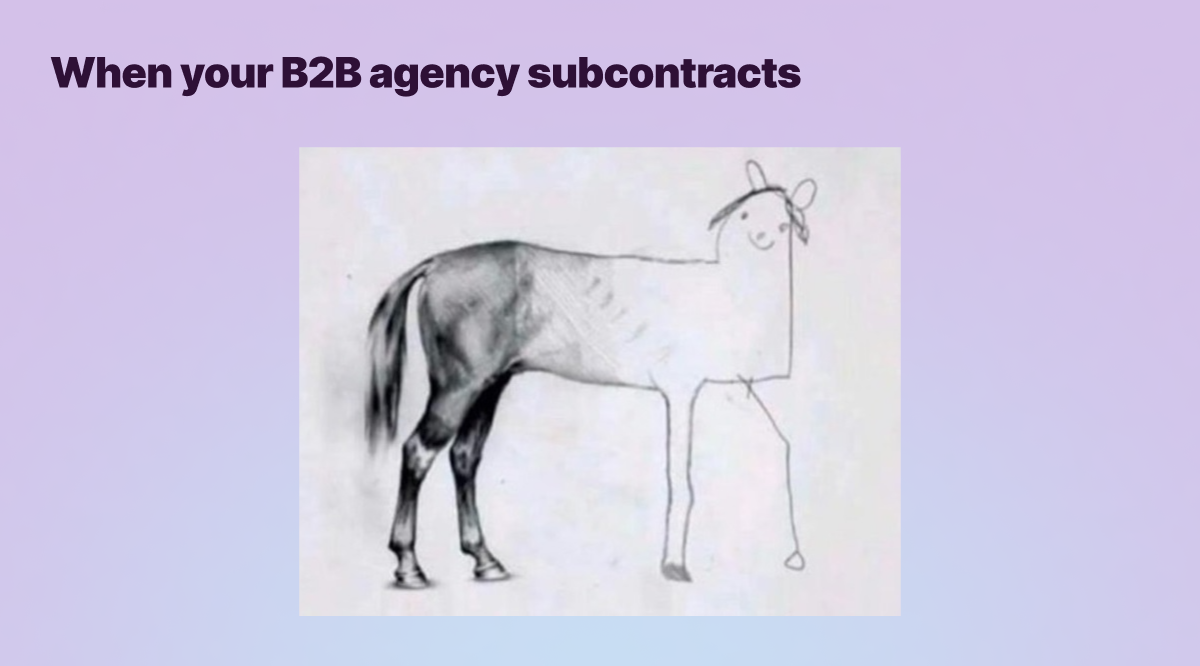
Agency founders love to jump on the call and share wisdom. But will they stay on the account? Ensure you meet your delivery team, and that you like and trust them every bit as much as the pre-sales team. Write into your contract what’s allowed or disallowed, like subcontracting. (Never without express permission.) The last thing you want is an ABM agency that outsources the account research or graphic design to someone far more junior, and scrambles what would have been a clear message into a middle school art project.
Want an agency that’ll do ZERO of these things?
Then you’re looking for a team like Inverta.

About the author
Service page feature

Account-based marketing


It’s been 10 years since ABM swept B2B marketing, and haven’t we all learned the key lesson? Execution is everything.
No amount of guidelines or theory can make up for the fact that your teams need firsthand experience thinking about accounts. Decks can’t make salespeople cold call or use the dang message. “High value offers” may earn you a meeting but alone are not enough to compel someone to seriously evaluate. And no amount of saying, “This should be possible in Salesforce …” can ever make that a reality. (Signed, your martech team.)
Hence, over half of organizations that run an account-based marketing program use an agency. And hence you are here: Looking for a group who can execute, not just build a deck to woo the board.
You’ll find a lot of B2B agencies claim to offer account-based marketing and very few that have the case study receipts to show. I.e. Having driven 75% of a 2,000-person company’s inbound pipeline from ABM, or generated 8 opportunities in 3 months, or analyzed 4,444 accounts in 48 hours. Or have invented the ABM certification itself! But we digress.
Actually, we will digress. Schedule a no-pressure consultation, and we’ll answer anything.
However, if you want to know if your ABM agency knows what it’s doing, here are 11 red flags to look out for.
1. Run account-based marketing
Yes, it’s confusing, but insiders know the difference: Account-based is not, and can never be, just a marketing exercise. Jon Miller made a valiant push to rebrand ABM “ABX”—account-based everything, but alas it never stuck.
Real account-based marketing is a co-equal effort between the marketing, sales, success, and product teams to grow revenue from a target list of accounts that are a fit for your product. You need everyone’s buy-in. You need them to feel responsible enough that they do not resort to pointing fingers—none of this, “Marketing, give my accounts more coverage!” or “The accounts were weak!”—only bona fide, joint problem-solving.
Some ABM agencies will try to lure you into a project saying, “We’ll make this easy on the sales team and barely involve them,” and that’s a recipe for disaster later; it ensures virtual fist fights and finger-pointing.
2. Pitch you 1:many ABM
The internet is absolutely littered with diagrams of the ABM trifecta: 1:1, 1:few, and 1:many. Any agency you encounter who is still offering 1:many ABM as of this year has somehow missed out on the prior decade of discussion. Because there’s no such thing. It was one of those ideas that makes sense in theory but has basically never worked in practice because the tools just aren’t there for the level of reliable personalization at scale you need.
Issues with 1:many ABM:
- The real marketing currency today is handmade and in-person.
- Mechanical / AI personalization is never reliable enough at that scale.
- And if a human has to check the LLM’s work, does it save time?
You should read “1:many” as “just demand marketing, but we missed the message because we haven’t yet tried it.”
3. Propose you run ABM as a side pilot
“You can just pilot ABM on the down-low, and prove it out, before announcing it,” some agencies will tell you. And we’d tell you, good luck? Having cleaned up dozens of those experiments, there’s no way around the hardest part of ABM: executive buy-in. Get it now or get it later, you need it, and an ABM side project is just not going to generate the meaningful data you need to make a CRO-ready case. It’s just not. It’s going to generate ambiguous, limited data, and the CRO is still going to ask you to prove it out.
Best, we find, to just ask now and work through those issues because they only become arguments later.
4. Let your company cut the plan down to “just demand gen”
ABM is, by definition, a method for changing how your company works. If you were already coordinating on-target accounts with all go-to-market teams, there’d be no need for it. So if an agency tells you that they can implement ABM but they also say “yes” to the pushback from each of those other teams, they’ll let it get watered down to … just running ads.
How that typically goes:
- You propose full ABM.
- Sales doesn’t want to give up leads, so you agree to do both.
- The CFO won’t give up the MQL, and wants an MQL → MQA equation.
- Martech can’t devote hours to this so you’re tracking in spreadsheets.
- Success can’t afford to retrain right now, so they don’t adjust to buying groups.
- Product’s roadmap is too full, so they sit this one out.
- The agency says “No problem!” to all of it.
But, yes, problem. Big problem! Now you’re just running demand gen and when it doesn’t work like ABM is supposed to, they’ll say “ABM didn’t work.”
5. Buy lead lists and building upon bad data
The debate around “intent” and “signals” is all quite silly because it depends on your audience. I don’t presume to know that audience, but I can bet you a big data provider like ZoomInfo is not going to know them better than you do. So if your ABM agency’s entire plan for running account-specific personalized campaigns to your audience with mostly third-party data, freak out. Garbage in, garbage guaranteed.
That agency needs to have a plan that starts with working with the first-party data you already have, and continuously gathering and improving it as the foundation.
6. Mention “PDF” and “syndication” in the same sentence
When the internet was new, companies invented the email-capture form because there was no other way to measure contact requests. But some things have changed, and if your ABM agency is telling you their primary strategy is to create PDFs to promote via syndication, you’re buying a dinosaur plan. Just ask for those syndication sites and look at them yourself. Would you spend time there? Would you complete that monstrous form? A lot of that traffic isn’t real, many of the clicks aren’t intentional, and the branding options are so limited, most of the people you reach out to will say, “I didn’t download anything, I don’t know what you’re talking about.”
We have never in 10 years of doing this seen that work well enough to be the centerpiece. It is a supplementary motion, and you must be obsessive about greenlighting specific syndication sites.
7. Let the tech lead the conversation
Test your agency: Tell them your current tech stack and nothing else, and ask for a strategy. If their first response is, “No problem,” worry. Any ABM practitioner worth anything knows that strategy leads the technology, period. Real pros don’t bleed purple anymore, they are tech agnostic. They know it’s all in the plan and the execution, and that most systems can be jury-rigged to do most of what they need. And if there’s something missing, it is rarely the deciding factor.
Hard truths:
- Real ABM pros are tech agnostic.
- Real experts know more systems means more mess.
- Real experts will push you to make the strategy lead.
Any ABM agency you talk to that leads with technology is a martech reseller in disguise.
8. Promise shallow personalization
Can we all agree that "personalization" is the vaguest corporate term since synergy? And that creating one ebook and CTRL+F-ing “healthcare” and replacing all with "manufacturing" is not it?
Account-based personalization means tailoring content in a very structured fashion: You need individualized content for every relevant buyer persona, and consensus content that draws them together.
Further, ABM personalization is about layering in real relevance based on all the signals you’re taking in; so you can have your default content, and then you need to tailor the actual outreach. As Kathy Macchi, Inverta Co-Founder says, “There’s no better personalization engine than sales.”
9. Let Claude aka “uncle AI psychosis” take the wheel
Never ever outsource the understanding. That’s got to be the strongest lesson of the past four years of figuring out how to help B2B marketing organizations scale their outputs with LLMs. LLMs are fundamentally prediction tools which guess the next most likely word, not necessarily the truest word; which means they don’t really reason. They are useful. Just where the output is predictable.
And you know what shouldn’t be predictable? Your ABM strategy. If you’re going to pattern-interrupt your audience, you need it to be tailored to your key accounts in a way that is not represented in ChatGPT’s or Claude’s dataset. You need to be unexpected. Not expected. As Claude is going to lead you to.
The result is simple: Lead with human strategy, scale original outputs with AI.
10. Ditch you after the delivery
If the ABM agency is proposing a quick sprint of work with the assumption that you’ll then have highly performing campaigns that run on their own, ask for references. Seriously. ABM is about learning those accounts, adapting what works, and continuously tailoring the ABM playbook, and so 50% of the learnings are in the integration portion. There is almost no point to running ABM unless you are going to learn and adapt. For example, small things I saw come up on the latest engagement:
- Google rejects the ads even though they have less than 20% text (whhy, Googs?).
- The files were too large to actually upload, creatives needed to edit all.
- The customer’s lawyers vigorously objected to the term “delight,” so had to rewrite.
- The least likely outreach sequence was the winner, we had to double down on that.
- The buyer wasn’t the signer and we needed to add another profile.
- The company learned a lot from sales and success feedback.
- And so on and so on.
Don’t sign on with a partner that’s going to take their best guess and leave that back-half and all the learning and updating and improvement, to you.
11. Sub-contracting your poor project into oblivion
Agency founders love to jump on the call and share wisdom. But will they stay on the account? Ensure you meet your delivery team, and that you like and trust them every bit as much as the pre-sales team. Write into your contract what’s allowed or disallowed, like subcontracting. (Never without express permission.) The last thing you want is an ABM agency that outsources the account research or graphic design to someone far more junior, and scrambles what would have been a clear message into a middle school art project.
Want an agency that’ll do ZERO of these things?
Then you’re looking for a team like Inverta.
Resources
About the author
Service page feature
Account-based marketing
11 things the best ABM agency would *never* do

Speakers
Other helpful resources
It’s been 10 years since ABM swept B2B marketing, and haven’t we all learned the key lesson? Execution is everything.
No amount of guidelines or theory can make up for the fact that your teams need firsthand experience thinking about accounts. Decks can’t make salespeople cold call or use the dang message. “High value offers” may earn you a meeting but alone are not enough to compel someone to seriously evaluate. And no amount of saying, “This should be possible in Salesforce …” can ever make that a reality. (Signed, your martech team.)
Hence, over half of organizations that run an account-based marketing program use an agency. And hence you are here: Looking for a group who can execute, not just build a deck to woo the board.
You’ll find a lot of B2B agencies claim to offer account-based marketing and very few that have the case study receipts to show. I.e. Having driven 75% of a 2,000-person company’s inbound pipeline from ABM, or generated 8 opportunities in 3 months, or analyzed 4,444 accounts in 48 hours. Or have invented the ABM certification itself! But we digress.
Actually, we will digress. Schedule a no-pressure consultation, and we’ll answer anything.
However, if you want to know if your ABM agency knows what it’s doing, here are 11 red flags to look out for.
1. Run account-based marketing
Yes, it’s confusing, but insiders know the difference: Account-based is not, and can never be, just a marketing exercise. Jon Miller made a valiant push to rebrand ABM “ABX”—account-based everything, but alas it never stuck.
Real account-based marketing is a co-equal effort between the marketing, sales, success, and product teams to grow revenue from a target list of accounts that are a fit for your product. You need everyone’s buy-in. You need them to feel responsible enough that they do not resort to pointing fingers—none of this, “Marketing, give my accounts more coverage!” or “The accounts were weak!”—only bona fide, joint problem-solving.
Some ABM agencies will try to lure you into a project saying, “We’ll make this easy on the sales team and barely involve them,” and that’s a recipe for disaster later; it ensures virtual fist fights and finger-pointing.
2. Pitch you 1:many ABM
The internet is absolutely littered with diagrams of the ABM trifecta: 1:1, 1:few, and 1:many. Any agency you encounter who is still offering 1:many ABM as of this year has somehow missed out on the prior decade of discussion. Because there’s no such thing. It was one of those ideas that makes sense in theory but has basically never worked in practice because the tools just aren’t there for the level of reliable personalization at scale you need.
Issues with 1:many ABM:
- The real marketing currency today is handmade and in-person.
- Mechanical / AI personalization is never reliable enough at that scale.
- And if a human has to check the LLM’s work, does it save time?
You should read “1:many” as “just demand marketing, but we missed the message because we haven’t yet tried it.”
3. Propose you run ABM as a side pilot
“You can just pilot ABM on the down-low, and prove it out, before announcing it,” some agencies will tell you. And we’d tell you, good luck? Having cleaned up dozens of those experiments, there’s no way around the hardest part of ABM: executive buy-in. Get it now or get it later, you need it, and an ABM side project is just not going to generate the meaningful data you need to make a CRO-ready case. It’s just not. It’s going to generate ambiguous, limited data, and the CRO is still going to ask you to prove it out.
Best, we find, to just ask now and work through those issues because they only become arguments later.
4. Let your company cut the plan down to “just demand gen”
ABM is, by definition, a method for changing how your company works. If you were already coordinating on-target accounts with all go-to-market teams, there’d be no need for it. So if an agency tells you that they can implement ABM but they also say “yes” to the pushback from each of those other teams, they’ll let it get watered down to … just running ads.
How that typically goes:
- You propose full ABM.
- Sales doesn’t want to give up leads, so you agree to do both.
- The CFO won’t give up the MQL, and wants an MQL → MQA equation.
- Martech can’t devote hours to this so you’re tracking in spreadsheets.
- Success can’t afford to retrain right now, so they don’t adjust to buying groups.
- Product’s roadmap is too full, so they sit this one out.
- The agency says “No problem!” to all of it.
But, yes, problem. Big problem! Now you’re just running demand gen and when it doesn’t work like ABM is supposed to, they’ll say “ABM didn’t work.”
5. Buy lead lists and building upon bad data
The debate around “intent” and “signals” is all quite silly because it depends on your audience. I don’t presume to know that audience, but I can bet you a big data provider like ZoomInfo is not going to know them better than you do. So if your ABM agency’s entire plan for running account-specific personalized campaigns to your audience with mostly third-party data, freak out. Garbage in, garbage guaranteed.
That agency needs to have a plan that starts with working with the first-party data you already have, and continuously gathering and improving it as the foundation.
6. Mention “PDF” and “syndication” in the same sentence
When the internet was new, companies invented the email-capture form because there was no other way to measure contact requests. But some things have changed, and if your ABM agency is telling you their primary strategy is to create PDFs to promote via syndication, you’re buying a dinosaur plan. Just ask for those syndication sites and look at them yourself. Would you spend time there? Would you complete that monstrous form? A lot of that traffic isn’t real, many of the clicks aren’t intentional, and the branding options are so limited, most of the people you reach out to will say, “I didn’t download anything, I don’t know what you’re talking about.”
We have never in 10 years of doing this seen that work well enough to be the centerpiece. It is a supplementary motion, and you must be obsessive about greenlighting specific syndication sites.
7. Let the tech lead the conversation
Test your agency: Tell them your current tech stack and nothing else, and ask for a strategy. If their first response is, “No problem,” worry. Any ABM practitioner worth anything knows that strategy leads the technology, period. Real pros don’t bleed purple anymore, they are tech agnostic. They know it’s all in the plan and the execution, and that most systems can be jury-rigged to do most of what they need. And if there’s something missing, it is rarely the deciding factor.
Hard truths:
- Real ABM pros are tech agnostic.
- Real experts know more systems means more mess.
- Real experts will push you to make the strategy lead.
Any ABM agency you talk to that leads with technology is a martech reseller in disguise.
8. Promise shallow personalization
Can we all agree that "personalization" is the vaguest corporate term since synergy? And that creating one ebook and CTRL+F-ing “healthcare” and replacing all with "manufacturing" is not it?
Account-based personalization means tailoring content in a very structured fashion: You need individualized content for every relevant buyer persona, and consensus content that draws them together.
Further, ABM personalization is about layering in real relevance based on all the signals you’re taking in; so you can have your default content, and then you need to tailor the actual outreach. As Kathy Macchi, Inverta Co-Founder says, “There’s no better personalization engine than sales.”
9. Let Claude aka “uncle AI psychosis” take the wheel
Never ever outsource the understanding. That’s got to be the strongest lesson of the past four years of figuring out how to help B2B marketing organizations scale their outputs with LLMs. LLMs are fundamentally prediction tools which guess the next most likely word, not necessarily the truest word; which means they don’t really reason. They are useful. Just where the output is predictable.
And you know what shouldn’t be predictable? Your ABM strategy. If you’re going to pattern-interrupt your audience, you need it to be tailored to your key accounts in a way that is not represented in ChatGPT’s or Claude’s dataset. You need to be unexpected. Not expected. As Claude is going to lead you to.
The result is simple: Lead with human strategy, scale original outputs with AI.
10. Ditch you after the delivery
If the ABM agency is proposing a quick sprint of work with the assumption that you’ll then have highly performing campaigns that run on their own, ask for references. Seriously. ABM is about learning those accounts, adapting what works, and continuously tailoring the ABM playbook, and so 50% of the learnings are in the integration portion. There is almost no point to running ABM unless you are going to learn and adapt. For example, small things I saw come up on the latest engagement:
- Google rejects the ads even though they have less than 20% text (whhy, Googs?).
- The files were too large to actually upload, creatives needed to edit all.
- The customer’s lawyers vigorously objected to the term “delight,” so had to rewrite.
- The least likely outreach sequence was the winner, we had to double down on that.
- The buyer wasn’t the signer and we needed to add another profile.
- The company learned a lot from sales and success feedback.
- And so on and so on.
Don’t sign on with a partner that’s going to take their best guess and leave that back-half and all the learning and updating and improvement, to you.
11. Sub-contracting your poor project into oblivion
Agency founders love to jump on the call and share wisdom. But will they stay on the account? Ensure you meet your delivery team, and that you like and trust them every bit as much as the pre-sales team. Write into your contract what’s allowed or disallowed, like subcontracting. (Never without express permission.) The last thing you want is an ABM agency that outsources the account research or graphic design to someone far more junior, and scrambles what would have been a clear message into a middle school art project.
Want an agency that’ll do ZERO of these things?
Then you’re looking for a team like Inverta.
About the author
Service page feature