B2B buying group insights—here’s all the research

In partnership with:
Featuring
Featuring
How are you going to stand out in 2026?
Buyers are in control of the buying process. Over 70% of it is happening online. And they are putting companies on their short list of vendors that provide value and establish trust with their content.
How are you accounting for this in your 2026 strategy?
You need to stand out. To make sure your buyers notice you. Let us help you build that into your strategy for next year -->


The Revenue Marketer

B2B buying group insights—here’s all the research
Still chasing 10% efficiency gains?
2023-2025 were the years of experimentation with AI. 2026 is the year to make it transformative. If you're still trying to figure out the strategic advantage AI will bring to your team, we're here to help!

We didn’t just save you a click, we’ve saved you hundreds. We read all the Gartner, Forrester, and 6Sense reports about buying groups in existence so you don’t have to.
In this guide, we’ll lay out the case for buying groups in all its statistical rigor. Perhaps you know it’s the right approach, but you just don’t have enough evidence to make the case. I think you’ll find this article is useful for weighing the question for yourself, and for presenting to your CRO and others.
At the end, our friends at Intentsify share the results of research they’ve done to prove the effectiveness of intent data in buying group marketing. TL;DR on that, you need signal data at the role level, not just category or account.

Selling to individuals shrinks deals
By the numbers:
Tailoring messages to individuals lowers group consensus by 59% and 40% less likely to complete a high-quality purchase. - Gartner
Only 3% of buyers will ever fill out a form. - 6Sense
88% of B2B purchases involve 2+ people. 38% involve 4+. - Gartner
When you speak to one person, deals are smaller and win rates are lower. - Gartner
This should come as a rude shock to marketers who, since 1999, have been on a personalization bender. But we should all remember: Buying has gotten really hard. By 2018, 67% of B2B buyers were telling Gartner they couldn’t make sense of the crush of information, and that’s before the widespread use of large language models. Now, one-third of all new websites are AI-generated. An AWS study in 2024 found that 47% of all content seemed like low-quality AI sludge.
That was years ago. Today, it’s worse. Buyers can easily fall into a personalized advertising echo chamber and all end up blaming others on the committee rather than agreeing. To wit, buyers who each see their own “version” of your marketing message are 59% less likely to come to consensus.
If they don’t come to consensus, that stalls your deals. You lose to a poor decision, or no decision.
The gifting platform Sendoso ran into this exact issue. They suddenly noticed that too many of their small and medium deals started going sideways and they invested in multi-threading all accounts, of every size—ensuring they had at least two contacts in different departments. Their conversions rebounded. Now, they don’t go-to-market without considering buying groups.
They also use AI the right way: to personalize high-quality assets in small ways that get the right attention, to get the group together. (Also, with gifts.)
Listen to the head of sales Tyler Bernstein tell this story:
Selling to groups increases deal sizes
By the numbers:
Collective relevance increases consensus. And high consensus groups are 2.5% more likely to feel they made the right decision. - Gartner
Sysdig switched to buying group marketing and increased contract sizes 36%. - Inverta
Palo Alto Networks switched to buying groups and saw a 260% increase in BDR conversions and 2.6% larger deal sizes. - Forrester
When you get the group together, you accumulate more budget. Engineering and product, for example, may both decide to split the cost of your solution. Or, higher-level executives may get involved and say, “Let’s move some budget around.”
It also makes deals go faster. “I would never advocate for bullying,” laughs Hannah Swanson, VP of Marketing at Intentsify, “But … multiple people putting pressure on procurement can unstick deals that might have been lost.”
Consensus is something you have to organize—it doesn’t happen by accident. Marketers do not naturally invite the legal team or procurement to join calls. By definition, the different buying group roles do not talk amongst themselves enough. That’s why you have to very actively design content with callouts and asidees for each group member. “By the way, legal, this means for you.” And yes, it’s crucial they all be one PDF asset or page—you need those groups overlapping and seeing, “Oh, I guess that’s what IT needs to know, I’ll ask about SOC 2 Type II.”
Marketing is playing a bigger and bigger role
By the numbers:
95% of vendors are already on the day-one shortlist, up from 85% two years ago. - 6Sense
67% of buyers say they prefer a rep-free buying experience. - Gartner
81% have already chosen their preferred vendor. - 6Sense
17% of the buying process is spent meeting with suppliers. If they’re talking to three vendors, you might get just 5 or 6% of their time. - Gartner
Buyers say they have prior personal experience with at least one of the vendors on their shortlist 97% of the time. - 6Sense
In 2025, buyers initiated 79% of engagements. - 6Sense
Buying group “marketing” is actually a misnomer—it’s a whole team, entire go-to-market effort. And yet, marketing really is the star of the show. (Don’t tell sales.) Two-thirds of B2B buyers say they’d really prefer a sales-rep-free buying experience, and with people doing so much research online ahead of time, they’ve basically decided which vendor they want by the time they enter an evaluation. 6Sense’s research is definitive on this point.
Prospective buyers encounter a problem at work and over time, start thinking, “We need to buy something /hire someone for this.” At which point, they draft a “day one” list in their head. Typically, three vendors. If you are not on that list, it is very hard to win the deal.
How do you get into their head? Brand. There’s a reason so many B2B tech companies are investing in brand marketing in what feels like a downturn: There is just so much competition, they have no choice. If anyone can spin up a competitive demo of a fictitious product overnight, it’s very hard to get on that day- one shortlist. Even if that fake product won’t work, IT teams everywhere are attempting to create internal software applications using LLMs to avoid paying those recurring software licenses. When the developer tech company Temporal asked engineers, “Have you built something that you’d previously have purchased?” 67% said, “Yes, and it’s working.”
Brand is maybe not what you think. It demands you take a risk. A real risk. One that makes your palms sweat.
AI-powered ‘fake personalization’ fatigue is real
By the numbers:
75% of B2B buyers will prefer sales experiences that prioritize human interaction over AI. - Gartner
Nearly 90% of buyers report that AI features are now part of the solutions they acquired. - 6Sense
I’d like to reframe all of today’s talk of “personalization.” Buyers don’t need the white paper to carry their face and say “Made just for you.” They aren’t twelve. They know how LLMs work. And they know that if the output feels cheap, it’s probably slop, and not particularly useful.
My reframe is this: Aim for relevance. Relevance may not involve any of what you’d think of as “personalization.” When I was at Demandbase, we’d create white papers where we’d swap out the title page and change some words, and voila: A general ABM marketing guide would suddenly be a healthcare ABM marketing guide. And it worked. And it still works.
All that matters is each buyer on the committee gets their questions answered and feels seen. Sometimes you can send one PDF to 1,000 people on a list and if you segmented well, they all think it was personal outreach. So, don’t wrap yourself up making content worse when it doesn’t help with relevance. You may already have that.
Most marketing teams have the buying group tech, but not the talent
By the numbers:
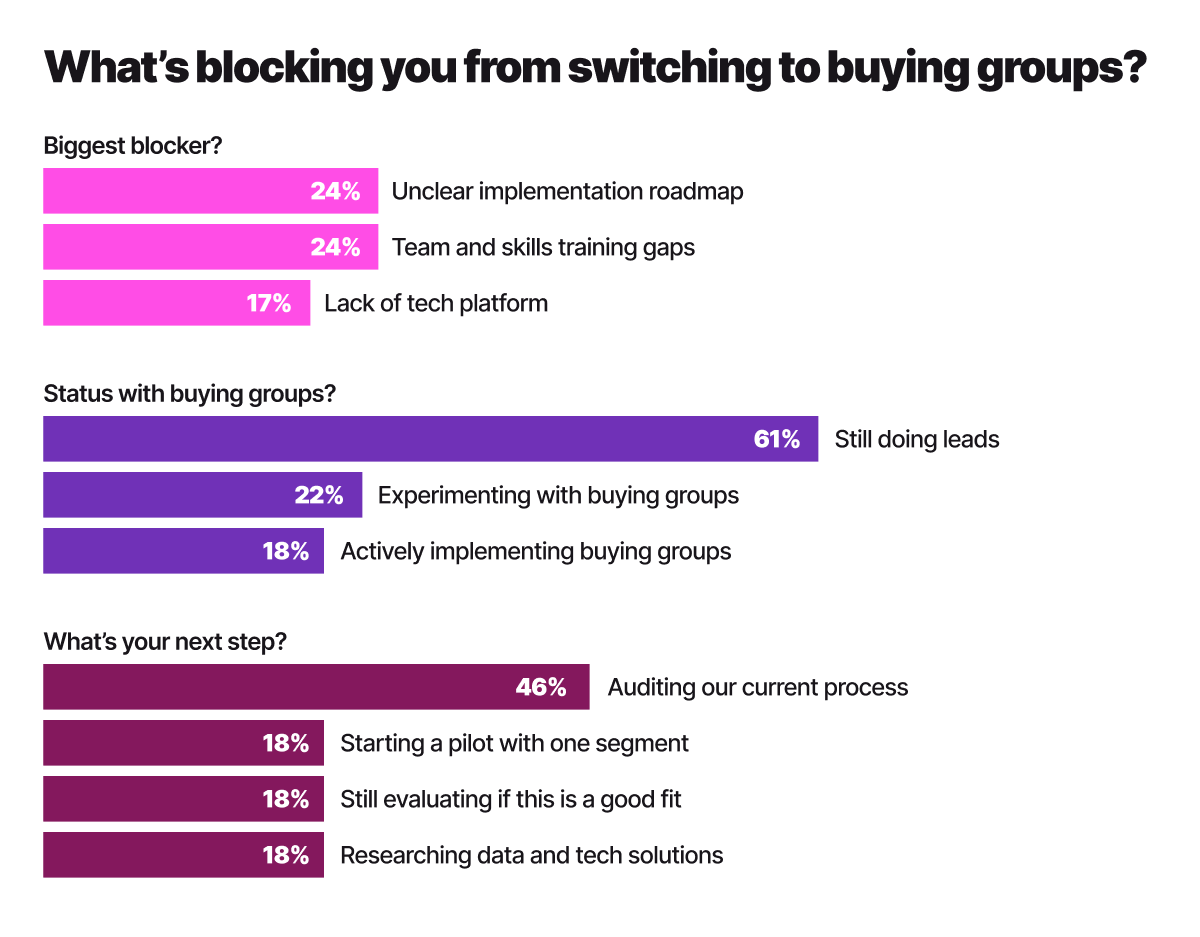
Tech is not the thing blocking marketers, according to a poll we ran on a recent buying group webinar. Instead, they feel equally blocked by how to proceed and with having the skills on the team to pull it off. Our webinar attendees from Sendoso and Intentisfy echoed this. “Nobody’s tech is set up for buying groups,” says Brandie Marone, SVP of Sales Operations at Intentisfy. “Everyone has to jury-rig it, to pull the information in.”
There are two approaches you can take: high road and low road. Below, Intentsify shares its low-tech approach, then Sendoso shares its high-tech approach. Both can work. Again, buying groups is a mental filter you put on when looking at all your marketing activities, and think, “This’d be better if we had more consensus pulling for us in that account.”
The data is clear: You will need persona-level intent data
Not all intent data is created equal. First, you will need more than just form-fill data if you want to understand all the buying personas involved in the deal. Just 3% of buyers fill out a form. And what they give you via a typical ebook download form is sparse—if they answer honestly.
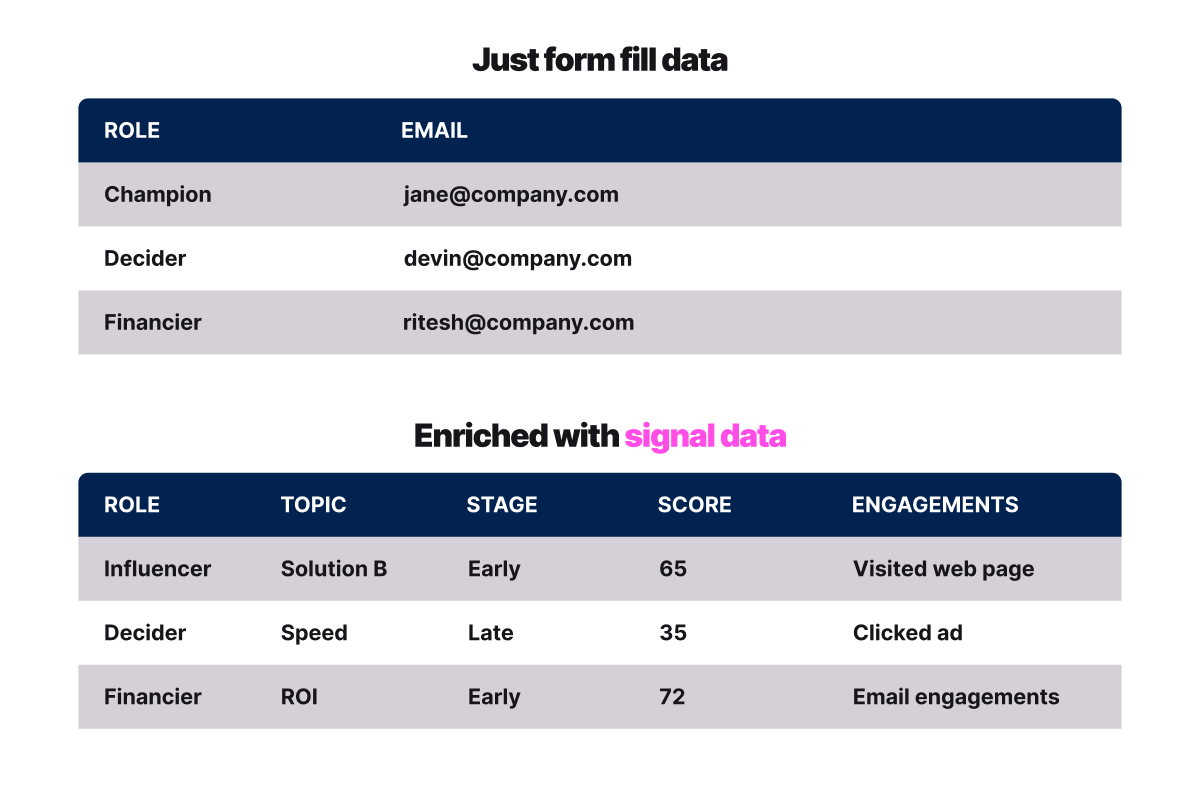
And further, the type of intent data you use matters. Most providers surface category-level intent at the account level, but Intentsify has experimented with going deeper, delivering solution-level and persona-level intent for the buying groups within those accounts, and found that granularity makes a substantial difference.
When you have role-specific data, you can actually complete the account. You can catch glimmers of insight into the known-unknown personas (procurement is finally poring through our terms of service) and the personas (why is HR involved?).

Without visibility into the right decision-makers, even the most promising accounts can stall. Account-wide signals alone can be misleading: Account A may show moderate intent while Account B appears to be surging, but if Account A's signals are coming from actual decision-makers and Account B's activity is driven by people with no purchasing authority, you're chasing the wrong opportunity.
This is where buying-group insights change everything. Most of the buying journey happens long before a prospect ever fills out a "request a demo" form. Having the data to surface those hidden engagements early isn't just useful, it's essential.
Making your case
If you are convinced and want to convince others, we find the best approach is to reverse-engineer your presentation in terms of what they care about. Which maybe sounds obvious. But one of the top things CROs find interesting about buying groups is the predictability.
When you know that having five roles attached to an account makes it 3x more likely to close, and where BDRs, marketing, and sales are all focused on those accounts that are showing the highest completion/cross-role engagement, forecasts grow more accurate. That gives your CRO the certainty they crave and the materials they need to make a case to the CEO and board.
For more, I recommend watching the whole webinar we did on this →
About the author
Service page feature

Account-based marketing


We didn’t just save you a click, we’ve saved you hundreds. We read all the Gartner, Forrester, and 6Sense reports about buying groups in existence so you don’t have to.
In this guide, we’ll lay out the case for buying groups in all its statistical rigor. Perhaps you know it’s the right approach, but you just don’t have enough evidence to make the case. I think you’ll find this article is useful for weighing the question for yourself, and for presenting to your CRO and others.
At the end, our friends at Intentsify share the results of research they’ve done to prove the effectiveness of intent data in buying group marketing. TL;DR on that, you need signal data at the role level, not just category or account.
Selling to individuals shrinks deals
By the numbers:
Tailoring messages to individuals lowers group consensus by 59% and 40% less likely to complete a high-quality purchase. - Gartner
Only 3% of buyers will ever fill out a form. - 6Sense
88% of B2B purchases involve 2+ people. 38% involve 4+. - Gartner
When you speak to one person, deals are smaller and win rates are lower. - Gartner
This should come as a rude shock to marketers who, since 1999, have been on a personalization bender. But we should all remember: Buying has gotten really hard. By 2018, 67% of B2B buyers were telling Gartner they couldn’t make sense of the crush of information, and that’s before the widespread use of large language models. Now, one-third of all new websites are AI-generated. An AWS study in 2024 found that 47% of all content seemed like low-quality AI sludge.
That was years ago. Today, it’s worse. Buyers can easily fall into a personalized advertising echo chamber and all end up blaming others on the committee rather than agreeing. To wit, buyers who each see their own “version” of your marketing message are 59% less likely to come to consensus.
If they don’t come to consensus, that stalls your deals. You lose to a poor decision, or no decision.
The gifting platform Sendoso ran into this exact issue. They suddenly noticed that too many of their small and medium deals started going sideways and they invested in multi-threading all accounts, of every size—ensuring they had at least two contacts in different departments. Their conversions rebounded. Now, they don’t go-to-market without considering buying groups.
They also use AI the right way: to personalize high-quality assets in small ways that get the right attention, to get the group together. (Also, with gifts.)
Listen to the head of sales Tyler Bernstein tell this story:
Selling to groups increases deal sizes
By the numbers:
Collective relevance increases consensus. And high consensus groups are 2.5% more likely to feel they made the right decision. - Gartner
Sysdig switched to buying group marketing and increased contract sizes 36%. - Inverta
Palo Alto Networks switched to buying groups and saw a 260% increase in BDR conversions and 2.6% larger deal sizes. - Forrester
When you get the group together, you accumulate more budget. Engineering and product, for example, may both decide to split the cost of your solution. Or, higher-level executives may get involved and say, “Let’s move some budget around.”
It also makes deals go faster. “I would never advocate for bullying,” laughs Hannah Swanson, VP of Marketing at Intentsify, “But … multiple people putting pressure on procurement can unstick deals that might have been lost.”
Consensus is something you have to organize—it doesn’t happen by accident. Marketers do not naturally invite the legal team or procurement to join calls. By definition, the different buying group roles do not talk amongst themselves enough. That’s why you have to very actively design content with callouts and asidees for each group member. “By the way, legal, this means for you.” And yes, it’s crucial they all be one PDF asset or page—you need those groups overlapping and seeing, “Oh, I guess that’s what IT needs to know, I’ll ask about SOC 2 Type II.”
Marketing is playing a bigger and bigger role
By the numbers:
95% of vendors are already on the day-one shortlist, up from 85% two years ago. - 6Sense
67% of buyers say they prefer a rep-free buying experience. - Gartner
81% have already chosen their preferred vendor. - 6Sense
17% of the buying process is spent meeting with suppliers. If they’re talking to three vendors, you might get just 5 or 6% of their time. - Gartner
Buyers say they have prior personal experience with at least one of the vendors on their shortlist 97% of the time. - 6Sense
In 2025, buyers initiated 79% of engagements. - 6Sense
Buying group “marketing” is actually a misnomer—it’s a whole team, entire go-to-market effort. And yet, marketing really is the star of the show. (Don’t tell sales.) Two-thirds of B2B buyers say they’d really prefer a sales-rep-free buying experience, and with people doing so much research online ahead of time, they’ve basically decided which vendor they want by the time they enter an evaluation. 6Sense’s research is definitive on this point.
Prospective buyers encounter a problem at work and over time, start thinking, “We need to buy something /hire someone for this.” At which point, they draft a “day one” list in their head. Typically, three vendors. If you are not on that list, it is very hard to win the deal.
How do you get into their head? Brand. There’s a reason so many B2B tech companies are investing in brand marketing in what feels like a downturn: There is just so much competition, they have no choice. If anyone can spin up a competitive demo of a fictitious product overnight, it’s very hard to get on that day- one shortlist. Even if that fake product won’t work, IT teams everywhere are attempting to create internal software applications using LLMs to avoid paying those recurring software licenses. When the developer tech company Temporal asked engineers, “Have you built something that you’d previously have purchased?” 67% said, “Yes, and it’s working.”
Brand is maybe not what you think. It demands you take a risk. A real risk. One that makes your palms sweat.
AI-powered ‘fake personalization’ fatigue is real
By the numbers:
75% of B2B buyers will prefer sales experiences that prioritize human interaction over AI. - Gartner
Nearly 90% of buyers report that AI features are now part of the solutions they acquired. - 6Sense
I’d like to reframe all of today’s talk of “personalization.” Buyers don’t need the white paper to carry their face and say “Made just for you.” They aren’t twelve. They know how LLMs work. And they know that if the output feels cheap, it’s probably slop, and not particularly useful.
My reframe is this: Aim for relevance. Relevance may not involve any of what you’d think of as “personalization.” When I was at Demandbase, we’d create white papers where we’d swap out the title page and change some words, and voila: A general ABM marketing guide would suddenly be a healthcare ABM marketing guide. And it worked. And it still works.
All that matters is each buyer on the committee gets their questions answered and feels seen. Sometimes you can send one PDF to 1,000 people on a list and if you segmented well, they all think it was personal outreach. So, don’t wrap yourself up making content worse when it doesn’t help with relevance. You may already have that.
Most marketing teams have the buying group tech, but not the talent
By the numbers:
Tech is not the thing blocking marketers, according to a poll we ran on a recent buying group webinar. Instead, they feel equally blocked by how to proceed and with having the skills on the team to pull it off. Our webinar attendees from Sendoso and Intentisfy echoed this. “Nobody’s tech is set up for buying groups,” says Brandie Marone, SVP of Sales Operations at Intentisfy. “Everyone has to jury-rig it, to pull the information in.”
There are two approaches you can take: high road and low road. Below, Intentsify shares its low-tech approach, then Sendoso shares its high-tech approach. Both can work. Again, buying groups is a mental filter you put on when looking at all your marketing activities, and think, “This’d be better if we had more consensus pulling for us in that account.”
The data is clear: You will need persona-level intent data
Not all intent data is created equal. First, you will need more than just form-fill data if you want to understand all the buying personas involved in the deal. Just 3% of buyers fill out a form. And what they give you via a typical ebook download form is sparse—if they answer honestly.
And further, the type of intent data you use matters. Most providers surface category-level intent at the account level, but Intentsify has experimented with going deeper, delivering solution-level and persona-level intent for the buying groups within those accounts, and found that granularity makes a substantial difference.
When you have role-specific data, you can actually complete the account. You can catch glimmers of insight into the known-unknown personas (procurement is finally poring through our terms of service) and the personas (why is HR involved?).
Without visibility into the right decision-makers, even the most promising accounts can stall. Account-wide signals alone can be misleading: Account A may show moderate intent while Account B appears to be surging, but if Account A's signals are coming from actual decision-makers and Account B's activity is driven by people with no purchasing authority, you're chasing the wrong opportunity.
This is where buying-group insights change everything. Most of the buying journey happens long before a prospect ever fills out a "request a demo" form. Having the data to surface those hidden engagements early isn't just useful, it's essential.
Making your case
If you are convinced and want to convince others, we find the best approach is to reverse-engineer your presentation in terms of what they care about. Which maybe sounds obvious. But one of the top things CROs find interesting about buying groups is the predictability.
When you know that having five roles attached to an account makes it 3x more likely to close, and where BDRs, marketing, and sales are all focused on those accounts that are showing the highest completion/cross-role engagement, forecasts grow more accurate. That gives your CRO the certainty they crave and the materials they need to make a case to the CEO and board.
For more, I recommend watching the whole webinar we did on this →
Resources
About the author
Service page feature
Account-based marketing
B2B buying group insights—here’s all the research

Speakers
Other helpful resources
We didn’t just save you a click, we’ve saved you hundreds. We read all the Gartner, Forrester, and 6Sense reports about buying groups in existence so you don’t have to.
In this guide, we’ll lay out the case for buying groups in all its statistical rigor. Perhaps you know it’s the right approach, but you just don’t have enough evidence to make the case. I think you’ll find this article is useful for weighing the question for yourself, and for presenting to your CRO and others.
At the end, our friends at Intentsify share the results of research they’ve done to prove the effectiveness of intent data in buying group marketing. TL;DR on that, you need signal data at the role level, not just category or account.
Selling to individuals shrinks deals
By the numbers:
Tailoring messages to individuals lowers group consensus by 59% and 40% less likely to complete a high-quality purchase. - Gartner
Only 3% of buyers will ever fill out a form. - 6Sense
88% of B2B purchases involve 2+ people. 38% involve 4+. - Gartner
When you speak to one person, deals are smaller and win rates are lower. - Gartner
This should come as a rude shock to marketers who, since 1999, have been on a personalization bender. But we should all remember: Buying has gotten really hard. By 2018, 67% of B2B buyers were telling Gartner they couldn’t make sense of the crush of information, and that’s before the widespread use of large language models. Now, one-third of all new websites are AI-generated. An AWS study in 2024 found that 47% of all content seemed like low-quality AI sludge.
That was years ago. Today, it’s worse. Buyers can easily fall into a personalized advertising echo chamber and all end up blaming others on the committee rather than agreeing. To wit, buyers who each see their own “version” of your marketing message are 59% less likely to come to consensus.
If they don’t come to consensus, that stalls your deals. You lose to a poor decision, or no decision.
The gifting platform Sendoso ran into this exact issue. They suddenly noticed that too many of their small and medium deals started going sideways and they invested in multi-threading all accounts, of every size—ensuring they had at least two contacts in different departments. Their conversions rebounded. Now, they don’t go-to-market without considering buying groups.
They also use AI the right way: to personalize high-quality assets in small ways that get the right attention, to get the group together. (Also, with gifts.)
Listen to the head of sales Tyler Bernstein tell this story:
Selling to groups increases deal sizes
By the numbers:
Collective relevance increases consensus. And high consensus groups are 2.5% more likely to feel they made the right decision. - Gartner
Sysdig switched to buying group marketing and increased contract sizes 36%. - Inverta
Palo Alto Networks switched to buying groups and saw a 260% increase in BDR conversions and 2.6% larger deal sizes. - Forrester
When you get the group together, you accumulate more budget. Engineering and product, for example, may both decide to split the cost of your solution. Or, higher-level executives may get involved and say, “Let’s move some budget around.”
It also makes deals go faster. “I would never advocate for bullying,” laughs Hannah Swanson, VP of Marketing at Intentsify, “But … multiple people putting pressure on procurement can unstick deals that might have been lost.”
Consensus is something you have to organize—it doesn’t happen by accident. Marketers do not naturally invite the legal team or procurement to join calls. By definition, the different buying group roles do not talk amongst themselves enough. That’s why you have to very actively design content with callouts and asidees for each group member. “By the way, legal, this means for you.” And yes, it’s crucial they all be one PDF asset or page—you need those groups overlapping and seeing, “Oh, I guess that’s what IT needs to know, I’ll ask about SOC 2 Type II.”
Marketing is playing a bigger and bigger role
By the numbers:
95% of vendors are already on the day-one shortlist, up from 85% two years ago. - 6Sense
67% of buyers say they prefer a rep-free buying experience. - Gartner
81% have already chosen their preferred vendor. - 6Sense
17% of the buying process is spent meeting with suppliers. If they’re talking to three vendors, you might get just 5 or 6% of their time. - Gartner
Buyers say they have prior personal experience with at least one of the vendors on their shortlist 97% of the time. - 6Sense
In 2025, buyers initiated 79% of engagements. - 6Sense
Buying group “marketing” is actually a misnomer—it’s a whole team, entire go-to-market effort. And yet, marketing really is the star of the show. (Don’t tell sales.) Two-thirds of B2B buyers say they’d really prefer a sales-rep-free buying experience, and with people doing so much research online ahead of time, they’ve basically decided which vendor they want by the time they enter an evaluation. 6Sense’s research is definitive on this point.
Prospective buyers encounter a problem at work and over time, start thinking, “We need to buy something /hire someone for this.” At which point, they draft a “day one” list in their head. Typically, three vendors. If you are not on that list, it is very hard to win the deal.
How do you get into their head? Brand. There’s a reason so many B2B tech companies are investing in brand marketing in what feels like a downturn: There is just so much competition, they have no choice. If anyone can spin up a competitive demo of a fictitious product overnight, it’s very hard to get on that day- one shortlist. Even if that fake product won’t work, IT teams everywhere are attempting to create internal software applications using LLMs to avoid paying those recurring software licenses. When the developer tech company Temporal asked engineers, “Have you built something that you’d previously have purchased?” 67% said, “Yes, and it’s working.”
Brand is maybe not what you think. It demands you take a risk. A real risk. One that makes your palms sweat.
AI-powered ‘fake personalization’ fatigue is real
By the numbers:
75% of B2B buyers will prefer sales experiences that prioritize human interaction over AI. - Gartner
Nearly 90% of buyers report that AI features are now part of the solutions they acquired. - 6Sense
I’d like to reframe all of today’s talk of “personalization.” Buyers don’t need the white paper to carry their face and say “Made just for you.” They aren’t twelve. They know how LLMs work. And they know that if the output feels cheap, it’s probably slop, and not particularly useful.
My reframe is this: Aim for relevance. Relevance may not involve any of what you’d think of as “personalization.” When I was at Demandbase, we’d create white papers where we’d swap out the title page and change some words, and voila: A general ABM marketing guide would suddenly be a healthcare ABM marketing guide. And it worked. And it still works.
All that matters is each buyer on the committee gets their questions answered and feels seen. Sometimes you can send one PDF to 1,000 people on a list and if you segmented well, they all think it was personal outreach. So, don’t wrap yourself up making content worse when it doesn’t help with relevance. You may already have that.
Most marketing teams have the buying group tech, but not the talent
By the numbers:
Tech is not the thing blocking marketers, according to a poll we ran on a recent buying group webinar. Instead, they feel equally blocked by how to proceed and with having the skills on the team to pull it off. Our webinar attendees from Sendoso and Intentisfy echoed this. “Nobody’s tech is set up for buying groups,” says Brandie Marone, SVP of Sales Operations at Intentisfy. “Everyone has to jury-rig it, to pull the information in.”
There are two approaches you can take: high road and low road. Below, Intentsify shares its low-tech approach, then Sendoso shares its high-tech approach. Both can work. Again, buying groups is a mental filter you put on when looking at all your marketing activities, and think, “This’d be better if we had more consensus pulling for us in that account.”
The data is clear: You will need persona-level intent data
Not all intent data is created equal. First, you will need more than just form-fill data if you want to understand all the buying personas involved in the deal. Just 3% of buyers fill out a form. And what they give you via a typical ebook download form is sparse—if they answer honestly.
And further, the type of intent data you use matters. Most providers surface category-level intent at the account level, but Intentsify has experimented with going deeper, delivering solution-level and persona-level intent for the buying groups within those accounts, and found that granularity makes a substantial difference.
When you have role-specific data, you can actually complete the account. You can catch glimmers of insight into the known-unknown personas (procurement is finally poring through our terms of service) and the personas (why is HR involved?).
Without visibility into the right decision-makers, even the most promising accounts can stall. Account-wide signals alone can be misleading: Account A may show moderate intent while Account B appears to be surging, but if Account A's signals are coming from actual decision-makers and Account B's activity is driven by people with no purchasing authority, you're chasing the wrong opportunity.
This is where buying-group insights change everything. Most of the buying journey happens long before a prospect ever fills out a "request a demo" form. Having the data to surface those hidden engagements early isn't just useful, it's essential.
Making your case
If you are convinced and want to convince others, we find the best approach is to reverse-engineer your presentation in terms of what they care about. Which maybe sounds obvious. But one of the top things CROs find interesting about buying groups is the predictability.
When you know that having five roles attached to an account makes it 3x more likely to close, and where BDRs, marketing, and sales are all focused on those accounts that are showing the highest completion/cross-role engagement, forecasts grow more accurate. That gives your CRO the certainty they crave and the materials they need to make a case to the CEO and board.
For more, I recommend watching the whole webinar we did on this →
About the author
Service page feature