Resource constrained? Stop trying to fit more work into the same capacity.
.svg)

In partnership with:
Featuring
Featuring
How are you going to stand out in 2026?
Buyers are in control of the buying process. Over 70% of it is happening online. And they are putting companies on their short list of vendors that provide value and establish trust with their content.
How are you accounting for this in your 2026 strategy?
You need to stand out. To make sure your buyers notice you. Let us help you build that into your strategy for next year -->

%20(1).webp)

The Revenue Marketer


Resource constrained? Stop trying to fit more work into the same capacity.
Still chasing 10% efficiency gains?
2023-2025 were the years of experimentation with AI. 2026 is the year to make it transformative. If you're still trying to figure out the strategic advantage AI will bring to your team, we're here to help!

Marketing Leadership Under Pressure
A Perspective Series from Inverta · Volume 04
Every marketing leader has heard some version of “do more with less.”
The response is usually predictable. Prioritize harder. Repurpose content. Consolidate agencies. Automate workflows. Use AI. Find efficiencies wherever you can.
Those are reasonable responses to resource pressure. But they focus on managing work after it has already been approved, rather than questioning earlier which work should enter the plan at all.
Marketing has spent years making execution more repeatable. Campaign frameworks, content workflows and channel plans make it easy to know what happens once a priority is approved. The risk is that the operating model starts to shape the questions Marketing asks. Instead of beginning with the buyer or customer and what needs to change for the business goal to be achieved, teams can move quickly to what needs to go to market, how to generate interest, and how to move buyers toward the next step.
When new work comes in, the request rarely reflects everything the team will need to do to deliver it. A campaign request doesn't sound like a request for landing pages, content, creative, media, Sales enablement, measurement and optimization. A new channel doesn't arrive labeled with the requirements to maintain it.
Each request may seem manageable on its own, but together they create more work than the team can support.
Prioritization alone won't fix that. Marketing leaders need a decision point before new work becomes a commitment: one that makes the real cost, tradeoffs and expected value visible before anyone says yes.
In Volume 01, we explored what happens when pipeline pressure turns into activity pressure. Resource pressure exposes the other side of the same problem: once activity enters the plan, very little forces the organization to account for what delivering it actually requires. That includes AI, which is changing what teams can produce, but not yet changing what they choose to produce in the first place.
The opportunity is to move the resource decision upstream.
Resource pressure exposes the work your operating model creates
Capacity problems usually show up during execution.
There are more requests than people, more campaigns than the team can support, more content than Creative can produce, more channels than anyone can consistently maintain.
At that point, resource planning becomes a ranking exercise. Priority 1 gets identified, Priority 2 gets pushed, and the rest moves to another month or quarter. The calendar shifts, but the underlying workload rarely shrinks.
Lower-priority work sits in the backlog while new requests keep entering the system. When budget or time opens up, the instinct is often to fill it.
Observation from the Field
Across our client work, we are beginning to see teams make firmer stop/start decisions. Activities are being shut down to create real capacity and redirect investment. The harder question is what, if anything, should be added back once that capacity opens up.
Resource constraints aren't always evidence that a team needs more people or budget. Often they're evidence that the organization has gotten better at adding work than at evaluating what that work costs.
When the plan starts dictating the work
Campaign planning is meant to help teams coordinate, but the way campaigns are commonly structured can also create work. Each campaign gets its own audience, messaging, content, channel activation, Sales support and measurement requirements. When Demand, Brand, Product, Customer, Field and ABM follow similar playbooks, those requirements repeatedly draw from the same content plans, channels and production resources.
We saw this recently while helping a client operationalize an existing campaign plan. One campaign alone translated into landing-page copy, emails, social, paid creative, multiple image formats and dozens of headlines and descriptions. One line in the marketing plan turned into weeks of production.
Rather than continuing to accept the production work the campaign plans suggested, the team stepped back and asked what each campaign was actually trying to accomplish, how that differed from what Marketing was already doing, and where it could actually make a difference for the buyer.
That changed the planning conversation. Instead of building each campaign out across the same stages and channels, the team could determine which content and channels were actually needed, what existing work could continue doing its job, and where something new would make a meaningful difference. The campaign plan stopped dictating the work in isolation.
The real resource question is whether the work the plan creates is actually required to achieve the goal, not just whether the team has the capacity to execute it.
A resource decision checkpoint creates space for that judgment. Before a plan becomes a set of production requirements, leaders need to understand what the priority is meant to accomplish, what has to be true for that to happen, what already exists, and what additional work is actually required. Only then can they make the resource tradeoffs visible and decide what should move, change or stop to make room for it.
Without that checkpoint, prioritization happens too late. By then, the team is already committed to the work and has to make the tradeoffs during execution.
“A decision checkpoint makes those tradeoffs part of the decision to proceed.”
AI can reduce the lift. It can also change the resource decision.
AI arrived at exactly the moment marketing teams are being asked to do more with less.
Most early use cases focus on production efficiency: faster first drafts, content adapted for new audiences, asset variations, repurposed webinars, automated workflows. That creates more capacity, but it doesn’t create less work to manage.
AI can also help teams question the work before producing it: surfacing what already exists, exposing duplication and estimating downstream requirements. An existing asset may still work. A channel may need optimization rather than another content stream. The bigger opportunity is using AI to avoid creating work the team does not actually need.
Stop asking how to resource everything
A decision checkpoint requires leaders to make explicit choices about existing work, not just new requests.
Before making those choices, it helps to step back from the request itself: what has to be true for the goal to be achieved, what the buyer or customer actually needs, and where the real gap is. That keeps Build from becoming the automatic response just because a new priority entered the plan.
One useful way to make those choices explicit is to evaluate the plan through five decisions: Build, Maintain, Optimize, Change and Remove.
BUILD / MAINTAIN / OPTIMIZE / CHANGE / REMOVE
Build when there is a meaningful gap that requires something new. Maintain the work that continues to serve buyers, customers or the business. Optimize work that has value but can perform better. Change an approach when the current one is no longer solving the problem it was designed to address. Remove work when the evidence no longer justifies the resources required to sustain it.
Most planning processes naturally favor Build. New priorities produce new initiatives, and existing commitments stay in place unless someone explicitly challenges them. Over time, teams accumulate campaigns, channels, reports and programs that each made sense when they were introduced. When resources get tight, teams start to see how much work they have added over time.
Observation from the Field
In one recent example, a paid-media platform recommended roughly twenty image assets to improve ad quality. Creating them was possible, but the marketer questioned whether new design work was the best use of limited creative capacity given the expected value. The team reviewed the library of existing creative and reused what was already available.
The recommendation did not change, but the team chose not to create new assets. They had enough context to question the recommendation instead of following it automatically.
The same discipline protects what's already working. Buyers still need current information, proof and a consistent experience with the company. Existing content doesn't need to be replaced just because a new campaign or planning cycle begins. New production should have to justify the time and resources it requires.
Resource discipline starts upstream of the marketing plan
The same thinking applies when resource requests are tied to business pressure. Pipeline declines and Marketing is asked to generate more demand. Engagement drops and the response becomes new content.
Sometimes that's exactly right. But a pipeline problem could just as easily originate in conversion, Sales follow-up, pricing, packaging, proof or friction in the buying experience. When resources are tight, teams can't afford to invest in the wrong solution.
Before deciding how Marketing should respond to a business goal, it helps to ask what has to be true for that goal to be achieved and what the buyer or customer actually needs. It also means looking at what already exists across the business that might already address the problem. That diagnosis may still point to a campaign or new content. It may also point to an experience that needs improving, an asset that needs to be easier to find, or work that doesn't need to be created at all.
Getting that diagnosis right is what turns resource management into a leadership discipline instead of a scheduling exercise.
As we explored in Volume 03, fresh perspective can make assumptions easier to see. A resource checkpoint creates that same pause in the operating model: before the next request gets a yes, the team has to examine the expected outcome, resource requirement and impact on existing commitments.
Closing perspective
Resource constraints are not going away. Efficiency, automation and sharper prioritization will help, but sustainable resource management starts earlier: before a priority becomes a campaign, content request or channel plan.
A team running at full production capacity has little room to investigate what isn't working, listen to Sales and customers, or build something genuinely different.
Ask what has to be true for the goal to be achieved, what the buyer actually needs, and what already exists. Then decide what new work, if any, deserves to enter the system.
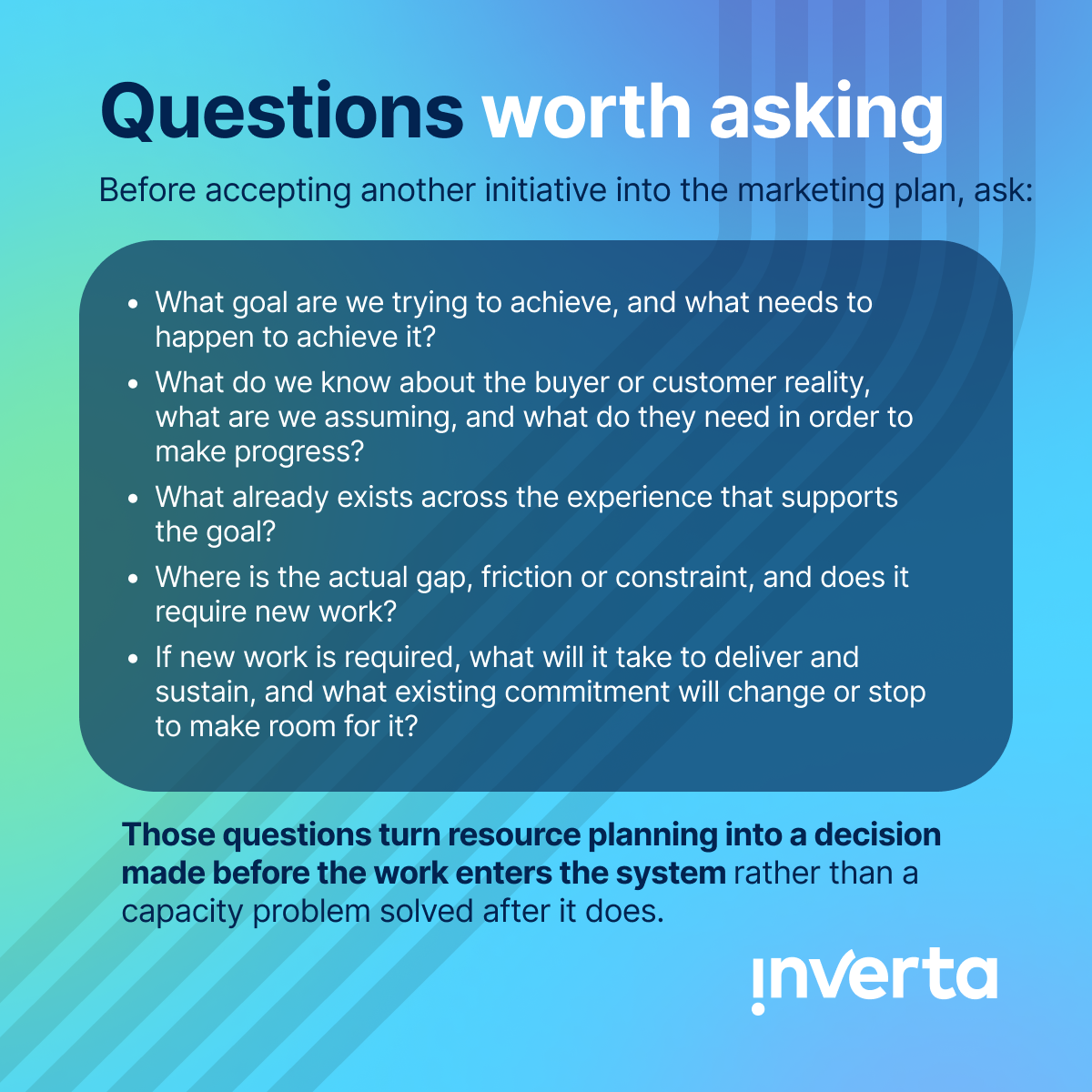
Start here: take the next request headed for your plan (a campaign, a channel, a launch) and run it through the five checkpoint questions before it's added, not after. If the team can't answer them yet, the work isn't ready to enter the plan.
“Before new work enters the plan, make the cost of saying yes visible.”
About Inverta
Marketing Leadership Under Pressure is Inverta's ongoing perspective series exploring the real challenges marketing leaders face as they navigate growth, complexity, and change.
Through practical perspectives, proven consulting experience, and modern revenue operating models, Inverta helps marketing organizations make better decisions under pressure.
Because when marketing leaders think more clearly under pressure, they make better decisions. And better decisions create better business outcomes.
About the author
Service page feature

Demand gen


Marketing Leadership Under Pressure
A Perspective Series from Inverta · Volume 04
Every marketing leader has heard some version of “do more with less.”
The response is usually predictable. Prioritize harder. Repurpose content. Consolidate agencies. Automate workflows. Use AI. Find efficiencies wherever you can.
Those are reasonable responses to resource pressure. But they focus on managing work after it has already been approved, rather than questioning earlier which work should enter the plan at all.
Marketing has spent years making execution more repeatable. Campaign frameworks, content workflows and channel plans make it easy to know what happens once a priority is approved. The risk is that the operating model starts to shape the questions Marketing asks. Instead of beginning with the buyer or customer and what needs to change for the business goal to be achieved, teams can move quickly to what needs to go to market, how to generate interest, and how to move buyers toward the next step.
When new work comes in, the request rarely reflects everything the team will need to do to deliver it. A campaign request doesn't sound like a request for landing pages, content, creative, media, Sales enablement, measurement and optimization. A new channel doesn't arrive labeled with the requirements to maintain it.
Each request may seem manageable on its own, but together they create more work than the team can support.
Prioritization alone won't fix that. Marketing leaders need a decision point before new work becomes a commitment: one that makes the real cost, tradeoffs and expected value visible before anyone says yes.
In Volume 01, we explored what happens when pipeline pressure turns into activity pressure. Resource pressure exposes the other side of the same problem: once activity enters the plan, very little forces the organization to account for what delivering it actually requires. That includes AI, which is changing what teams can produce, but not yet changing what they choose to produce in the first place.
The opportunity is to move the resource decision upstream.
Resource pressure exposes the work your operating model creates
Capacity problems usually show up during execution.
There are more requests than people, more campaigns than the team can support, more content than Creative can produce, more channels than anyone can consistently maintain.
At that point, resource planning becomes a ranking exercise. Priority 1 gets identified, Priority 2 gets pushed, and the rest moves to another month or quarter. The calendar shifts, but the underlying workload rarely shrinks.
Lower-priority work sits in the backlog while new requests keep entering the system. When budget or time opens up, the instinct is often to fill it.
Observation from the Field
Across our client work, we are beginning to see teams make firmer stop/start decisions. Activities are being shut down to create real capacity and redirect investment. The harder question is what, if anything, should be added back once that capacity opens up.
Resource constraints aren't always evidence that a team needs more people or budget. Often they're evidence that the organization has gotten better at adding work than at evaluating what that work costs.
When the plan starts dictating the work
Campaign planning is meant to help teams coordinate, but the way campaigns are commonly structured can also create work. Each campaign gets its own audience, messaging, content, channel activation, Sales support and measurement requirements. When Demand, Brand, Product, Customer, Field and ABM follow similar playbooks, those requirements repeatedly draw from the same content plans, channels and production resources.
We saw this recently while helping a client operationalize an existing campaign plan. One campaign alone translated into landing-page copy, emails, social, paid creative, multiple image formats and dozens of headlines and descriptions. One line in the marketing plan turned into weeks of production.
Rather than continuing to accept the production work the campaign plans suggested, the team stepped back and asked what each campaign was actually trying to accomplish, how that differed from what Marketing was already doing, and where it could actually make a difference for the buyer.
That changed the planning conversation. Instead of building each campaign out across the same stages and channels, the team could determine which content and channels were actually needed, what existing work could continue doing its job, and where something new would make a meaningful difference. The campaign plan stopped dictating the work in isolation.
The real resource question is whether the work the plan creates is actually required to achieve the goal, not just whether the team has the capacity to execute it.
A resource decision checkpoint creates space for that judgment. Before a plan becomes a set of production requirements, leaders need to understand what the priority is meant to accomplish, what has to be true for that to happen, what already exists, and what additional work is actually required. Only then can they make the resource tradeoffs visible and decide what should move, change or stop to make room for it.
Without that checkpoint, prioritization happens too late. By then, the team is already committed to the work and has to make the tradeoffs during execution.
“A decision checkpoint makes those tradeoffs part of the decision to proceed.”
AI can reduce the lift. It can also change the resource decision.
AI arrived at exactly the moment marketing teams are being asked to do more with less.
Most early use cases focus on production efficiency: faster first drafts, content adapted for new audiences, asset variations, repurposed webinars, automated workflows. That creates more capacity, but it doesn’t create less work to manage.
AI can also help teams question the work before producing it: surfacing what already exists, exposing duplication and estimating downstream requirements. An existing asset may still work. A channel may need optimization rather than another content stream. The bigger opportunity is using AI to avoid creating work the team does not actually need.
Stop asking how to resource everything
A decision checkpoint requires leaders to make explicit choices about existing work, not just new requests.
Before making those choices, it helps to step back from the request itself: what has to be true for the goal to be achieved, what the buyer or customer actually needs, and where the real gap is. That keeps Build from becoming the automatic response just because a new priority entered the plan.
One useful way to make those choices explicit is to evaluate the plan through five decisions: Build, Maintain, Optimize, Change and Remove.
BUILD / MAINTAIN / OPTIMIZE / CHANGE / REMOVE
Build when there is a meaningful gap that requires something new. Maintain the work that continues to serve buyers, customers or the business. Optimize work that has value but can perform better. Change an approach when the current one is no longer solving the problem it was designed to address. Remove work when the evidence no longer justifies the resources required to sustain it.
Most planning processes naturally favor Build. New priorities produce new initiatives, and existing commitments stay in place unless someone explicitly challenges them. Over time, teams accumulate campaigns, channels, reports and programs that each made sense when they were introduced. When resources get tight, teams start to see how much work they have added over time.
Observation from the Field
In one recent example, a paid-media platform recommended roughly twenty image assets to improve ad quality. Creating them was possible, but the marketer questioned whether new design work was the best use of limited creative capacity given the expected value. The team reviewed the library of existing creative and reused what was already available.
The recommendation did not change, but the team chose not to create new assets. They had enough context to question the recommendation instead of following it automatically.
The same discipline protects what's already working. Buyers still need current information, proof and a consistent experience with the company. Existing content doesn't need to be replaced just because a new campaign or planning cycle begins. New production should have to justify the time and resources it requires.
Resource discipline starts upstream of the marketing plan
The same thinking applies when resource requests are tied to business pressure. Pipeline declines and Marketing is asked to generate more demand. Engagement drops and the response becomes new content.
Sometimes that's exactly right. But a pipeline problem could just as easily originate in conversion, Sales follow-up, pricing, packaging, proof or friction in the buying experience. When resources are tight, teams can't afford to invest in the wrong solution.
Before deciding how Marketing should respond to a business goal, it helps to ask what has to be true for that goal to be achieved and what the buyer or customer actually needs. It also means looking at what already exists across the business that might already address the problem. That diagnosis may still point to a campaign or new content. It may also point to an experience that needs improving, an asset that needs to be easier to find, or work that doesn't need to be created at all.
Getting that diagnosis right is what turns resource management into a leadership discipline instead of a scheduling exercise.
As we explored in Volume 03, fresh perspective can make assumptions easier to see. A resource checkpoint creates that same pause in the operating model: before the next request gets a yes, the team has to examine the expected outcome, resource requirement and impact on existing commitments.
Closing perspective
Resource constraints are not going away. Efficiency, automation and sharper prioritization will help, but sustainable resource management starts earlier: before a priority becomes a campaign, content request or channel plan.
A team running at full production capacity has little room to investigate what isn't working, listen to Sales and customers, or build something genuinely different.
Ask what has to be true for the goal to be achieved, what the buyer actually needs, and what already exists. Then decide what new work, if any, deserves to enter the system.
Start here: take the next request headed for your plan (a campaign, a channel, a launch) and run it through the five checkpoint questions before it's added, not after. If the team can't answer them yet, the work isn't ready to enter the plan.
“Before new work enters the plan, make the cost of saying yes visible.”
About Inverta
Marketing Leadership Under Pressure is Inverta's ongoing perspective series exploring the real challenges marketing leaders face as they navigate growth, complexity, and change.
Through practical perspectives, proven consulting experience, and modern revenue operating models, Inverta helps marketing organizations make better decisions under pressure.
Because when marketing leaders think more clearly under pressure, they make better decisions. And better decisions create better business outcomes.
Resources
About the author
Service page feature
Demand gen
Resource constrained? Stop trying to fit more work into the same capacity.


Speakers
Other helpful resources
Marketing Leadership Under Pressure
A Perspective Series from Inverta · Volume 04
Every marketing leader has heard some version of “do more with less.”
The response is usually predictable. Prioritize harder. Repurpose content. Consolidate agencies. Automate workflows. Use AI. Find efficiencies wherever you can.
Those are reasonable responses to resource pressure. But they focus on managing work after it has already been approved, rather than questioning earlier which work should enter the plan at all.
Marketing has spent years making execution more repeatable. Campaign frameworks, content workflows and channel plans make it easy to know what happens once a priority is approved. The risk is that the operating model starts to shape the questions Marketing asks. Instead of beginning with the buyer or customer and what needs to change for the business goal to be achieved, teams can move quickly to what needs to go to market, how to generate interest, and how to move buyers toward the next step.
When new work comes in, the request rarely reflects everything the team will need to do to deliver it. A campaign request doesn't sound like a request for landing pages, content, creative, media, Sales enablement, measurement and optimization. A new channel doesn't arrive labeled with the requirements to maintain it.
Each request may seem manageable on its own, but together they create more work than the team can support.
Prioritization alone won't fix that. Marketing leaders need a decision point before new work becomes a commitment: one that makes the real cost, tradeoffs and expected value visible before anyone says yes.
In Volume 01, we explored what happens when pipeline pressure turns into activity pressure. Resource pressure exposes the other side of the same problem: once activity enters the plan, very little forces the organization to account for what delivering it actually requires. That includes AI, which is changing what teams can produce, but not yet changing what they choose to produce in the first place.
The opportunity is to move the resource decision upstream.
Resource pressure exposes the work your operating model creates
Capacity problems usually show up during execution.
There are more requests than people, more campaigns than the team can support, more content than Creative can produce, more channels than anyone can consistently maintain.
At that point, resource planning becomes a ranking exercise. Priority 1 gets identified, Priority 2 gets pushed, and the rest moves to another month or quarter. The calendar shifts, but the underlying workload rarely shrinks.
Lower-priority work sits in the backlog while new requests keep entering the system. When budget or time opens up, the instinct is often to fill it.
Observation from the Field
Across our client work, we are beginning to see teams make firmer stop/start decisions. Activities are being shut down to create real capacity and redirect investment. The harder question is what, if anything, should be added back once that capacity opens up.
Resource constraints aren't always evidence that a team needs more people or budget. Often they're evidence that the organization has gotten better at adding work than at evaluating what that work costs.
When the plan starts dictating the work
Campaign planning is meant to help teams coordinate, but the way campaigns are commonly structured can also create work. Each campaign gets its own audience, messaging, content, channel activation, Sales support and measurement requirements. When Demand, Brand, Product, Customer, Field and ABM follow similar playbooks, those requirements repeatedly draw from the same content plans, channels and production resources.
We saw this recently while helping a client operationalize an existing campaign plan. One campaign alone translated into landing-page copy, emails, social, paid creative, multiple image formats and dozens of headlines and descriptions. One line in the marketing plan turned into weeks of production.
Rather than continuing to accept the production work the campaign plans suggested, the team stepped back and asked what each campaign was actually trying to accomplish, how that differed from what Marketing was already doing, and where it could actually make a difference for the buyer.
That changed the planning conversation. Instead of building each campaign out across the same stages and channels, the team could determine which content and channels were actually needed, what existing work could continue doing its job, and where something new would make a meaningful difference. The campaign plan stopped dictating the work in isolation.
The real resource question is whether the work the plan creates is actually required to achieve the goal, not just whether the team has the capacity to execute it.
A resource decision checkpoint creates space for that judgment. Before a plan becomes a set of production requirements, leaders need to understand what the priority is meant to accomplish, what has to be true for that to happen, what already exists, and what additional work is actually required. Only then can they make the resource tradeoffs visible and decide what should move, change or stop to make room for it.
Without that checkpoint, prioritization happens too late. By then, the team is already committed to the work and has to make the tradeoffs during execution.
“A decision checkpoint makes those tradeoffs part of the decision to proceed.”
AI can reduce the lift. It can also change the resource decision.
AI arrived at exactly the moment marketing teams are being asked to do more with less.
Most early use cases focus on production efficiency: faster first drafts, content adapted for new audiences, asset variations, repurposed webinars, automated workflows. That creates more capacity, but it doesn’t create less work to manage.
AI can also help teams question the work before producing it: surfacing what already exists, exposing duplication and estimating downstream requirements. An existing asset may still work. A channel may need optimization rather than another content stream. The bigger opportunity is using AI to avoid creating work the team does not actually need.
Stop asking how to resource everything
A decision checkpoint requires leaders to make explicit choices about existing work, not just new requests.
Before making those choices, it helps to step back from the request itself: what has to be true for the goal to be achieved, what the buyer or customer actually needs, and where the real gap is. That keeps Build from becoming the automatic response just because a new priority entered the plan.
One useful way to make those choices explicit is to evaluate the plan through five decisions: Build, Maintain, Optimize, Change and Remove.
BUILD / MAINTAIN / OPTIMIZE / CHANGE / REMOVE
Build when there is a meaningful gap that requires something new. Maintain the work that continues to serve buyers, customers or the business. Optimize work that has value but can perform better. Change an approach when the current one is no longer solving the problem it was designed to address. Remove work when the evidence no longer justifies the resources required to sustain it.
Most planning processes naturally favor Build. New priorities produce new initiatives, and existing commitments stay in place unless someone explicitly challenges them. Over time, teams accumulate campaigns, channels, reports and programs that each made sense when they were introduced. When resources get tight, teams start to see how much work they have added over time.
Observation from the Field
In one recent example, a paid-media platform recommended roughly twenty image assets to improve ad quality. Creating them was possible, but the marketer questioned whether new design work was the best use of limited creative capacity given the expected value. The team reviewed the library of existing creative and reused what was already available.
The recommendation did not change, but the team chose not to create new assets. They had enough context to question the recommendation instead of following it automatically.
The same discipline protects what's already working. Buyers still need current information, proof and a consistent experience with the company. Existing content doesn't need to be replaced just because a new campaign or planning cycle begins. New production should have to justify the time and resources it requires.
Resource discipline starts upstream of the marketing plan
The same thinking applies when resource requests are tied to business pressure. Pipeline declines and Marketing is asked to generate more demand. Engagement drops and the response becomes new content.
Sometimes that's exactly right. But a pipeline problem could just as easily originate in conversion, Sales follow-up, pricing, packaging, proof or friction in the buying experience. When resources are tight, teams can't afford to invest in the wrong solution.
Before deciding how Marketing should respond to a business goal, it helps to ask what has to be true for that goal to be achieved and what the buyer or customer actually needs. It also means looking at what already exists across the business that might already address the problem. That diagnosis may still point to a campaign or new content. It may also point to an experience that needs improving, an asset that needs to be easier to find, or work that doesn't need to be created at all.
Getting that diagnosis right is what turns resource management into a leadership discipline instead of a scheduling exercise.
As we explored in Volume 03, fresh perspective can make assumptions easier to see. A resource checkpoint creates that same pause in the operating model: before the next request gets a yes, the team has to examine the expected outcome, resource requirement and impact on existing commitments.
Closing perspective
Resource constraints are not going away. Efficiency, automation and sharper prioritization will help, but sustainable resource management starts earlier: before a priority becomes a campaign, content request or channel plan.
A team running at full production capacity has little room to investigate what isn't working, listen to Sales and customers, or build something genuinely different.
Ask what has to be true for the goal to be achieved, what the buyer actually needs, and what already exists. Then decide what new work, if any, deserves to enter the system.
Start here: take the next request headed for your plan (a campaign, a channel, a launch) and run it through the five checkpoint questions before it's added, not after. If the team can't answer them yet, the work isn't ready to enter the plan.
“Before new work enters the plan, make the cost of saying yes visible.”
About Inverta
Marketing Leadership Under Pressure is Inverta's ongoing perspective series exploring the real challenges marketing leaders face as they navigate growth, complexity, and change.
Through practical perspectives, proven consulting experience, and modern revenue operating models, Inverta helps marketing organizations make better decisions under pressure.
Because when marketing leaders think more clearly under pressure, they make better decisions. And better decisions create better business outcomes.
About the author
Service page feature